Why a Marketing Campaign Plan Is the Difference Between Busy and Effective
A solid marketing campaign plan is the single most important thing standing between you and another quarter of scattered effort with nothing to show for it. Without one, you’re guessing — posting, running ads, sending emails — but never quite sure what’s working or why.
Think of it this way: running a campaign without a plan is like taking a road trip without a map. You might move forward, but you’ll burn time, money, and energy getting somewhere you didn’t intend to go.
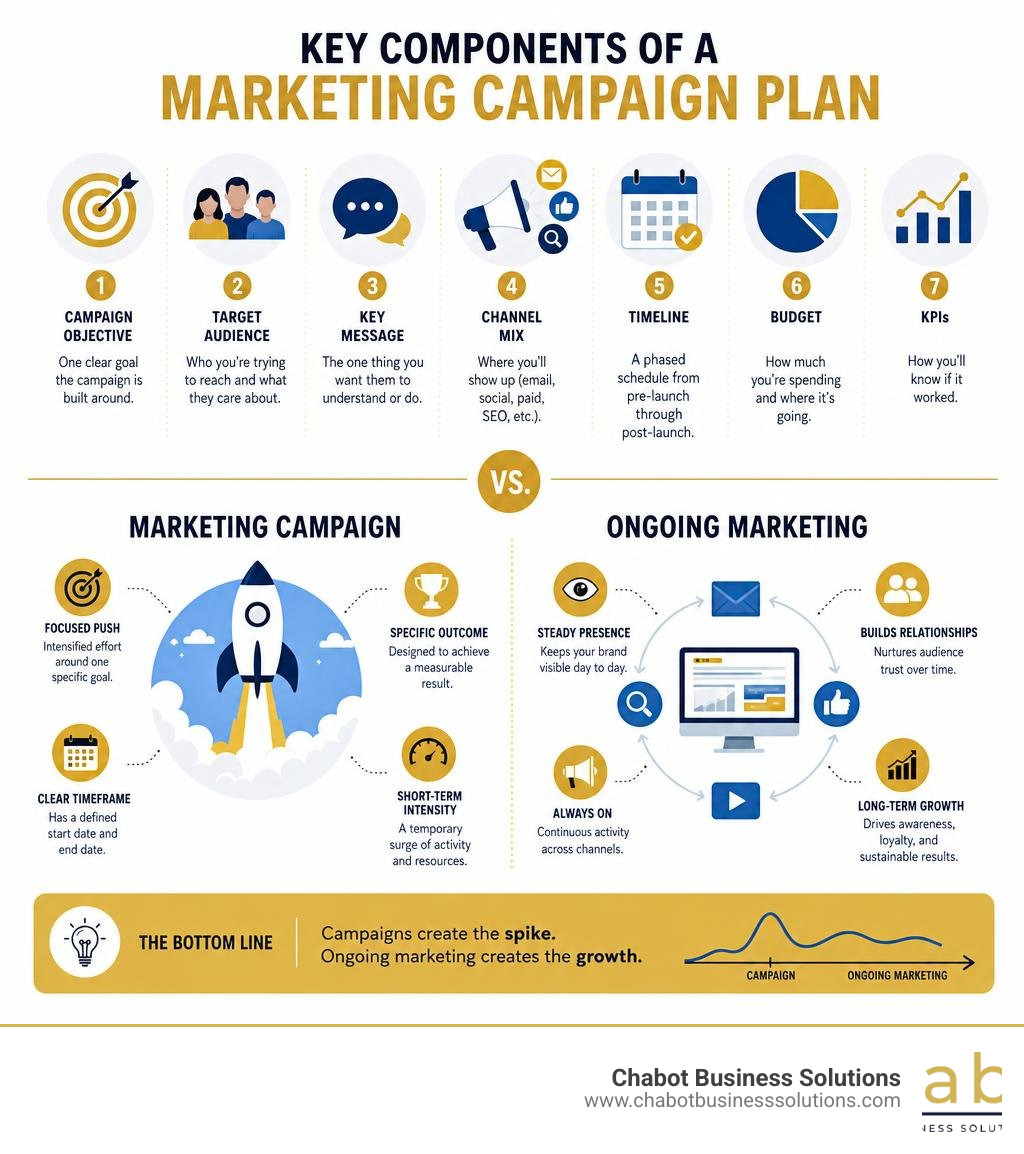
Here’s a quick snapshot of what a marketing campaign plan covers:
- Campaign objective — one clear goal the campaign is built around
- Target audience — who you’re trying to reach and what they care about
- Key message — the one thing you want them to understand or do
- Channel mix — where you’ll show up (email, social, paid, SEO, etc.)
- Timeline — a phased schedule from pre-launch through post-launch
- Budget — how much you’re spending and where it’s going
- KPIs — how you’ll know if it worked
A marketing campaign is not the same as your ongoing marketing. Ongoing marketing keeps your brand visible day to day. A campaign is a temporary intensification — a focused push around one specific goal, with a clear start date, end date, and measurable outcome.
I’m Alyx Lofton, founder of Chabot Business Solutions, and over more than 20 years of hands-on digital strategy work I’ve helped business owners build and execute marketing campaign plans that create real, measurable results rather than just activity. If you’ve been stuck in the cycle of inconsistent marketing with no clear system, this guide is built for you.
What is a Marketing Campaign Plan and How Does It Differ from Ongoing Marketing?
To understand how to build a high-performing campaign, we must first draw a line between your everyday marketing efforts and a dedicated campaign.
Ongoing marketing is your baseline “always-on” activity. It is the steady heartbeat of your business: your weekly newsletter, daily social media presence, or continuous organic SEO efforts. These activities build long-term trust, maintain brand visibility, and nurture existing relationships over months and years. For example, when you are Creating a Marketing Plan for Your Beauty Salon, your ongoing marketing might include maintaining your Google Business Profile and posting weekly styling tips on Instagram.
A marketing campaign, however, is a strategic, temporary intensification. It is a highly coordinated series of activities designed to achieve a single, specific business outcome within a defined timeframe. Think of it as a sprint rather than a marathon.

At Chabot Business Solutions, we advocate for the “Rule of One” in campaign planning: one core message, one primary target audience, and one single business objective. While your ongoing marketing handles multiple goals at once, a campaign focuses all your resources on a singular target—such as launching a new service, driving sign-ups for a seasonal event, or clearing out specific inventory.
Essential Components of a High-Performing Campaign
A successful campaign is built on a solid foundation. Rather than jumping straight into creative asset production, top-performing marketing teams use a structured campaign brief to align their efforts. This brief serves as the single source of truth for everyone involved.
Every robust campaign brief must organize its strategy into a clear message hierarchy. This hierarchy must systematically answer four foundational questions for your audience:
- Why should I care? (Addressing their specific pain point)
- What is the solution? (Introducing your specific offering)
- Why you? (Highlighting your unique differentiation and proof points)
- What should I do next? (Providing a clear, singular call to action)
To turn this strategy into reality, you must also define your resource architecture—the team, tools, and visual assets required for execution. Using a structured Marketing Campaign Planning Template helps prevent alignment gaps before you spend a single dollar on advertising. For technical teams or those leveraging AI-driven workflows, resources like the Campaign Plan | Claude Code Playbooks or the Campaign Planner | Claude Code Playbooks can streamline this initial planning phase.
Every campaign requires a core set of essential assets. Depending on your goals, your checklist should include:
- A dedicated, high-converting campaign landing page
- Segmented email sequences (nurture, launch, and follow-up)
- Tailored ad creatives (copy, images, and short-form video)
- Social media graphics and promotional copy
- Tracking URLs with structured UTM parameters
Setting SMART Goals for Your Marketing Campaign Plan
Ambiguity is the ultimate killer of marketing performance. To prevent budget fragmentation and message dilution, your campaign must be built around SMART goals: Specific, Measurable, Achievable, Relevant, and Time-bound.
When setting these goals, always establish your baseline metrics first. If you do not know your current average conversion rate or cost per lead, you cannot set realistic targets. Align your primary objective with a specific stage of the customer buying journey:
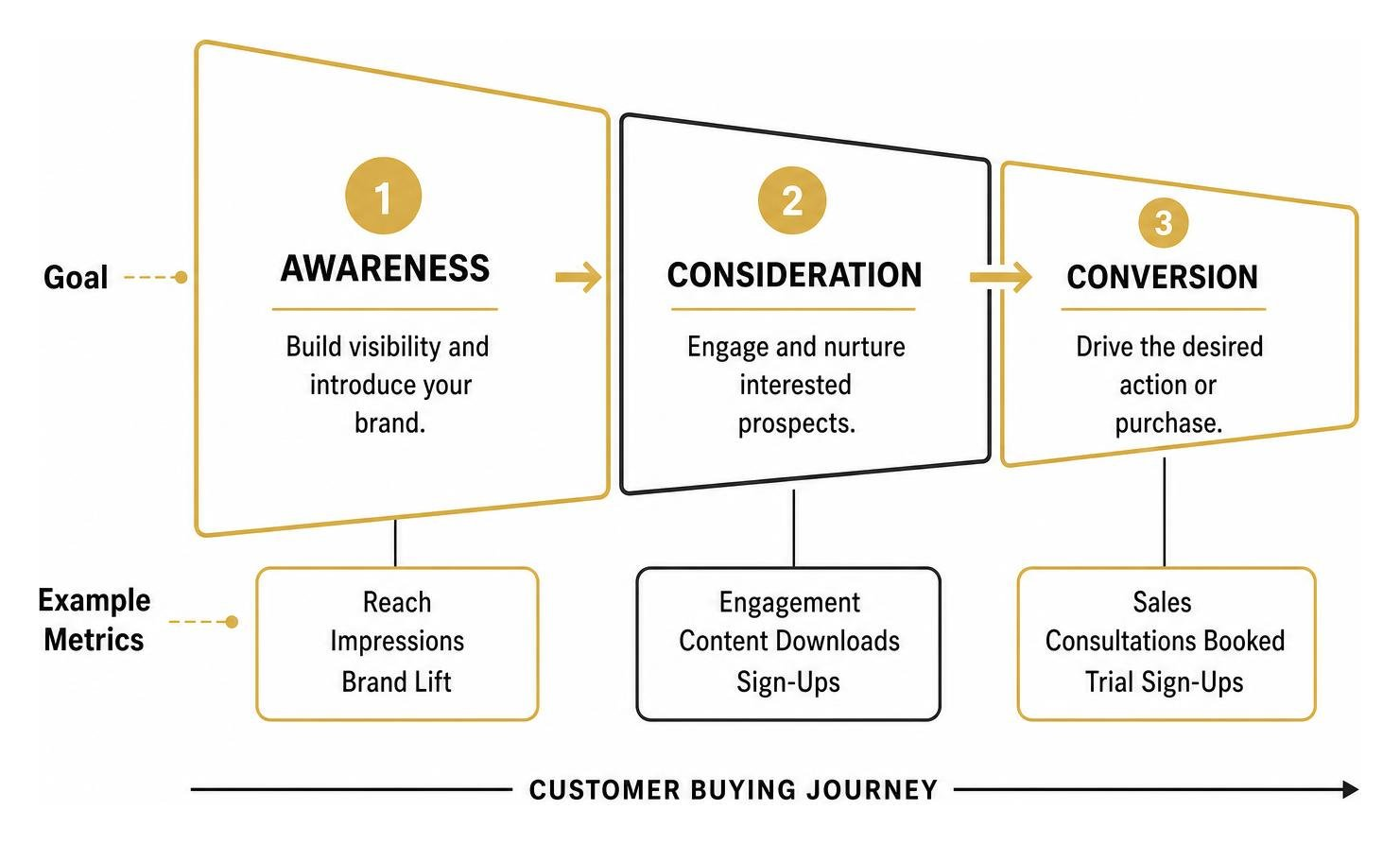
- Awareness: Focuses on reach, impressions, and brand lift.
- Consideration: Tracks high-value engagement, such as webinar registrations, content downloads, or newsletter sign-ups.
- Conversion: Measures direct sales, booked consultations, or trial sign-ups.
For example, instead of setting a vague goal to “get more leads,” a SMART objective would be: “Generate 150 qualified sales leads for our new consulting package from East Bay businesses within 30 days of campaign launch, keeping our Cost Per Acquisition (CPA) under $75.”
Identifying and Segmenting Your Target Audience
The most persuasive campaigns do not try to speak to everyone. They sell highly targeted solutions to specific problems. To achieve this, you must build detailed buyer personas that represent real people involved in the buying decision.
Do not rely on generic demographic assumptions. Instead, build accurate customer avatars by researching the exact language your target market uses. Read local forums, analyze client emails, and study industry reviews to uncover their deepest pain points, daily frustrations, and desired outcomes.
Once you understand these challenges, segment your audience. A campaign targeting local business owners in San Leandro who are struggling with employee retention requires completely different messaging, imagery, and channels than a campaign aimed at corporate executives looking to scale their operations across California.
Selecting the Right Channel Mix and Allocating Budget
Selecting the right media mix is not about showing up on every platform; it is about showing up where your target audience already spends their time. To maximize your return on investment, you must balance your distribution across owned, earned, and paid channels.
To help you choose the right channels, we recommend reviewing how your campaign distribution fits into your broader digital strategy. Understanding this relationship is key to Maximizing ROI with a Professional Digital Marketing Strategy.
| Channel Type | Description | Key Examples | Pros | Cons |
|---|---|---|---|---|
| Owned Channels | Mediums you fully control and manage. | Email list, website, blog, organic social media profiles. | High control, low direct cost, builds long-term equity. | Takes time to scale, limited to your existing audience. |
| Paid Channels | Platforms where you pay to distribute your message. | Google Search Ads, LinkedIn Ads, Meta Ads, sponsored content. | Instant scalability, precise targeting, fast results. | High cost, performance stops the moment budget runs out. |
| Earned Channels | Exposure gained through third-party recognition. | PR, local media coverage, influencer mentions, word-of-mouth. | High credibility, expands reach to new audiences. | Difficult to predict, low control over the final message. |
When selecting your channels, let your campaign goals guide you. If you are running a bottom-of-funnel lead generation campaign, paid search ads (Google Ads) are highly effective because they capture active search intent. If you are running a brand awareness campaign, a mix of local PR, content marketing, and organic social media is often more appropriate. For automated planning support, you can also leverage specialized frameworks like the Campaign Plan ⋅ Claude Skill | Collective Brain to generate tailored channel recommendations based on your unique business context.
Designing a Balanced Budget for Your Marketing Campaign Plan
A common mistake in campaign planning is allocating budget equally across all channels or guessing how much to spend. In 2026, rising ad costs and privacy regulations require a highly structured approach to financial planning.
We recommend dividing your campaign budget across five distinct categories:
- Paid Acquisition (30-40%): Your primary engine for driving immediate traffic and conversions.
- Content Production (20-30%): Copywriting, graphic design, video production, and landing page creation.
- Tools and Technology (10-15%): Software subscriptions, tracking tools, and CRM integrations.
- Testing and Experimentation (5-10%): A dedicated reserve to test new ad creatives, copy variations, or secondary channels without risking your core budget.
- Contingency Fund (10-15%): A safety net to protect against unexpected cost fluctuations or to capitalize on high-performing assets mid-campaign.
Always reserve 60-70% of your paid acquisition budget for your highest-confidence channel, allocating the remainder to secondary platforms. This ensures your campaign has a strong baseline of predictable performance while still allowing room for optimization.
Mapping Your Campaign Timeline and Content Calendar
A successful campaign is a coordinated symphony of moving parts. To keep your team aligned and prevent last-minute delays, you must map your campaign timeline and content calendar using a visual project management tool, such as a Gantt chart.
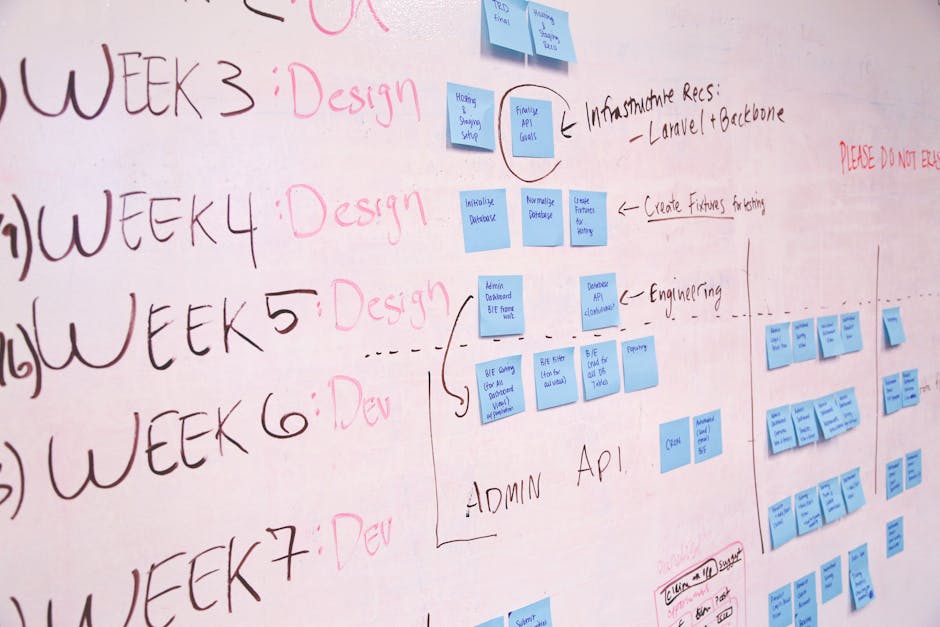
When building your timeline, work backward from your target launch date. Standard industry production benchmarks show that asset creation is usually the primary bottleneck. Use these realistic lead times when planning:
- Social Media Posts: 1-2 days
- Email Campaigns: 2-3 days
- Blog Posts / Articles: 3-5 days
- Landing Pages: 5-7 days
- Videos / Ebooks / Whitepapers: 2-4 weeks
To ensure your campaign remains agile, do not over-schedule your content calendar. We recommend leaving exactly 20% of your content slots open. This reactive buffer allows your team to pivot, respond to real-time feedback, or jump on trending local topics without disrupting the core schedule. For inspiration on structuring your promotional timeline, you can review the structured Marketing plans provided by California’s state tourism resources, which showcase how to coordinate complex, multi-channel schedules.
Pre-Launch, Launch, and Post-Launch Phases
To build momentum and maximize conversions, divide your campaign timeline into three distinct, highly structured phases:
- Phase I: Pre-Launch (Teasers & Asset Preparation): This phase typically runs 2 to 3 weeks before your official launch. Focus on building anticipation, training your team, and testing your tracking setups. Create teaser content, offer early-bird waitlists, and conduct an internal launch to get your staff aligned and excited.
- Phase II: Launch Week (Activation & Outreach): This is your high-intensity push. Activate your paid ads, send your primary email sequences, publish your core content, and monitor your tracking systems closely.
- Phase III: Post-Launch (Nurturing & Follow-up): A significant portion of campaign conversions occur after the initial launch excitement fades. Use this phase to nurture leads who showed interest but did not convert. Offer down-sells, share customer transformation stories, and transition warm leads into your long-term email nurturing sequences.
Tracking Success and Conducting a Campaign Post-Mortem
You cannot manage what you do not measure. To run a successful digital campaign, you must move away from retrospective, end-of-campaign analysis and transition to real-time, in-flight optimization.
Every single link used in your campaign must have structured UTM parameters. This allows you to track exactly which email, social post, or paid ad drove every conversion. This data should feed into a centralized dashboard, allowing you to monitor performance daily. If a specific ad variation is underperforming, you can reallocate its budget to your highest-converting creative immediately. To ensure your marketing data connects seamlessly with your sales pipeline, Why Every Business Needs a CRM to Go with Your Sales and Marketing Plan is essential for tracking leads from their first click to the final sale.
Key Performance Indicators (KPIs) to Monitor
Avoid the trap of focusing on vanity metrics like “likes,” “shares,” or raw impressions. While these numbers look nice on a report, they rarely impact your bottom line. Instead, focus on business-level KPIs that align with your campaign goals:
- Conversion Rate: The percentage of visitors who take your desired action (e.g., landing page conversion rates should ideally sit between 2% and 5%).
- Cost Per Lead (CPL) / Cost Per Acquisition (CPA): How much you are spending to acquire a single lead or customer.
- Customer Lifetime Value to Customer Acquisition Cost Ratio (LTV:CAC): A critical indicator of long-term campaign health; this ratio should ideally be greater than 3:1.
- Return on Ad Spend (ROAS) / Campaign ROI: The direct financial return generated by your campaign budget.
The Post-Mortem: Documenting Lessons Learned
Within two weeks of your campaign’s end date, gather your team for a formal campaign post-mortem. This meeting is not about assigning blame; it is about documenting lessons learned to make your next campaign even stronger.
During the post-mortem, compare your actual results against your initial goals. Analyze your channel performance to see which platforms delivered the highest quality leads at the lowest cost. Document what worked, what did not, and any unexpected bottlenecks in your asset production or follow-up processes. Save these insights directly into your campaign planning templates to build a repeatable, compounding marketing system.
Common Mistakes in Campaign Planning and How to Avoid Them
Even the most experienced marketing teams can fall into common planning traps. Recognizing these mistakes early is the first step to avoiding them.
- Defining the Theme Before the Goal: The most common mistake in marketing is brainstorming creative slogans or design concepts before setting your SMART objectives. Your goals must drive your creative decisions, channel selection, and calls to action—not the other way around.
- Goal Dilution: Trying to achieve brand awareness, lead generation, and customer retention all within a single campaign fragments your budget and confuses your audience. Stick to the “Rule of One.”
- Ignoring the Sales Team: If your campaign generates leads that your sales team cannot follow up on, your budget is wasted. Align both teams on lead definitions, handoff processes, and follow-up timelines before launch.
- Creating rigid, 40-page plans: A massive, theoretical document will sit on a digital shelf and never be executed. Keep your core plan under 10 pages, focusing on actionable timelines, clear responsibilities, and flexible budgets.
When local businesses in the East Bay look to design their regional strategies, they often seek guidance from structured community initiatives like the Retail Action Plan | San Leandro, CA . Navigating these regional opportunities can be complex, which is why working with local experts who understand the East Bay business landscape is so valuable.
If you are looking for local support to execute your campaign, you can consult local business advisors such as the Marketing services offered by the East Bay Small Business Development Center (SBDC). They provide excellent guidance to help you navigate the local market and set your business up for long-term success.
Frequently Asked Questions about Marketing Campaign Plans
How far in advance should campaign planning start?
For major, multi-channel campaigns, you should begin planning 6 to 8 weeks before your target launch date. For mid-size campaigns, 3 to 4 weeks of lead time is usually sufficient, while quick-turn promotional pushes can be planned in 1 to 2 weeks. Asset creation—such as video production, copywriting, and landing page design—is typically the main constraint, so always build your timeline around your production team’s capacity.
Should every campaign have a dedicated landing page?
Yes, almost always. Sending campaign traffic to your standard homepage is a major source of wasted ad spend. A dedicated campaign landing page matches the exact messaging, imagery, and call to action of your ads. This consistent “message match” reduces confusion and typically converts traffic at 2 to 5 times the rate of a generic homepage.
How many campaigns should a business run per quarter?
We strongly advocate for quality over quantity. For most small to mid-sized businesses, running one highly polished, well-executed campaign per quarter will deliver significantly better results than scrambling to launch three or four rushed, uncoordinated promotions. Focus your resources on making one campaign exceptionally successful, and let your ongoing marketing handle your baseline visibility.
Conclusion
Building a successful marketing campaign plan does not have to be a headache. By focusing on a singular goal, deeply understanding your target audience, selecting the right channel mix, and tracking your performance in real-time, you can stop guessing and start driving predictable growth.
At Chabot Business Solutions, we specialize in designing focused marketing systems for business owners. Located right here in San Leandro, CA, we take a strategy-first, clarity-driven approach to simplify your marketing, eliminate the noise, and support sustainable business growth in the East Bay and beyond.
Ready to stop winging your marketing and build a campaign that actually delivers? Explore our tiered digital marketing Growth Packages page, or book a strategy call with our team today to design your custom marketing system.