
Why Content Creation Social Media Is Harder Than It Looks
Content creation for social media is the process of planning, producing, and publishing text, images, and video designed to grow your brand on social platforms. Here is what you need to know fast:
- What it takes: A mix of original content (posts, Reels, carousels) plus a system for publishing, engaging, and analyzing performance
- Who does it: Anyone from solo business owners to full teams — but the roles of creator and manager are distinct
- Why it matters: Over 80% of social media content recommendations are powered by AI, meaning the competition for attention has never been steeper
- The core challenge: Most business owners are unknowingly doing two full-time jobs at once — and burning out because of it
- The fix: A repeatable system built on content pillars, five universal content types, and smart repurposing
Here is the uncomfortable truth: most business owners do not struggle with social media because they lack creativity. They struggle because they have no system.
You sit down to post something. The blank screen stares back. An hour disappears. You publish something mediocre, or nothing at all. Then the guilt sets in.
Sound familiar?
The accounts that grow consistently are not the ones with the biggest teams or the flashiest graphics. They are the ones that never run out of ideas — because they built a repeatable process instead of relying on inspiration.
This guide gives you that process: 15 practical tips to take the chaos out of your social media content and replace it with clarity.
I’m Alyx Lofton, founder of Chabot Business Solutions, and over more than 20 years in digital strategy I have helped countless founders build content creation social media systems that actually hold up under the pressure of running a real business. The tips in this guide come directly from that work — no theory, just what moves the needle.
Creator vs. Manager: The Solopreneur’s Burnout Trap
If you are running a business in the East Bay, from San Leandro to Oakland, you already have your hands full. When you add “social media” to your to-do list, you might think it is just one task. But in reality, you are trying to play two entirely different, full-time professional roles: the Content Creator and the Social Media Manager.
Trying to do both without a clear boundary is a recipe for swift, painful burnout.
To understand why this is so exhausting, let’s look at how these roles differ. Think of it like a puzzle: the content creator is responsible for designing and cutting out the individual puzzle pieces, while the social media manager is responsible for finding the right table, arranging the pieces, and making sure people actually show up to look at the finished picture.
As we reflect on The Power of Content Creation in Digital Marketing: A Personal Reflection, it becomes clear that producing high-quality assets is a deeply creative, focused act. On the flip side, as highlighted in our guide on How Professional Social Media Management Boosts Brand Visibility, managing those assets requires an analytical, systematic approach to distribution, community engagement, and performance tracking.
Why Solopreneurs Struggle with Content Creation Social Media
When you are a solopreneur, you do not have the luxury of separate departments. You wake up, write a caption, design a graphic, reply to comments, look at analytics, and try to figure out why your last post got zero reach. You are constantly switching between the creative right-brain work of creation and the analytical left-brain work of management. This context-switching is what drains your energy.
| Role | Primary Focus | Key Tasks | Core Skills |
|---|---|---|---|
| Content Creator | Asset Production | Writing copy, filming videos, designing carousels, taking photos | Copywriting, video editing, graphic design, storytelling |
| Social Media Manager | Strategy & Distribution | Scheduling posts, community management, tracking metrics, managing ad budgets | Data analysis, project management, customer service, strategic planning |
To save your sanity, you must separate these roles in your schedule.
- Pro Tip 1: Separate your “Creator” and “Manager” hats. Never try to create a post and publish it in the same hour. Dedicate specific blocks of time to creative production (writing, filming) and separate blocks to management tasks (scheduling, engaging, reviewing analytics).
- Pro Tip 2: Outsource or automate the distribution. You do not have to do everything manually. Once your creative assets are produced, use scheduling tools to handle the distribution, or partner with a professional service to manage the day-to-day community interaction.
- Pro Tip 3: Build a structured weekly checklist. Create a simple, repeatable checklist that outlines exactly when you create, when you schedule, and when you engage. This prevents social media tasks from bleeding into your core business hours.
The 5 Universal Content Types for Every Industry
The fastest-growing accounts do not rely on constant creative lightning strikes. Instead, they use a structured framework. No matter what industry you are in—whether you run a local bakery in San Leandro or a professional consulting firm in the East Bay—there are five universal content types that keep your feed balanced, engaging, and highly effective.
By rotating through these five categories, you ensure your audience never gets bored and your brand never sounds like a broken record. For a deeper dive into specific post ideas, you can check out 50 Social Media Content Ideas for Every Industry | Later , but let’s break down how these five types function to support your business goals, which is exactly Why Social Media Marketing is Important for Small Businesses.
- Educational: This content establishes your authority. You are teaching your audience something valuable for free, solving a small problem, or breaking down a complex industry concept.
- Behind-the-Scenes (BTS): Humanize your brand. Show the messy desk, the unboxing of new inventory, or the morning routine at your San Leandro office. People buy from people, and BTS content builds that crucial human connection.
- Social Proof: Let your clients do the talking. Share screenshots of glowing text messages, video testimonials, or case studies showing real-world results.
- Entertainment: Stop the scroll. This could be a relatable industry meme, a funny observation about your daily work life, or an inspiring story. It does not have to be a dance routine; it just needs to resonate emotionally.
- Community: Spark a conversation. Ask open-ended questions, run polls, or host a Q&A session. This content is designed to get people talking in your comment section.
- Pro Tip 4: Use the 5 universal content types to balance your feed. Avoid the temptation to make every post a sales pitch. Aim for a healthy mix where promotional or social proof posts make up no more than 20% of your feed, while educational, BTS, and community posts do the heavy lifting of building trust.
A Repeatable System for Content Creation Social Media
To make content creation social media sustainable, you need a repeatable system that generates an unlimited stream of ideas. The secret lies in multiplying your Content Pillars by your Content Types.
First, define 3 to 5 core themes (pillars) that your brand represents. For example, if you run a fitness studio in San Leandro, your pillars might be:
- Strength Training Form
- Daily Nutrition
- Mindset & Motivation
- Client Success Stories
Next, run each pillar through the 5 universal content types. Suddenly, you have a matrix of ideas:
- Pillar 1 (Form) + Educational = A video showing the right vs. wrong way to squat.
- Pillar 1 (Form) + Behind-the-Scenes = A quick clip of your trainers practicing a new movement pattern.
- Pillar 1 (Form) + Social Proof = A quote from a client who finally lifted pain-free.
- Pillar 1 (Form) + Entertainment = A funny meme about how heavy the weights feel on Monday mornings.
- Pillar 1 (Form) + Community = A poll asking: “Do you prefer back squats or front squats?”
By multiplying 4 pillars by 5 content types, you instantly generate 20 highly targeted content ideas. This structured approach helps you avoid 10 Social Media Mistakes Hurting Your Brand: How to Fix Them, keeping your messaging focused and cohesive.
- Pro Tip 5: Establish 3-5 core content pillars. Keep your pillars tightly aligned with your business offerings so that every post naturally guides your audience back to what you sell.
- Pro Tip 6: Batch your creation by pillar. Instead of jumping from topic to topic, write all your “Educational” posts for the month in one sitting. Your brain will stay in the same creative zone, allowing you to write faster and with much better focus.
Ethical Challenges and AI in Modern Social Media
The landscape of social media has shifted dramatically. As of July 2026, generative AI is no longer a futuristic novelty—it is the engine driving the vast majority of what we see online.
Consider these striking industry shifts:
- Over 80% of social media content recommendations are now powered by AI algorithms, prioritizing highly engaging, personalized feeds.
- An incredible 71% of social media images are AI-generated, completely reshaping the visual standards of online platforms.
While tools like AI-assisted writing and automated design make production faster, they also introduce significant ethical and practical challenges. Audiences in 2026 are increasingly skeptical. They can spot low-effort, generic AI copy from a mile away, and search algorithms are actively penalizing unoriginal content.
Furthermore, platform policies are constantly changing. With Meta ending its formal political fact-checking efforts in early 2025, the burden of verifying information and maintaining digital trust has shifted heavily onto individual creators and businesses. If you want to stand out, your content must remain deeply authentic and human.
As we discuss in our analysis of How AI-Driven Video Creation is Revolutionizing the Industry, the goal is not to let machines do the thinking for you. Instead, use AI to automate the tedious parts of production—like generating rough transcripts, resizing video formats, or brainstorming initial outlines—while keeping your unique voice, local expertise, and real-world relationships at the absolute center of your strategy.
- Pro Tip 7: Disclose and label AI-generated assets. If you use AI to create highly stylized images or complex graphics, maintain transparency with your audience. Trust is the most valuable currency on social media; once lost, it is incredibly difficult to rebuild.
- Pro Tip 8: Keep short-form video native and unpolished. In a world flooded with hyper-perfect, AI-generated graphics, raw and authentic video content stands out. Film quick, unedited videos on your phone. Unpolished, real-life moments build deep credibility because they cannot be easily faked by a machine.
The Art of Repurposing and Reverse-Engineering
If you are creating every single social media post from scratch, you are working too hard. The smartest creators use a systematic workflow to turn a single core asset into dozens of platform-specific posts.
This workflow is about smart adaptation, not lazy cross-posting. You cannot simply copy and paste a long-form blog post directly onto TikTok. Each platform has its own native culture, user demographics, and algorithmic preferences:
- Instagram: Highly visual. Demographics lean toward ages 18-44. Short-form vertical videos (Reels) get 2x the reach of static posts.
- TikTok: Raw, unpolished, and . Demographics lean toward ages 16-34. Native, conversational video performs vastly better than highly produced ads.
- LinkedIn: Professional, intellectual, and industry-focused. The algorithm heavily prioritizes dwell time (how long someone spends reading your post) and early engagement.
- X (formerly Twitter): Real-time, punchy, and conversational. Demographics appreciate sharp threads and timely industry commentary.
To see how top creators consistently master these formats, you can study the framework outlined in the social-content: Claude skill | implexa playbook. The secret is to reverse-engineer what is already working in your niche.
Find 10 to 20 top-performing accounts in your industry. Do not copy their words—instead, analyze their structural patterns. How do they start their videos? What is the visual rhythm of their carousels? How do they structure their written hooks? Once you decode these repeatable patterns, you can apply them to your own unique business insights. This is especially powerful when integrating Video Content for Marketing: Trends and Innovations into your local brand strategy.
- Pro Tip 9: Run a 6-step reverse-engineering process on top creators. Identify top creators, save their high-performing posts, break down the structural templates they use, layer your authentic brand voice over those structures, and use them to drive real business results.
Hook Formulas and Templates for LinkedIn, Instagram, and X
To stop the scroll, you need a powerful hook. The first 1 to 2 seconds of a video, or the first sentence of a text post, will determine whether a user stays or swipes away.
When writing text-based posts for LinkedIn or X, use the “Short. Breathe. Land.” copywriting rhythm. This means writing one short, punchy sentence, leaving a clean line break (the “breath”), and letting a bold statement stand alone (the “land”). This layout maximizes readability and increases dwell time.
Here are three proven hook formulas you can adapt today, keeping in mind the visual principles from How to Craft a Winning Video Marketing Strategy for 2024:
1. The Contrarian Hook (Perfect for LinkedIn)
“Most people think [Common Belief] is the key to [Desired Result].
But after [Number] years in [Industry], I’ve realized the exact opposite is true.
Here is what actually works:”
2. The Raw Emotion Hook (Perfect for X/Twitter)
“I was terrified when [Vulnerable Business Moment].
My hands were shaking when I [Action taken].
But that one scary decision taught me 3 massive lessons about [Topic]:”
3. The Curated List Hook (Perfect for Instagram Carousels)
“I analyzed [Large Number] of [Subject] so you don’t have to.
Here are the only 5 tools/tips you need to [Achieve Goal] in 2026:”
- Pro Tip 10: Adopt the “Short. Breathe. Land.” writing rhythm. Avoid massive, dense blocks of text. Keep your paragraphs short, use line breaks generously, and write as if you are texting advice to a smart friend.
- Pro Tip 11: Put links in the comments to protect your reach. Platforms like LinkedIn and Facebook hate external links because they drive users off their sites. Write a compelling post, build up your dwell time, and state clearly: “Link to the full guide is in the comments below!”
- Pro Tip 12: Repurpose a single long-form asset into 5 distinct formats. Take one blog post or video and turn it into a LinkedIn text post, an Instagram carousel, a short video script, an X thread, and a quick email newsletter.
Metrics, Optimization, and Knowing When to Pivot
You cannot optimize what you do not measure. However, many business owners get trapped tracking “vanity metrics” like follower counts or casual likes. While a high follower count looks nice, it does not pay the bills.
To build a social media strategy that actually drives revenue, you must align your tracking with deep audience insights. You need to know how to transition your community from simple engagement to real action. Our framework on How to Take Social Media Followers from Scrolling to Buying highlights that conversion relies on tracking meaningful interactions, such as:
- Saves and Shares: These indicate high-value utility. If someone saves your post, it means your content was useful enough for them to reference later.
- Direct Messages (DMs) and Comments: These show active engagement and relationship-building.
- Dwell Time: How long users spend reading or watching your content.
Another highly effective way to boost your reach and build local authority is through active community engagement. By implementing strategic Building Relationships Through Comment Marketing, you can start valuable conversations directly in the comment sections of industry peers and local East Bay business accounts, driving organic traffic back to your own profile.
- Pro Tip 13: Track dwell time and first-hour engagement over vanity metrics. If your posts are getting high saves and long view times, the algorithm will naturally reward you with broader organic reach over time.
- Pro Tip 14: Use comment marketing to build real-world relationships. Spend 15 minutes a day leaving thoughtful, high-value comments on other local East Bay accounts. This builds organic visibility far faster than shouting into the void on your own empty feed.
- Pro Tip 15: Run a monthly content audit to decide when to pivot. Look at your top 3 performing posts each month. Identify what they had in common—was it the format, the visual style, or the specific topic? Double down on those patterns and ruthlessly cut the formats that are failing to resonate.
Frequently Asked Questions about Content Creation Social Media
How often should I post on social media in 2026?
There is no single magic number, but consistency will always beat sheer volume. For professional B2B platforms like LinkedIn, posting 3 to 5 times a week is highly effective. For highly visual, platforms like Instagram or TikTok, aiming for 1 to 2 short-form videos (Reels) per day can accelerate your reach, but only if you can maintain high quality. Pick a sustainable cadence you can stick to for six months without burning out.
What is the 1% rule in online content creation?
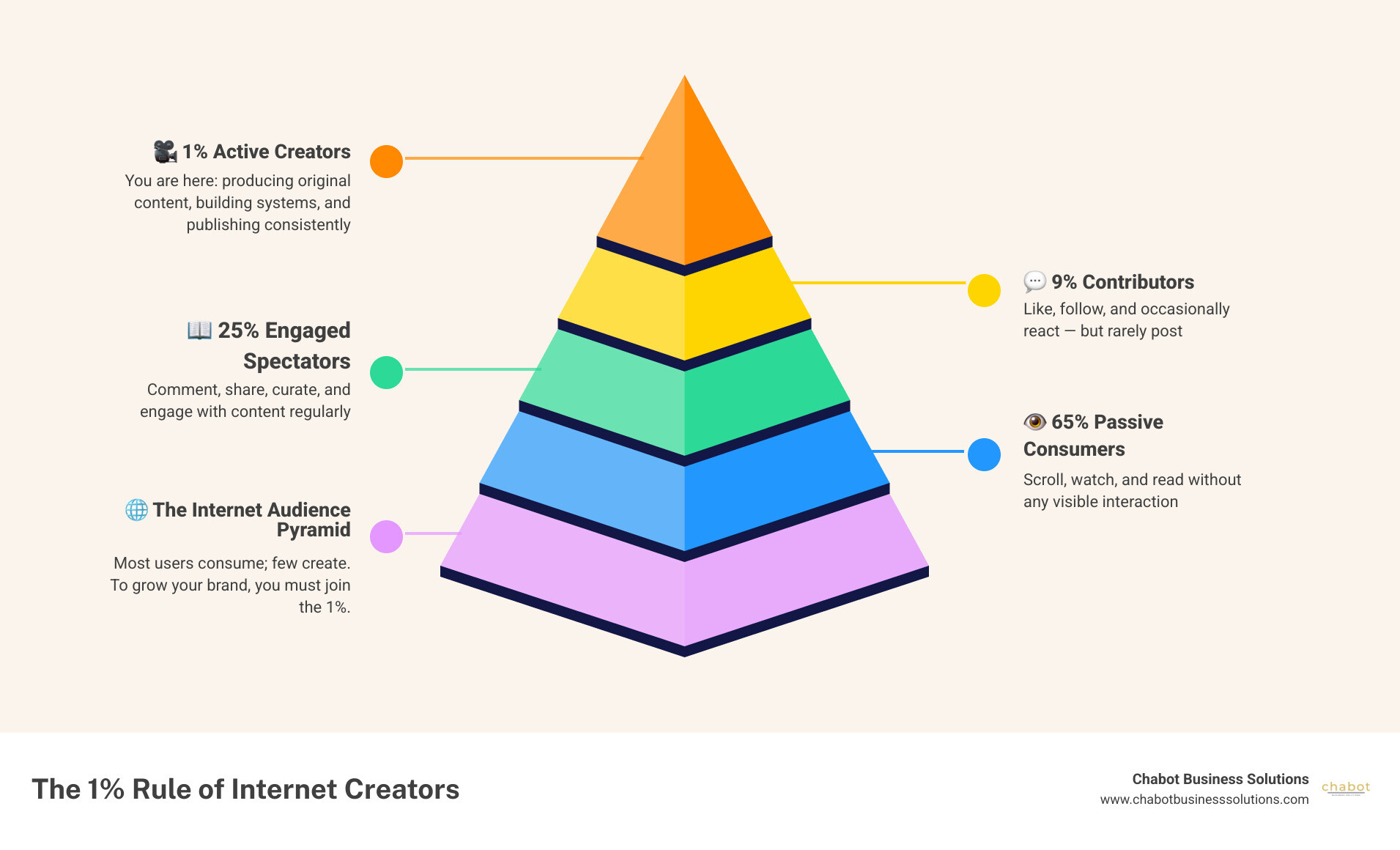
The 1% rule is an established internet culture principle stating that only about 1% of a platform’s user base actively creates original content. Approximately 25% of users are casual participators (commenting, sharing, or liking), while the vast majority—around 69%—are “spectators” who consume content silently without ever posting. This means that by simply creating and publishing consistently, you are already positioning your business in the top tier of online visibility.
How do I prevent my external links from killing post reach?
Social media algorithms are designed to keep users on their platforms as long as possible. When you include an external link in the main body of your post, the algorithm often flags it and restricts its organic reach. To prevent this, write your post copy without any outbound links, publish it, and then immediately place your link in the very first comment. You can add a quick note at the end of your post directing readers to the comment section.
Conclusion
Building a successful content creation social media strategy does not require a massive production studio or a complicated, overwhelming schedule. It requires a clear, strategy-first system that respects your time and protects your energy.
At Chabot Business Solutions, located right here in San Leandro, California, we specialize in designing focused, clarity-driven marketing systems that take the guesswork out of growing your brand. We believe in a sustainable approach that connects your organic social media directly to your business growth.
If you are ready to stop staring at a blank screen and finally want a streamlined, high-performing social media presence, let us build it with you. Explore our tailored Services: AI-Driven Social Media today, and let’s turn your social channels into a powerful engine for your business.