
Why Most Photographers Struggle to Turn Followers into Clients
A strong content strategy for photographers is the difference between a full booking calendar and a beautiful portfolio that no one acts on. If you’re posting consistently and still not getting inquiries, the problem usually isn’t your photos — it’s your strategy.
Here’s a quick overview of what an effective photographer content strategy looks like:
- Post four content types — results, process, education, and personality
- Document, don’t create — capture content from shoots you’re already doing
- Niche down — target a specific style, client type, and location
- Optimize for search — use descriptive alt text, keyword-rich filenames, and a Google Business Profile
- Stay consistent — batch content weekly and maintain a realistic posting rhythm
- Repurpose strategically — turn one session into blog posts, social captions, emails, and pins
- Build recurring revenue — offer monthly retainer packages to local businesses
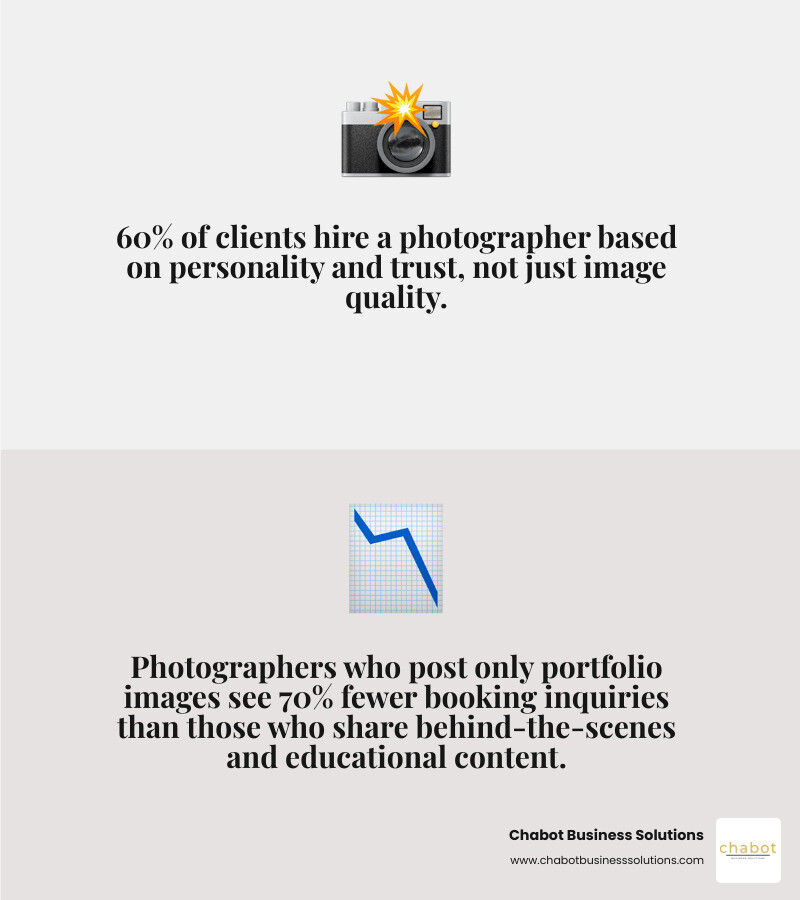
Most photographers treat Instagram and their website like a gallery. They post polished, technically flawless images and wait for the phone to ring. It doesn’t — at least not consistently. That’s because platforms like Instagram function as trust platforms first, and portfolio platforms second. Clients don’t just hire the best photographer. They hire the one they feel like they already know.
The gap between great work and steady bookings is almost always a content and positioning problem, not a quality problem.
I’m Alyx Lofton, founder of Chabot Business Solutions, and over more than 20 years of digital strategy and client growth work I’ve helped business owners — including creative professionals — build the kind of content strategy for photographers and service providers that turns inconsistent marketing into a reliable lead system. This guide walks you through exactly how to do that, step by step.
Why Pretty Portfolios Fail to Convert Followers into Clients
It is one of the most frustrating paradoxes in the creative world: a photographer with breathtaking, technically flawless galleries struggles to book clients, while another photographer down the street with average, smartphone-quality snapshots is completely booked out.
Why does this happen? Because pretty photos get followers, but strategic content gets clients.
When your social media feed and website act purely as a silent art gallery, you fail to establish a personal connection. In July 2026, the digital landscape is noisier than ever. Instagram has scaled to approximately 3 billion monthly active users, and Facebook holds strong at 3.07 billion. In this hyper-saturated environment, simply showing “what” you can shoot is no longer enough. You must show “who” you are and “how” you solve your clients’ problems.
To bridge this gap, you must learn how to take social media followers from scrolling to buying. Consumers do not buy photography purely based on a camera sensor’s resolution; they buy based on trust, ease of experience, and emotional resonance. If your audience does not know your voice, your process, or your values, they will view you as a commodity. When you are a commodity, clients compare you solely on price.
By shifting your focus from broad, generic content to highly targeted, niche content, you immediately stand out. Many photographers fear that narrowing their focus will limit their bookings. In reality, cutting through the noise in a saturated market requires you to speak directly to a specific audience.
For example, a wedding photographer in the East Bay who posts broad photography tips like “5 tips for better lighting” is competing with millions of creators globally. But a photographer who posts niche content like “The 5 best outdoor portrait locations in San Leandro with shade” speaks directly to local, high-intent buyers.
Audience quality beats audience quantity every single time. You do not need 100,000 global followers to run a highly profitable local photography business; you need a few hundred local people who love your specific style and feel a genuine personal connection to your brand.
The Four Pillars of a Content Strategy for Photographers
To build an audience that actually books your services, you must balance your feed across four core content pillars. If you only post your final, polished images, you are only using one-quarter of your marketing power.
1. Results Content (Proof of Work)
This is your traditional portfolio, but with a strategic twist: make the client the hero of the story, not just your camera settings. Instead of simply captioning an image with “Golden hour with Sarah,” tell a narrative about how Sarah felt nervous before the session and how you helped her feel radiant and confident. Showcase the tangible results of your work.
2. Process Content (Behind the Scenes)
Show your audience how the magic happens. Process content is highly engaging because it demystifies your workflow. Show how you scout locations, how you set up your lighting, or how you interact with clients during a session. This builds immense trust because clients can visualize exactly what it feels like to work with you before they ever pay a deposit.
3. Education Content (Value-First Tips)
Educational content should solve your ideal client’s practical problems, not teach other photographers how to use their gear. Instead of sharing your aperture settings, share guides like “What to wear for an East Bay family portrait session” or “How to prepare your toddlers for a outdoor shoot.” By providing this value upfront, you establish yourself as an authority.
4. Personality Content (Human Connection)
People buy from people. Share your personal stories, your values, your favorite local coffee spots in San Leandro, and your unique opinions on photography. We do this because crafting compelling narratives is what transforms a cold business page into an inviting, human brand.
To supercharge these pillars, weave in social proof. Using the power of testimonials within your results and personality content proves that real people in your community have trusted you and walked away thrilled with their experience.
Document, Don’t Create: Streamlining Your Workflow
The biggest reason photographers abandon their content strategy is burnout. Trying to sit down every Sunday night to design, write, and schedule a week’s worth of highly polished social media posts from scratch is a recipe for creative exhaustion.
The solution? Document, don’t create.
As a working photographer, content is already happening all around you. Every time you pack your gear bag, drive to a beautiful location in California, interact with a client, or sit down at your desk to edit, you are surrounded by potential marketing assets. You simply need to train yourself to capture these moments rather than manufacturing new ideas.
Behind-the-scenes (BTS) content is incredibly valuable for justifying your premium pricing. Many clients look at a photographer’s invoice and mistakenly calculate the rate as a simple hourly fee based on the shoot duration. They do not see the hours of pre-production, planning, culling, and meticulous retouching.
By documenting your editing process, you show the sheer labor and artistry that goes into every single image. Here are a few practical ways to gather raw footage without slowing down your workflow:
- Set up a smartphone on a mini-tripod: Place a phone in the corner of your studio or shoot location and let it record a time-lapse of your session.
- Run screen-capture software: Use a free tool like OBS (Open Broadcaster Software) to record your screen while you edit in Lightroom or Photoshop, creating fast before-and-after timelapses.
- Leverage assistants or clients: Ask your assistant or a client’s friend to capture quick, vertical smartphone videos of you directing the shoot.
- Show the unglamorous reality: Do not just show the perfect moments. Showing how you navigated a difficult lighting situation or shot in a less-than-glamorous location proves your professional problem-solving skills.
Since video has taken over modern social algorithms, having a strong video marketing strategy is essential. On platforms like Instagram, Reels outperform static posts by 3x to 5x in organic reach.
By keeping up with current video content trends, you can easily package raw, unedited behind-the-scenes clips into high-performing short-form videos.
To keep these assets organized, use a structured Photographer Content Calendar Guide to map out your weekly, monthly, and seasonal publishing rhythms, ensuring you never run out of ideas during your quiet months.
Implementing a Weekly Posting System for Photographers
Consistency is the heartbeat of any successful digital marketing campaign. However, a realistic content plan must fit your actual energy levels and schedule. You do not need to post five times a day; you need a sustainable weekly posting cadence that covers all your core pillars.
For small business owners, understanding why social media marketing is important is the first step, but executing it consistently is where the challenge lies. If your schedule is too packed with client shoots and editing, investing in professional social media management can keep your brand visible without eating up your creative time.
If you are managing it yourself, here is a simple, highly effective 5-day weekly posting schedule that balances reach and conversion, using a healthy mix of 70% Reels (for reach) and 30% static carousels or images (for conversion and saves):
- Monday (Education – Carousel/Static): “3 Things to Avoid Wearing to Your Next Portrait Session.” Focus on saving and sharing metrics.
- Tuesday (Process – Reel): A quick 15-second behind-the-scenes video showing a raw smartphone clip next to the final edited portrait.
- Wednesday (Results – Carousel): A deep-dive client feature. Put the gorgeous final image first, followed by the client’s glowing testimonial and a story about their session.
- Thursday (Personality – Reel): A short video of you sharing a personal story, your creative philosophy, or a fun day-in-the-life clip of you working in the East Bay.
- Friday (Direct Call-to-Action – Carousel/Static): A clear, conversational post letting your audience know you have limited booking slots open for the upcoming season, with instructions on how to DM you to secure their date.
Integrating Search Engine Optimization into Your Visual Brand
While social media is fantastic for building immediate trust and nurturing relationships, it has a short shelf life. A post on Instagram is typically buried and forgotten within 48 hours. Search Engine Optimization (SEO), on the other hand, is an evergreen asset. A well-optimized blog post or image gallery can continue to bring you highly qualified, local leads for years after you publish it.
Because photography websites are incredibly image-heavy — often consisting of 80% to 90% images by weight — standard, text-only SEO advice fails. You must treat your portfolio as an indexable search asset. This is why mastering image SEO, alt text, filename structures, and local search signals is so critical.
To build a site that ranks, you must follow the technical rules outlined in SEO for Photographers: The 2026 Playbook (Real Tactics) . Let’s break down the essential steps:
- Alt Text Formula: Never leave your image alt text blank, and never stuff it with generic keywords. Instead, use a clear, descriptive formula:
[Subject + Style] + [Location/Setting] + [Your Specialty]. For example: “Couples lifestyle portrait during golden hour at Lake Chabot in San Leandro, CA by an East Bay wedding photographer.” - Filename Strategy: Standard camera outputs like
IMG_4827.JPGare invisible to search engines. Rename your files before uploading them using a descriptive, hyphen-separated format:client-name-session-type-location-photographer.jpg(e.g.,emily-john-wedding-lake-chabot-san-leandro-photographer.jpg). - File Compression: Large files slow down your site, destroying your mobile user experience and search rankings. Compress your images and convert them to modern formats like WebP. Target under 100KB for homepage hero banners and under 200KB for full-screen portfolio galleries.
- Image Quantity: A site with fewer than 50 total images will struggle to rank. The sweet spot for local photographers is between 200 and 500 well-optimized, compressed images.
Maximizing Local Search with a Content Strategy for Photographers
For local service providers in California, local search is where you win or lose clients. Many wedding, family, and brand photographers report that 30% to 40% of their digital inquiries originate directly from Google Images impressions. When local clients are looking for visual inspiration, they search Google Images for venues, styles, and ideas. If your images are optimized, those searchers will click through directly to your portfolio.
To capture this high-intent traffic, build dedicated local location pages on your website. If you serve San Leandro, Oakland, and the wider East Bay, create unique landing pages for each area. These pages should contain at least 800 words of unique local content, embedded Google Maps, local schema markup, and galleries showcasing shoots from those specific neighborhoods.
Additionally, ensure your Google Business Profile is fully optimized. Post at least 20+ high-quality portfolio photos, list your exact service areas, and actively collect reviews.
To expand your local digital footprint, you can also practice building relationships through comment marketing on local community blogs, venue pages, and neighborhood groups, establishing your brand as a helpful, active local expert.
Scaling Your Business with Advanced Content Systems
Once you have mastered the basics of social media and SEO, you can scale your marketing using advanced content systems that save you hours of manual work.
One of the smartest ways to generate a massive marketing package from a single session is by using voice notes. Immediately after a shoot, while driving home with your head full of details, open your phone’s voice recorder. Spend two minutes talking about the emotional highlights of the shoot, the client’s reactions, the specific locations you used, and how you solved any unexpected challenges.
By transcribing this raw voice note, you preserve the authentic, emotional details that make storytelling so powerful. You can then drop this transcript into an AI tool like Claude to format it without losing your personal voice.
This workflow is beautifully detailed in the Content System for Photographers | One Take – Showit Blog , which shows how one simple post-session voice note can be systematically repurposed into a full marketing package: a 1,500-word SEO-friendly blog post, social media captions, a client review request, and email newsletter content.
To do this ethically and effectively, follow the guidelines in Using AI for Content Creation As A Brand Photographer (Ethically & Best Tips) – maddiepeschong.com . The golden rule of ethical AI in creative fields is simple: never let AI generate your original ideas or write in a voice that doesn’t match how you actually speak.
Instead, use AI strictly as an assistant to organize, format, and repurpose your own original, long-form thoughts.
| Step | Action | AI Assistant’s Role | Output Generated |
|---|---|---|---|
| 1 | Record a 2-minute voice note post-shoot | Transcribe raw thoughts | Raw, emotional narrative text |
| 2 | Input transcript into AI tool | Organize and structure | 1,500-word draft blog post with local H2s |
| 3 | Request social media variations | Repurpose into bite-sized formats | 3 Instagram captions, 1 email newsletter draft |
| 4 | Human review and polish | Inject personal quirks and local touchpoints | Ready-to-publish, authentic content assets |
Embracing the power of content creation in digital marketing: a personal reflection reminds us that while systems and AI save time, the heart of your brand remains your human perspective.
Selling Monthly Retainer Packages via a Content Strategy for Photographers
If you want to move away from the unpredictable “feast-or-famine” freelance cycle, consider introducing monthly content retainer packages.
Local businesses, restaurants, and personal brands in the East Bay constantly need fresh visual content to keep their feeds active. By positioning yourself as a strategic content partner rather than a one-time service provider, you can sell monthly subscriptions that provide predictable, recurring revenue.
For example, professional food photography has been shown to increase online restaurant orders by 15% to 20%. By pitching this tangible business ROI to local eateries, you can secure ongoing agreements. Let’s look at the financial impact of transitioning from one-time shoots to a predictable retainer model:
| Business Model | Client Volume & Pricing | Monthly Revenue | Annual Recurring Revenue (ARR) |
|---|---|---|---|
| One-Time Shoots | 4 random shoots at $1,000 | $4,000 (Inconsistent) | Variable ($30k – $48k) |
| Starter Retainer | 3 local businesses at $1,000/mo | $3,000 (Guaranteed) | $36,000 |
| Standard Retainer | 3 at $1,000/mo + 1 brand at $1,500/mo | $4,500 (Guaranteed) | $54,000 |
| Premium Retainer | 4 standard + 1 premium brand at $2,500/mo | $7,000 (Guaranteed) | $84,000 |
To learn how to structure, price, and pitch these subscription packages without feeling pushy, read the full guide on Photography Monthly Retainer Packages .
A great way to close your first retainer client is the “Trial Shoot Method.” Offer a single, discounted session to a local business to prove your value, demonstrate how easy you are to work with, and show them the high-performing social media assets you can deliver month after month.
Frequently Asked Questions about Photographer Marketing
Why do photographers with great photos get fewer clients than those with average photos?
Because photography is a deeply personal service, and clients hire the professionals they know, like, and trust. A photographer with average photos who consistently shares their personality, explains their process, and shows up warm and approachable on social media builds a strong human connection. A photographer who hides behind a silent, sterile portfolio remains a stranger. Trust beats technical perfection every single time.
How often should photographers post on social media in 2026?
In July 2026, the key to social media success is sustainable consistency over sheer volume. We recommend a baseline of 3 to 4 high-quality feed posts per week on Instagram, paired with daily, low-friction Stories to stay top-of-mind. On Pinterest, aim for 3 to 7 keyword-rich pins per week to capture evergreen visual search traffic, particularly as Gen Z now makes up over 50% of Pinterest’s rapidly growing global audience of 631 million monthly active users.
How can photographers ethically use AI for content creation?
Ethical AI usage means using technology to support, structure, and repurpose your original ideas rather than generating fake content from scratch. Never use AI to write captions that do not sound like you, and never use AI-generated avatars of yourself in your marketing. Instead, feed your own raw post-shoot voice notes, outlines, or podcast transcripts into AI tools to help you format them into blog drafts, social posts, and email newsletters.
Conclusion
Building a successful content strategy for photographers does not require you to become a full-time influencer or spend all of your free time editing social media clips. It requires a clear, focused system that turns the creative work you are already doing on set into a reliable engine for local search discovery, brand authority, and client inquiries.
At Chabot Business Solutions, we design focused, strategy-first marketing systems that cut through the digital noise and support sustainable business growth. Based right here in San Leandro, we help creative entrepreneurs and local business owners build clear, high-converting digital footprints without the overwhelm.
If you are ready to stop guessing what to post and build a custom, sustainable marketing plan that fills your booking calendar, explore our marketing strategy planning services today. Let’s design a system that works as hard as you do.