
What Is the Difference Between a Community Manager and a Social Media Manager?
Understanding the difference between a community manager social media manager role is one of the most common questions business owners face when building their marketing team. Here is the short answer:
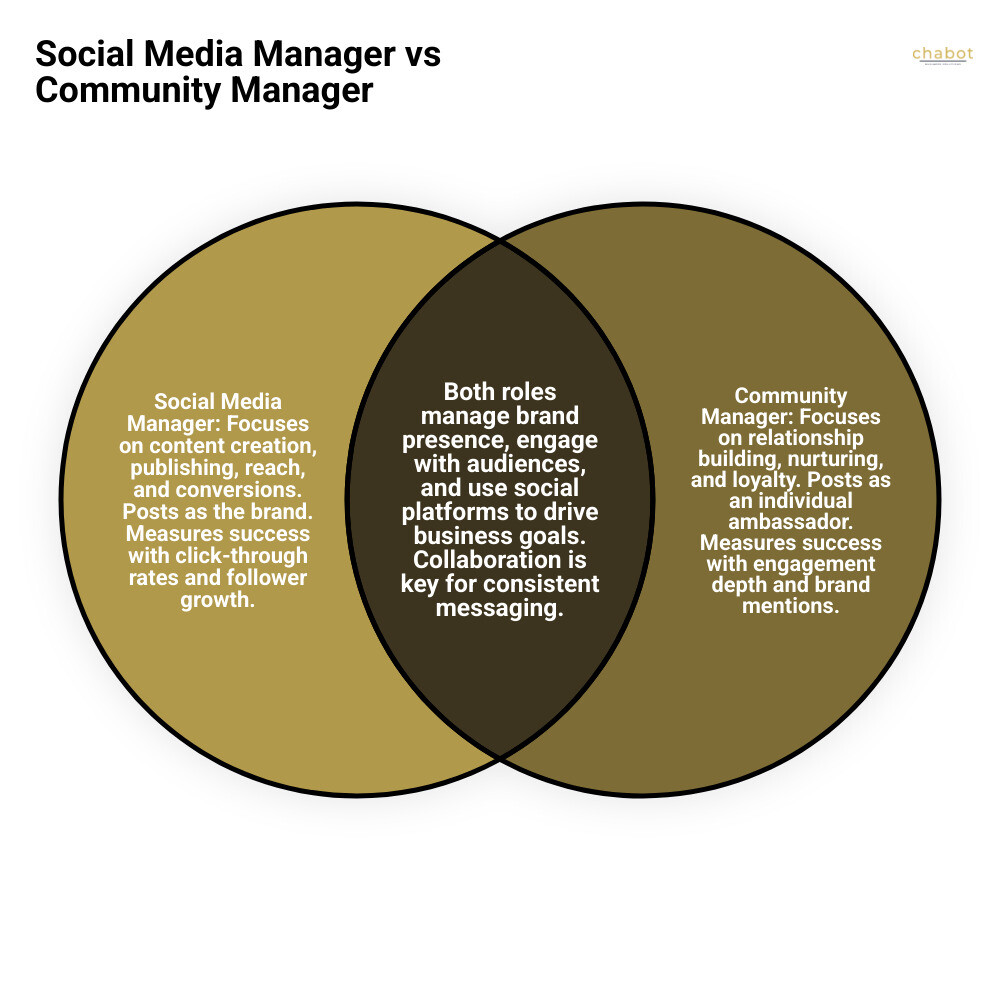
| Social Media Manager | Community Manager | |
|---|---|---|
| Primary focus | Creating and publishing content | Building and nurturing relationships |
| Posts as | The brand account | An individual brand ambassador |
| Main goal | Reach, awareness, and conversions | Engagement, loyalty, and community health |
| Measured by | Click-through rates, follower growth, conversions | Brand mentions, engagement depth, event attendance |
| Time horizon | Short-to-medium term | Long-term |
In short: the social media manager talks to your audience, the community manager listens and talks with them.
These two roles are frequently blended into a single job title — especially at startups and small businesses. But as a company grows, the distinction becomes critical. Getting it wrong means burning out one person, underserving your audience, or spending budget on the wrong hire.
I’m Alyx Lofton, founder of Chabot Business Solutions, and over 20 years of working in digital strategy I have helped business owners untangle exactly this kind of confusion — including how to structure community manager and social media manager responsibilities for sustainable, scalable growth. In the sections below, I’ll walk you through everything you need to know to make the right call for your business.
Defining the Roles: Community Manager Social Media Manager Differences
To build a marketing system that scales, we must look past the job titles and examine the fundamental philosophies of these two positions. Both roles sit within the broader marketing department, but they operate with entirely different objectives.
A Social Media Manager (SMM) is a content strategist and distributor. They are responsible for what we call the “broadcast” layer of your social presence. They design the visual assets, write the copy, schedule the posts, and analyze performance data to ensure the brand’s message reaches as many people as possible.
A Community Manager (CM), on the other hand, is a relationship builder. They operate in the “conversational” layer. Instead of broadcasting a message to a crowd, they step into the crowd to facilitate discussions, resolve complaints, and build a safe, welcoming digital space.
According to the 2025 Sprout Social Index, 90% of consumers use social media to follow brands and stay on top of social trends. However, modern consumers expect more than just a digital billboard. They want to interact with a living, breathing brand. This shift makes understanding Why Social Media Marketing Is Important For Small Businesses more evident than ever; you cannot rely solely on broadcasting if you want to retain customers over the long haul.
Posting as the Brand vs. Posting as an Ambassador
The most practical way to distinguish between these two roles is to look at how they communicate online.
When a Social Media Manager publishes a post, they do so as the brand. The profile picture is the company logo, and the tone is the official brand voice. They represent the unified identity of the business.
When a Community Manager interacts with the audience, they often do so as an individual brand ambassador. They might use their personal handle or sign off with their first name (e.g., “Hey there, this is Alyx from the team!”). This transparency shifts the dynamic from a corporate broadcast to a peer-to-peer conversation. By humanizing the brand, they build authentic connections, encourage user-generated content (UGC), and transform passive followers into active advocates.
When to Hire a Community Manager Social Media Manager Specialist
For many small businesses here in the East Bay, CA, a single team member initially wears both hats. However, as your business scales, this hybrid model can quickly become unsustainable.
We recommend splitting these roles when:
- Your audience size exceeds your capacity to respond: If you are receiving dozens of comments, direct messages, and brand mentions daily, your SMM will spend all their time moderating instead of planning strategy.
- Your engagement volume stalls: If you have high follower numbers but low interaction rates, you need a dedicated community builder to spark conversations.
- Your business relies on private spaces: If you run a customer-only forum, a Discord server, or a private Facebook Group, managing these spaces requires a dedicated moderator to maintain brand safety and value.
Daily Tasks and Core Responsibilities of Each Role
To understand how these roles function, let’s look at what a typical day looks like for each position. Both roles are highly collaborative, but their workflows require entirely different mindsets. While the SMM is focused on production and optimization, the CM is focused on interaction and moderation.
Integrating these two workflows effectively is key to learning How To Take Social Media Followers From Scrolling To Buying. As digital strategist Jessica D. points out in her work, converting passive views into business revenue requires a combination of strategic, video-first content execution (SMM) and structured, gamified backend community management (CM).
The Social Media Manager’s Daily Workflow
The SMM’s day is structured around content production, strategy, and analytics. Their core responsibilities include:
- Content Calendar Management: Planning, writing, and scheduling posts across platforms like Instagram, TikTok, and LinkedIn.
- Video and Asset Production: Conceptualizing and editing short-form videos, designing graphics, and writing engaging captions.
- Campaign Execution: Launching promotional campaigns, coordinating product launches, and aligning organic social with paid advertising efforts.
- Performance Tracking: Auditing reach, click-through rates (CTR), and conversions to optimize the brand’s digital footprint.
The Community Manager’s Daily Workflow
The CM’s day is highly dynamic, often requiring rapid multitasking and deep empathy. Their core responsibilities include:
- Notification Juggling: Monitoring and responding to comments, direct messages, and forum posts within a strict time window (ideally under 24 hours).
- Comment Moderation: Keeping online spaces safe, professional, and aligned with brand guidelines by managing spam or inappropriate behavior.
- Relationship Building: Proactively reaching out to active community members, highlighting user-generated content, and encouraging peer-to-peer discussions.
- Crisis Mitigation: Detecting potential customer service issues early and coordinating with PR or customer care teams before a small complaint escalates into a public relations issue.
Essential Skills, Tools, and Platform Expertise
Because these roles require different outputs, they demand distinct skill sets and technical tools. A great SMM needs to be a master of creative production and data analysis. A great CM must be a master of communication, active listening, and crisis management.
We can see this distinction in the career of Tarika Bhatt, an expert who has spent over six years navigating the intersection of community moderation and creator initiatives. Her work highlights how modern community builders must balance the chaotic nature of “notification juggling” with strategic brand safety practices to keep online spaces running smoothly.
Equipping your team with the right tools is essential for scaling your brand’s presence. Implementing these systems correctly is a major reason why How Professional Social Media Management Boosts Brand Visibility is so effective for businesses looking to expand their footprint in California and beyond.
| Tool Category | Social Media Manager Tools | Community Manager Tools |
|---|---|---|
| Content & Scheduling | Buffer, Hootsuite, Later, Canva | Notion, Google Sheets, Airtable |
| Engagement & Listening | Sprout Social, Dash Hudson | Sprinklr, Brandwatch |
| Community Platforms | Instagram, TikTok, Pinterest | Discord, Geneva, Private Forums |
Sourcing UGC and Managing Emerging Creators
A major crossover point for these roles is User-Generated Content (UGC) and creator partnerships. An SMM uses UGC to populate the content calendar, while a CM uses it to build relationships and reward loyal community members.
This strategy can yield incredible results. For example, digital marketing specialist Omar Altimany has demonstrated that sourcing approximately 50 emerging creators per week to build an organized UGC bank can drive a 24% increase in organic reach. The SMM uses these assets to maintain a fresh, high-performing feed, while the CM fosters the relationships with those creators to keep them engaged with the brand.
Platform-Specific Community Management
As digital spaces evolve, community management has moved far beyond the comment sections of Facebook and Instagram. Today, brands build private, dedicated spaces to foster deeper customer relationships.
This requires expertise in platforms like Discord or Geneva, where community members can participate in beta programs, attend live events, and interact in smaller, self-initiated sub-groups. Facilitating these spaces requires a high level of moderation, structured rules, and a clear community roadmap to keep members aligned with the brand’s long-term vision.
Measuring Success: Key Performance Indicators (KPIs)
One of the biggest mistakes we see businesses make is measuring both roles using the exact same metrics. If you judge a community manager solely by sales conversions, or a social media manager solely by community sentiment, you will miss the true value of their work.
To avoid this, we must align our metrics with the specific goals of each role. Failing to track the right KPIs is one of the 10 Social Media Mistakes Hurting Your Brand How To Fix Them.
Short-Term vs. Long-Term Metrics
The success of a Social Media Manager is highly visible in short-to-medium-term performance metrics. We look at:
- Reach and Impressions: How many people saw our content?
- Follower Growth Rate: Is our overall audience expanding?
- Click-Through Rate (CTR): Are people taking action on our posts?
- Conversion Rate: How many social media leads turned into paying customers?
The success of a Community Manager is reflected in long-term relationship metrics. We look at:
- Engagement Depth: Are people having meaningful, multi-comment conversations, or just leaving generic emojis?
- Brand Sentiment: Is the overall tone of online conversations about our brand positive, neutral, or negative?
- Customer Retention and Loyalty: Are active community members staying with our business longer?
- Troll Mitigation: How effectively do we turn negative feedback into positive resolutions?
As professional social media community manager Doe Antonio notes, managing a brand’s reputation online is akin to “taming the online wilderness.” Success in this area is measured by the ability to practice proactive “customer TLC” and turn critical voices into loyal brand advocates.
Translating Community Data into Actionable Insights
A great community management strategy does not just keep followers happy; it provides invaluable business intelligence. Because community managers spend their days talking directly to your customers, they hear their pain points, feature requests, and complaints first.
By establishing a structured feedback loop, we can translate these community insights into product optimizations and refined content strategies.
Organizational Structure, Collaboration, and Salaries
In a healthy marketing department, these two roles do not operate in silos. They work in tandem, feeding insights and creative assets back and forth to build a cohesive customer experience.
This collaboration is the foundation of Community Engagement Building A Brand That People Love. When the SMM and CM are aligned, your marketing transitions from a series of disjointed posts into a unified ecosystem.
Salary Benchmarks and Corporate Compensation
Because these roles are highly strategic, compensation reflects their value to the business. While entry-level hybrid roles exist, senior positions at major corporations command significant salaries.
In California and across major corporate roles in the United States, senior community engagement leaders can earn between $130,300 and $217,400 per year. These high-level roles typically require 8+ years of experience and involve managing global moderation teams, establishing brand safety protocols, and partnering cross-functionally with PR, Legal, and Customer Care departments.
For businesses looking to scale, investing in these professional roles is a highly effective way to protect and grow your brand. We discuss how to structure these investments in our guide on How To Align Your Brand Voice With Social Media Marketing Services.
Niche Verticals: Esports, Gaming, and Web3
The relationship between community and social media changes depending on your industry. In highly interactive spaces like esports, gaming, and Web3, the community manager is often the most critical hire a company makes.
We see this dynamic clearly in the profile of Nasha Sanchez, who has spent over a decade managing regional community initiatives, Discord servers, and marketing campaigns for esports and Web3 platforms. In these fast-moving industries, community managers must coordinate rapid-response tournament activations, manage regional moderation teams, and support complex operations like Web3 token launches or airdrops.
Career Paths: Transitioning Between Community Manager Social Media Manager Roles
Because these roles overlap, professionals frequently transition between them.
- Transitioning from SMM to CM: Requires shifting your focus from creative production to relationship building. You will need to develop deep empathy, learn advanced social listening tools like Sprinklr, and master community moderation frameworks.
- Transitioning from CM to SMM: Requires developing your technical and analytical skills. You will need to master graphic design, short-form video editing, content planning, and conversion metrics tracking.
Frequently Asked Questions about Social Media Roles
What is the main difference between a social media manager and a community manager?
A social media manager focuses on the “broadcast” layer of marketing, acting as the official voice of the brand to publish content, run campaigns, and track conversions. A community manager focuses on the “conversational” layer, acting as an individual ambassador to build relationships, moderate discussions, and nurture the audience.
What tools are essential for enterprise-level community management?
Enterprise-level community management requires robust, scalable tools. While standard scheduling tools work for small businesses, large corporations rely on advanced social listening and analytics platforms like Sprinklr to track brand sentiment, manage 24/7 moderation workflows, and coordinate crisis escalation protocols across PR, Legal, and Customer Care teams.
Can one person handle both social media and community management?
Yes, especially in startups and small businesses. However, as your audience grows, combining these roles can lead to burnout and poor performance. Splitting the roles allows your social media manager to focus on high-quality content production and strategy, while your community manager focuses on relationship building and customer retention.
Conclusion
Building a successful digital presence requires a balance of strategic content and authentic relationship building. Whether you need a dedicated Social Media Manager to expand your reach, a Community Manager to nurture your existing audience, or a hybrid strategy to get started, the key is to approach your marketing with absolute clarity.
At Chabot Business Solutions in San Leandro, California, we take a strategy-first, clarity-driven approach to digital marketing. We help business owners in the East Bay and across California design focused marketing systems that simplify their operations and support sustainable, long-term growth.
If you are ready to stop guessing and start building a social media system that converts, read our guide on Why Hiring A Social Media Marketing Agency Might Be Your Best Decision, or explore our AI-Driven Social Media Services to see how we can streamline your digital marketing today.