Your Website Has One Chance to Make a First Impression
A website redesign is one of the most important investments a business owner can make — and one of the most misunderstood.
Here is a quick answer to what it actually means:
What is a website redesign? A website redesign is a full rebuild of your site’s structure, design, content, and functionality to better serve your business goals and your visitors’ needs. It goes well beyond changing colors or swapping a photo.
Key facts at a glance:
- 38% of users will leave a website they find outdated — often within seconds
- First impressions form in as little as 50 milliseconds
- Industry leaders typically update their sites every 18 to 30 months
- A well-executed redesign improves trust, leads, and conversions — not just appearance
- Done wrong, a redesign can wipe out your Google rankings overnight
If your site is slow, confusing, or looks like it hasn’t been touched in years, it is likely costing you customers every single day — quietly, without any obvious warning sign.
This guide walks you through the full process: from knowing when a redesign is the right move, to protecting your SEO, to measuring results after launch.
I’m Alyx Lofton, founder of Chabot Business Solutions, and over more than 20 years of digital strategy work I’ve helped business owners navigate the complexity of website redesign — separating what actually moves the needle from what just looks good in a pitch deck. Let’s get into it.
Redesigning vs. Refreshing Your Site: Key Differences
When business owners in the East Bay realize their online presence is slipping, their first reaction is often to ask for a quick facelift. However, there is a fundamental difference between a surface-level refresh and a complete website redesign. Understanding this distinction is critical to avoiding wasted budget and misaligned expectations.
A website refresh is akin to applying a fresh coat of paint, swapping out outdated stock photos, and updating your typography. It is a cosmetic update that leaves your existing technical foundation, database, and site architecture untouched.
On the other hand, a full website redesign is an architectural reset. It is a ground-up rebuild where we analyze user behavior, restructure the information architecture, rewrite core messaging, and modernize the technical framework.
To help you decide which path is right for your business, we have mapped out the core differences below:
| Feature | Website Refresh | Full Website Redesign |
|---|---|---|
| Primary Focus | Visual aesthetics and minor UX tweaks | Strategic alignment, performance, and conversion |
| Codebase | Retains existing theme and backend code | Completely rebuilt or migrated to a modern framework |
| Information Architecture | Unchanged sitemap and navigation structure | Completely restructured for intuitive user journeys |
| SEO Impact | Low risk (URLs and structure remain the same) | High risk/reward (requires careful URL redirect mapping) |
| Typical Timeline | 1 to 3 weeks | 4 to 12 weeks depending on complexity |
| Typical Lifespan | 12 to 18 months | 3 to 5 years |
If your brand has recently evolved, or if you find that your backend system is bogged down by years of plugin bloat, a cosmetic refresh simply will not solve your problems. To explore how often you should be making these updates and the signs that your current setup is holding you back, read our deep dive: Is It Time for a Website Makeover? Here’s Why and How Often You Should Refresh Your Site.
Planning and Auditing Your Current Site
A successful website redesign never begins with a design tool; it begins with data. Jumping straight into mockups without auditing your current performance is a recipe for repeating the exact same mistakes that are currently hurting your conversions.
Before we write a single line of code or sketch a wireframe, we must conduct a thorough audit of your existing site. This planning phase is built on three core pillars:
1. Technical Performance Audit
We use tools like Google Search Console and PageSpeed Insights to establish baseline benchmarks. We look at critical metrics such as:
- Core Web Vitals: Google uses metrics like Largest Contentful Paint (LCP) and Interaction to Next Paint (INP) to evaluate user experience.
- Load Times: Over 70% of visitors will leave a website if it takes longer than 3 seconds to load, and a mere 1-second delay can drop conversions by 20%.
- Mobile Usability: We analyze how your site performs on mobile devices, which is critical since mobile traffic has generated over 50% of all global web traffic for nearly a decade.
2. User Behavior Research
We use heatmaps and behavioral analytics to see exactly where users click, where they get stuck, and where they abandon your pages. If your landing pages have an average bounce rate close to 50% and a conversion rate under 10%, behavior mapping will show us the exact friction points causing users to leave.
3. Market Positioning Review
We look at how your customers search, compare options, and evaluate credibility throughout California. What features do they expect? Where are the content gaps? By understanding the broader market landscape, we can design a digital property that positions your business clearly and confidently for the audience you want to reach.
By grounding your project in these insights, you ensure that every design choice is made to support your bottom line. To learn more about how to align your digital assets with your broader business objectives, check out our guide on Maximizing ROI with a Professional Digital Marketing Strategy.
The Step-by-Step Website Redesign Process
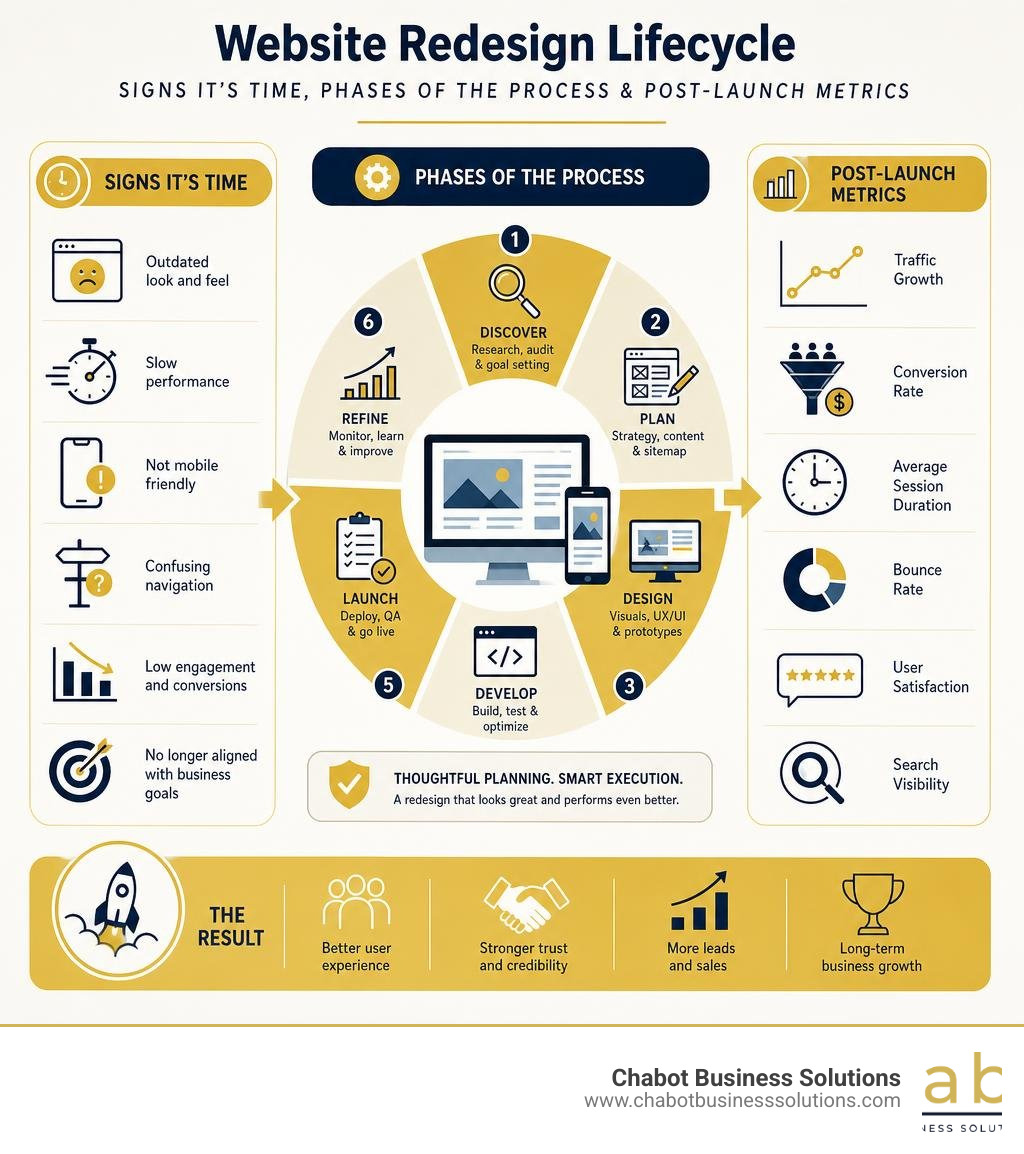
To deliver a high-performing website without the stress, we break the website redesign process down into structured, manageable phases. This methodical approach ensures alignment among stakeholders, prevents scope creep, and guarantees that the final product is built to convert.
Phase 1: Discovery, Research, and Content Strategy
We begin by defining your target user personas and mapping out their user journeys. A common mistake in web design is organizing your site around your internal company structure rather than how your customers actually think.
During this phase, we establish a clean information architecture. We map out a sitemap where key pages are no more than three clicks away from the homepage. We also evaluate your existing content. Rather than migrating thin, outdated, or duplicate copy, we rewrite and optimize your content to speak directly to your audience’s pain points.
Investing in this strategic phase pays off massively. Industry data shows that every $1 invested in user experience (UX) results in a return of up to $100—representing an exceptional return on investment.
Phase 2: Designing and Prototyping the User Experience
Once the strategy is locked in, we move to the visual layout. We start with low-fidelity wireframes to establish content placement and visual hierarchy without the distraction of colors or images.

After refining the wireframes, we develop high-fidelity interactive prototypes. This allows you to click through the site and experience the navigation before any backend development begins.
Our design team prioritizes a mobile-first approach. Because mobile devices have generated over 50% of all website traffic since 2017, we design the mobile experience first, then scale up to desktop screens. We focus on touch-friendly buttons, highly visible calls-to-action (CTAs), and readable typography to ensure seamless usability across all devices.
Phase 3: Development, Testing, and Launch
With approved designs in hand, our development team builds a clean, fast, and secure website. We select an SEO-friendly content management system (CMS) that gives you full ownership of your site, allowing you to make updates without needing a developer for every minor text change.
In 2026, modern development workflows have evolved. By leveraging advanced AI-assisted front-end development tools, our team can automate repetitive coding tasks. This results in up to 60% less front-end work during the initial build phase, allowing our developers to focus their energy on custom functionality, rigorous quality assurance (QA) testing, and speed optimization.
Before launching, we put the site through a comprehensive QA checklist, testing for:
- Cross-browser compatibility (Chrome, Safari, Edge, Firefox)
- Mobile responsiveness across various screen sizes
- Form submissions and integration with your CRM
- Page speed benchmarks to ensure sub-3-second load times
Protecting Your SEO and Google Rankings During a Redesign
Perhaps the biggest fear business owners face when considering a website redesign is losing their hard-earned search engine rankings. It is a valid concern: we have seen businesses lose 60% to 80% of their organic traffic overnight because an agency launched a beautiful new site but completely ignored SEO migration.
At Chabot Business Solutions, we treat search visibility as a non-negotiable priority. As a leading web design agency in California, we build SEO protection into every step of our technical workflow.
Technical SEO Risks in a Website Redesign
When you launch a new website, several technical changes can disrupt how search engines crawl and index your pages:
- Broken Links and Crawl Errors: If you change your URL structures without telling Google where the old pages went, visitors and search crawlers will hit frustrating 404 “Page Not Found” errors.
- Loss of Metadata: Forgetting to migrate optimized title tags, meta descriptions, and header structures can cause Google to re-evaluate your relevance for key search terms.
- Page Builder Bloat: Rebuilding a site using heavy, outdated page builders can ruin your Core Web Vitals, leading to a ranking drop due to slow mobile performance.
To prevent these issues, we map every single existing URL to its new equivalent using 301 redirects. This tells Google permanently that your content has moved, preserving your backlink equity and search authority.
Best Practices for SEO-Safe Website Redesign Migration
To ensure a seamless transition, we follow a strict migration protocol:
- Staging Server Development: We build and test your new website on a private, non-indexed staging server. Your current website remains fully live and functional, meaning there is zero downtime for your business.
- Schema Markup Preservation: We implement advanced structured data (such as LocalBusiness and FAQ schema) to help search engines understand your content and reward you with rich search snippets.
- Search Console Monitoring: On launch day, we submit a updated XML sitemap directly to Google Search Console and monitor crawl reports daily to catch and resolve any indexing issues immediately.
By choosing the top-rated East Bay web designers at Chabot Business Solutions, you can rest easy knowing your search engine rankings are fully protected.
Measuring Success and Post-Launch Optimization
Launching your new website is not the finish line; it is the starting point. A website is a living digital asset that requires ongoing optimization to perform at its peak.
To track the success of your website redesign, we set up robust analytics tracking to monitor key performance indicators (KPIs):

- Bounce Rate: Are users staying on your site longer? A drop in bounce rate indicates that your new design and content are engaging.
- Conversion Rate: Is the site generating more leads, phone calls, or sales? This is the ultimate measure of redesign success.
- Core Web Vitals: We monitor real-user loading speeds to ensure the site remains fast and responsive.
- Organic Search Traffic: We track keyword rankings to verify that search visibility remains stable or improves post-launch.
By continuously analyzing user interactions, we can make data-driven refinements that maximize your long-term return on investment. To explore how user expectations and digital technologies are continuing to evolve, read our forward-looking guide: Future-Proofing Your Marketing: Trends to Watch in 2025 and Beyond.
Frequently Asked Questions About Site Overhauls
Why do some site overhauls fail to improve performance?
Most failed website redesigns share the same flaw: they prioritized subjective aesthetic trends over user data. When a site is built to satisfy a designer’s personal taste rather than solve real user friction points, conversions suffer. Additionally, heavy page builder bloat, poor mobile navigation, and a failure to set up proper 301 redirects will actively damage both your user experience and search rankings.
How much does a professional site overhaul cost?
The investment for a professional website redesign varies based on the size of your site, the complexity of your features, and the depth of content strategy required. While basic template updates can be found at lower price points, a strategic, custom rebuild designed to drive business growth typically ranges from a few thousand dollars for small businesses to larger investments for complex e-commerce or enterprise platforms. To view our transparent pricing and options, visit our Services page.
How long does a full site overhaul typically take?
A standard strategic redesign typically takes between 4 to 8 weeks from kickoff to launch. This timeline includes the discovery phase, user research, content writing, design mockups, staging development, and rigorous QA testing. Larger websites with extensive content migration or custom software integrations may take 10 to 12 weeks to ensure a flawless launch.
Conclusion
Your website is the digital front door to your business. In today’s competitive landscape, relying on an outdated, slow, or confusing site is a liability that costs you revenue every day.
At Chabot Business Solutions, we reject the “lipstick on a pig” approach to web design. Located right here in San Leandro, we deliver strategy-first, clarity-driven websites designed to simplify your marketing and support sustainable business growth. We combine deep technical expertise with conversion design psychology to build digital assets that actually work for your business.
Ready to transform your online presence and turn your website into a high-performance lead generator? Explore our Website Design & Development services today, and let’s build something exceptional together.