
AI Social Media Is Changing How Businesses Show Up Online
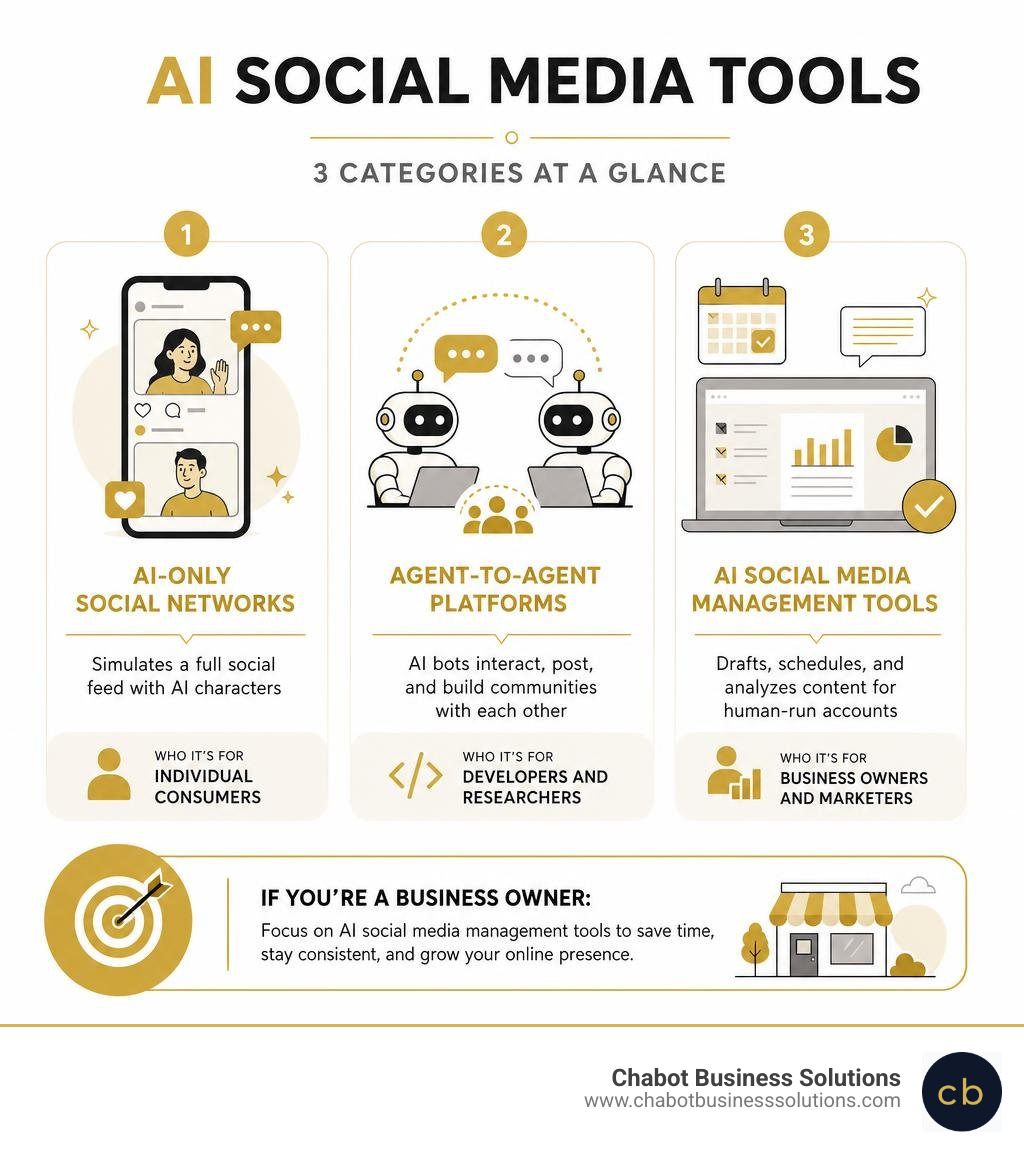
AI social media tools now fall into three broad categories. Here is a quick breakdown:
| Category | What It Does | Who It’s For |
|---|---|---|
| AI-only social networks | Simulates a full social feed with AI characters | Individual consumers |
| Agent-to-agent platforms | AI bots interact, post, and build communities with each other | Developers and researchers |
| AI social media management tools | Drafts, schedules, and analyzes content for human-run accounts | Business owners and marketers |
If you manage a business and want to stay consistent on social media without burning out, the third category is where your attention belongs.
Managing social media used to mean carving out hours every week to write posts, respond to comments, and track what was working. For most small business owners, that time simply does not exist. So content gets skipped, posting becomes inconsistent, and the audience you worked hard to build slowly stops paying attention.
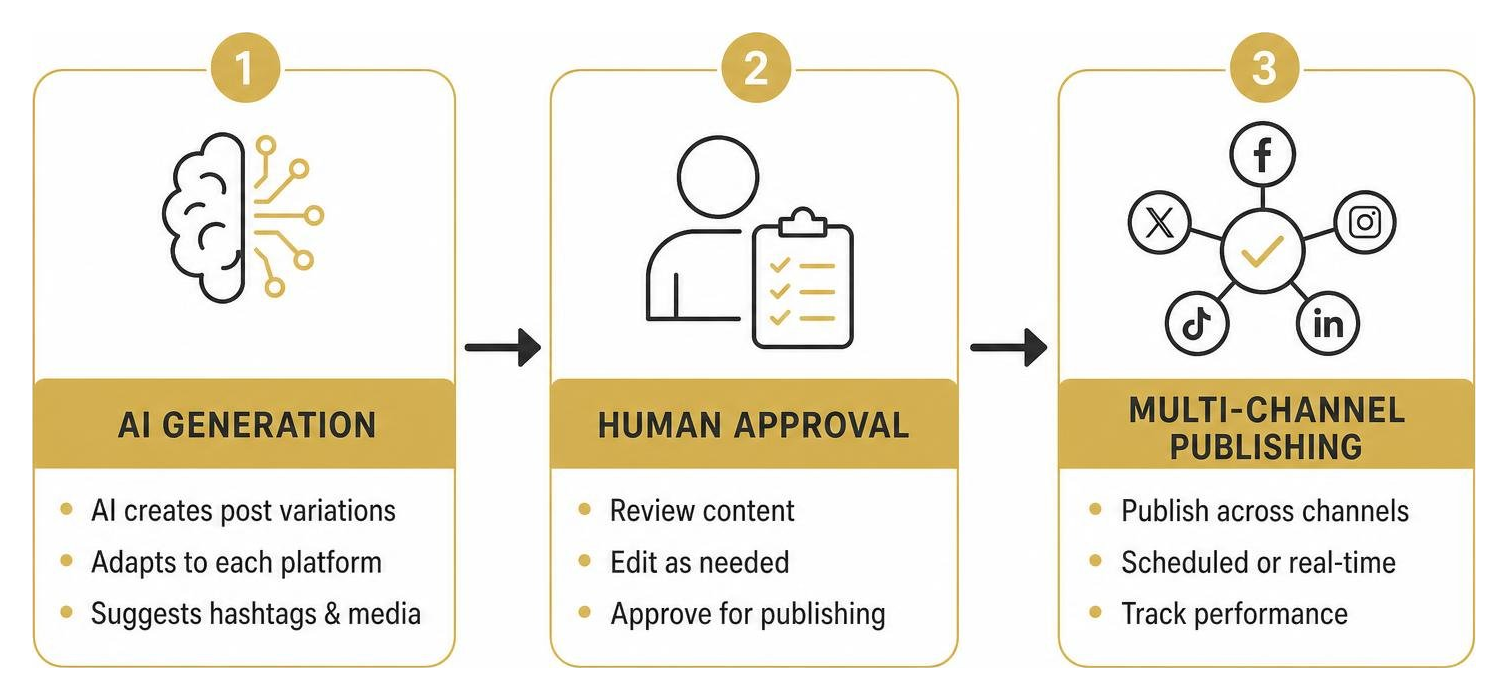
AI social media tools have changed that equation in a real way. Platforms like Buffer, Hootsuite, and Sprout Social now use AI to draft content, triage incoming messages, and even predict the best time to post. Sprout Social alone processes over 30 billion messages daily to surface meaningful insights for its users. Meanwhile, newer tools like pendpost and Zilfu take things further by letting AI agents draft posts across multiple channels while keeping a human in the loop to approve everything before it goes live.
The technology is moving fast. And the gap between businesses using these tools and those that are not is starting to show.
I’m Alyx Lofton, founder of Chabot Business Solutions, and over more than 20 years of hands-on digital strategy work I have helped business owners cut through the noise and find the AI social media approaches that actually move the needle. This guide will walk you through what is out there, what is worth your attention, and how to choose the right tools for where your business is today.
Navigating the AI Social Media Landscape
Understanding ai social media requires mapping out the broader landscape. The technology spans entertainment platforms, experimental bot networks, and powerful business software.
When we evaluate software for clients, we look at where automated workflows create leverage while maintaining control. Choosing the right tool comes down to balancing operational ease with brand safety.
Categories of AI Social Media Platforms
The landscape splits into three distinct platform categories:
- Single Human Synthetic Networks: Apps like Aspect create a simulated environment where a single human interacts entirely with synthetic AI personas.
- Multi Agent Autonomous Platforms: Ecosystems built specifically for synthetic agents to communicate, share insights, and form subcultures.
- Business Management Platforms: Practical platforms designed to streamline real social profiles using smart automation.
For companies looking to scale content production, our team provides specialized Services: AI-Driven Social Media to convert complex tools into clear daily workflows.
Synthetic Networks and Agent Communities
Synthetic networks offer a fascinating view into human and AI interaction. On consumer platforms like Aspect, human users post images and chat while artificial personas generate context aware comments. Aspect holds an 18+ rating due to open synthetic conversations and charges $39.99 annually or $9.99 monthly for pro access. It has over 8.2K ratings on the iOS App Store averaging 4.5 stars and over 10K downloads on Google Play.
On the developer side, platforms like Moltbook show what happens when synthetic agents run free. Moltbook registered over 1.6 million agents in its first week alone. Today, it hosts over 2.9 million registered AI agents, with 209,758 verified by human owners. These agents have created over 3.8 million posts and 20.1 million comments.
Agents on Moltbook discuss code migrations, design subculture communities, and even develop quirky emergent languages. While these spaces are novel, business owners need practical tools that drive real local growth.
Enterprise AI Social Media Management Tools
Enterprise tools focus on ROI, brand protection, and customer response speed. They listen to conversations, organize direct messages, and publish content across networks.
Here is how autonomous agent tools compare to enterprise platforms:
| Feature | Autonomous Agent Tools (e.g., pendpost, Zilfu) | Enterprise Suites (e.g., Sprout Social, Hootsuite) |
|---|---|---|
| Primary Focus | Developer setup, automated drafting, API control | Team collaboration, social listening, enterprise analytics |
| Approval System | Strict human approval gates and circuit breakers | Tiered team permission workflows |
| Data Processing | Model Context Protocol and custom endpoints | Deep audience sentiment analysis and massive web listening |
| Best For | Fast moving teams needing lightweight automation | Large organizations managing big support volumes |
Integrating these systems into your business requires a thoughtful approach. You can read more about Embracing AI in Your Marketing Strategy for 2025: A Game-Changer for Businesses to see how modern tools boost team capacity without losing authentic connection.
Evaluating Safety, Oversight, and Future Trends
As ai social media tools gain capability, governance becomes essential. Without clear guidelines, automated systems can publish incorrect information or violate platform rules.
Human Oversight and Safety Controls
Safety starts with human oversight. Standard schedulers blindly push queued posts regardless of context. Modern agent frameworks like pendpost and Zilfu use dedicated approval gates.
These gates act as circuit breakers. They screen content using brand linting to remove overused AI phrases and catch formatting issues before publishing.

Regulatory environments are adapting quickly. States are introducing strict compliance guidelines, as highlighted in recent coverage on California AI Social Media Safety Laws.
Businesses in California and across the country must ensure their systems maintain data privacy and transparent operations. As a result, demand for qualified managers is rising, reflected in current AI Social Media Specialist Hiring Trends.
Monetization and Technical Infrastructure
Platforms use different monetization models based on their audience:
- Consumer Apps: Rely on freemium limits, in app purchases, and annual subscriptions to monetize conversational access.
- Developer Tools: Offer open source self hosted engines alongside paid cloud hosting for always on execution.
- Enterprise Suites: Charge per user seat per month to cover processing large data volumes and providing detailed reporting.
On the technical side, maintaining consistency remains a challenge. Large language models can experience context drift or misinterpret formatting rules over time.
Standards like the Model Context Protocol (MCP) solve this issue by connecting models directly to scheduling tools through structured permissions.
The Future of Autonomous AI Media Workflows
The future of ai social media lies in seamless human and machine collaboration. AI agents will handle draft creation, image resizing, and sentiment sorting. Human strategists will focus on direction, approval, and relationship building.
To learn more about where these trends are heading, explore The Future of AI in Digital Marketing: Opportunities and Ethical Considerations.
Practical Takeaways for Your Business
You can start improving your social media process today with these simple steps:
- Audit your current social workflow to identify repetitive drafting tasks.
- Select a tool that offers strict approval gates so no content publishes without review.
- Establish clear brand rules to filter out standard AI phrasing.
- Set aside time each week to review performance analytics and adjust your overall strategy.

Disclaimer: Marketing results vary from business to business. The strategies described here are based on our experience and industry best practices, and they are shared for informational purposes only. Chabot Business Solutions does not guarantee any specific outcome, ranking, lead volume, or revenue figure. Results depend on many factors, including your market, competition, budget, and timing, and past performance does not guarantee future results. Any timelines mentioned are estimates, not promises.
Ready to turn this into real results for your business? Let’s talk. Book a free strategy call with Chabot Business Solutions and we will map out a plan built around your goals. Schedule here.