
Building a Complete System for Marketing for Small Construction Business
Effective marketing for a small construction business requires an integrated system that attracts high-margin inquiries, automates fast lead follow-up, and consistently converts estimates into signed contracts. Instead of relying on word-of-mouth or disconnected ads, successful contractors build a predictable pipeline using optimized local search visibility, structured project portfolios, automated customer relationship management (CRM) workflows, and strategic trade partnerships.
Treating your promotional pipeline with the same discipline as job costing—organized, tracked, and predictable—allows trade business owners to break out of feast-or-famine cycles. The U.S. construction market reached $2.2 trillion in 2024, and roughly 1.7 million people search online for independent contractors every month. Capturing this demand requires an operational system rather than scattered promotional tactics.
Core Foundation: Target Audience and Positioning in Marketing for Small Construction Business
Effective marketing begins by identifying your most profitable past projects and clarifying your core value proposition. Instead of using generic claims like “quality craftsmanship”—which force clients to compare you solely on price—build your messaging around specific buyer challenges, project scopes, and risk reduction. Clear positioning helps you screen out tire-kickers and focus your estimating capacity on high-value contracts.
Residential homeowners, real estate investors, and commercial developers evaluate risk differently:
- Homeowners worry about clean job sites, clear timelines, daily communication, and budget surprises.
- Investors focus on turnaround speed, durable materials, holding costs, and overall return on investment.
- Commercial developers prioritize safety compliance, strict schedules, sub-trade coordination, and bonding capacity.
For regional business planning, trade contractors can access advisory resources through the East Bay Small Business Development Center (SBDC). At Chabot Business Solutions, we help builders establish clear positioning through structured marketing strategy planning to attract higher-margin contracts.
High-Converting Digital Presence: Websites, Local SEO, and Google Business Profile
A contractor website must act as a 24/7 digital estimator. General galleries without context rarely convert serious prospects; each featured project should explain the client’s problem, the structural solution, and the final outcome. Create dedicated service pages for each distinct offering rather than combining multiple trades onto one generic page.
Local search optimization ensures your business appears when nearby clients need urgent or planned contracting work:
- Google Business Profile: Keep your business name, address, and phone number (NAP) identical across every platform. Post weekly project updates, upload high-resolution job site photos, and promptly answer customer reviews.
- Local Citations: Strengthen community authority by maintaining active directory listings, such as the San Leandro Chamber of Commerce business directory.
- Technical Performance: Fast loading speeds, clean layouts, and simple mobile navigation make it effortless for property owners to request estimates from any device.
Upgrading your online assets with modern website design and development and implementing targeted local SEO secures prime visibility on search engine map packs.
Pipeline Automation: Managing Leads and Follow-Up with Modern CRM Tools

Adoption of CRM and automation tools among contractors remains at 22% because many teams see setup as too complex. However, 40% of contractors who adopted tools like GoHighLevel achieved a 2x increase in lead qualification.
Missing a phone call while on a noisy job site often sends high-intent prospects straight to a competitor. Simple CRM automations eliminate this leak:
- Missed Call Text-Back: Instantly texts missed callers to acknowledge their inquiry and start a conversation.
- Instant Lead Confirmation: Notifies web form leads within seconds that their estimate request was received.
- Automated Appointment Reminders: Sends text and email confirmations to reduce missed on-site consultations.
- Post-Project Review Workflows: Prompts satisfied clients for Google reviews upon final walkthrough.
Keeping your pipeline visible and straightforward ensures every team member knows the status of every active estimate.
Multi-Channel Lead Generation: Paid Search, Content, and Referral Systems
A healthy pipeline balances immediate inquiries with long-term inbound demand:
- High-Intent Search Ads: Google Ads target users actively searching for emergency repairs, remodeling, or general contracting in your specific service area.
- Educational Content: Content marketing generates 54% more leads than traditional methods for contractors by addressing project budgets, material comparisons, and local permitting steps.
- B2B Referral Networks: Partner with architects, interior designers, real estate brokers, and trade suppliers who regularly encounter clients needing construction services.
Executing profitable paid advertising PPC allows small contractors to capture immediate demand while organic channels mature.
Executing a 90-Day Blueprint for Construction Marketing Success
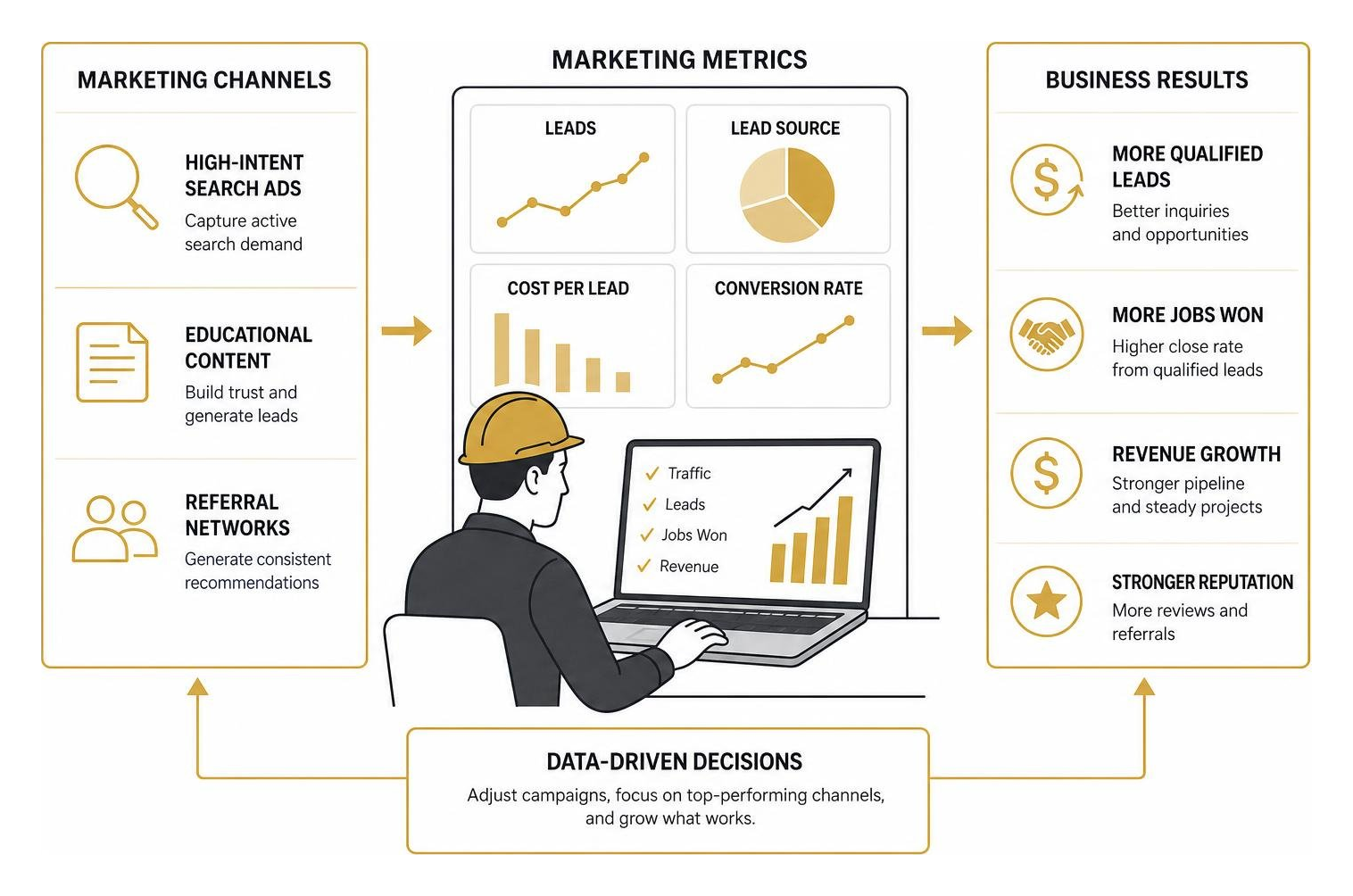
Transforming contractor marketing into an automated system works best in three structured 30-day stages:
| Phase | Core Objective | Key Deliverables |
|---|---|---|
| Days 1–30: Foundation | Clarify messaging and core web presence | Audit top-margin jobs, build dedicated service pages, optimize Google Business Profile |
| Days 31–60: Systemization | Automate lead capture and follow-up | Set up CRM pipeline, launch missed call text-back, establish review collection workflows |
| Days 61–90: Growth & Scale | Drive inbound volume and partnerships | Launch targeted PPC search ads, establish formal trade referral loops, publish local guides |
Contractors seeking complete setup and operational support can partner with us through customized growth packages.
Key Performance Indicators and Tracking Marketing for Small Construction Business
To manage marketing like an operator, track three fundamental numbers:
- Cost Per Lead (CPL): Total marketing spend divided by total leads generated.
- Lead-to-Customer Rate: The percentage of inquiries that convert into signed contracts.
- Customer Acquisition Cost (CAC): Total sales and marketing expenses divided by new clients acquired.
Tracking these numbers gives you complete visibility into project profitability, which is essential for maximizing ROI with a professional digital marketing strategy. Reviewing your metrics monthly ensures your marketing budget goes exclusively toward the campaigns and channels that produce verified returns.
Marketing results, lead volumes, search rankings, and revenue growth depend on local market conditions, service pricing, competition, and operational follow-up; individual business performance may vary and is not guaranteed.
Ready to build a reliable marketing system that delivers predictable projects for your business? Book a free strategy call with our team today at https://zbooking.us/dbOtP and let’s map out your growth blueprint.