Choosing a Bay Area Divorce Lawyer Starts With the Local Court
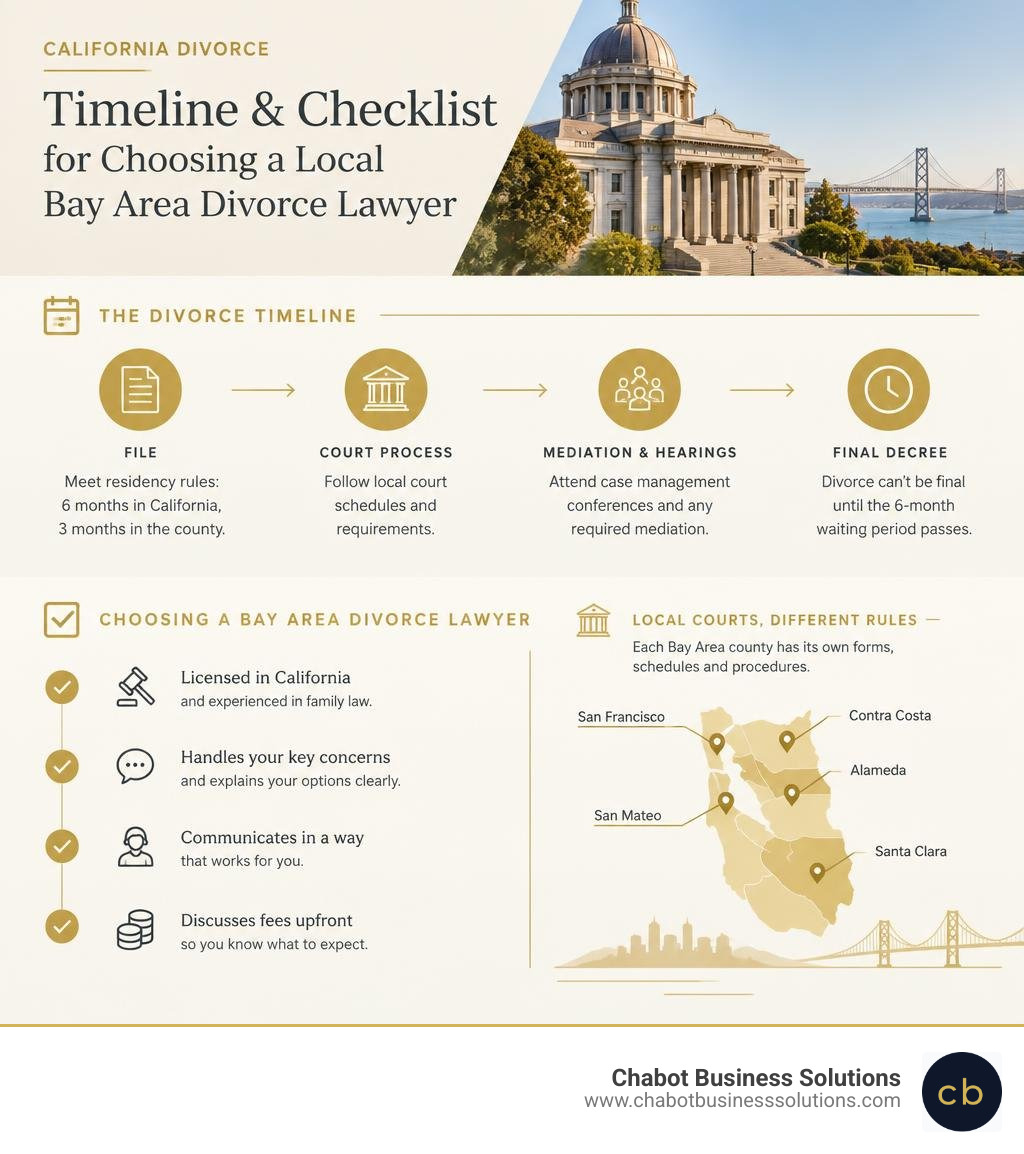
To find a Bay Area divorce lawyer, start with an attorney licensed in California who regularly handles family law cases in the county where you will file. Ask about their experience with your main concerns, how they communicate, and what you can expect to pay.
California sets the divorce rules, but local courts can differ in their forms, schedules, and custody mediation procedures. Before filing, at least one spouse generally must have lived in California for six months and in the filing county for three months. A divorce cannot become final until the required six-month waiting period has passed, even if you agree on everything sooner.
I’m Alyx Lofton, a Bay Area digital strategist with more than 20 years of experience helping business owners make clear decisions. I bring that research-focused approach to this guide so you can ask better questions when choosing a Bay Area divorce lawyer. For family law firms, a focused local SEO strategy helps connect that expertise with the clients who need it most.
How Bay Area County Family Courts Differ: SF, Silicon Valley, and East Bay
California family law applies across the entire state, but local county superior courts run day to day operations under their own unique local rules. Filing for divorce in San Francisco Superior Court feels very different from navigating proceedings in Santa Clara County, San Mateo County, Alameda County, or Contra Costa County.
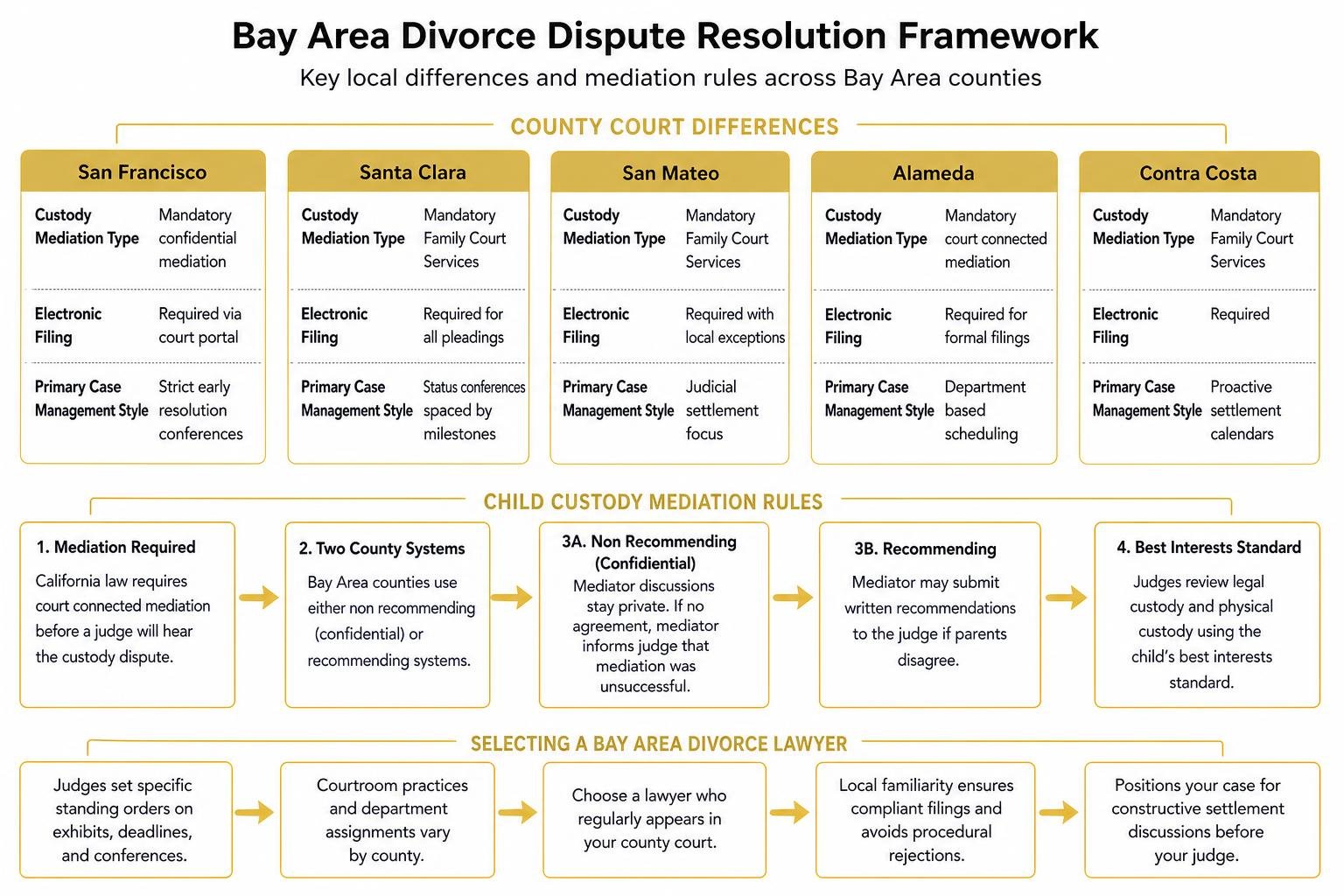
Each county sets specific requirements for case management conferences, preliminary document deadlines, and electronic filing mandates. For instance, San Francisco family courts heavily streamline online document submissions, whereas surrounding East Bay courthouses in Oakland or Hayward may handle motion calendar scheduling with distinct timelines. Understanding regional court workflows helps you prevent administrative delays and unnecessary court appearances.
| County Court | Custody Mediation Type | Electronic Filing | Primary Case Management Style |
|---|---|---|---|
| San Francisco | Mandatory confidential mediation | Required via court portal | Strict early resolution conferences |
| Santa Clara | Mandatory Family Court Services | Required for all pleadings | Status conferences spaced by milestones |
| San Mateo | Mandatory Family Court Services | Required with local exceptions | Judicial settlement focus |
| Alameda | Mandatory court connected mediation | Required for formal filings | Department based scheduling |
| Contra Costa | Mandatory Family Court Services | Required | Proactive settlement calendars |
Knowing the administrative rhythm of your local branch allows you to prepare accurate paperwork from day one. You can review official regional guidelines directly through the San Francisco Superior Court family division resources.
Child Custody Mediation Rules Across Bay Area Counties
When parents cannot reach an agreement regarding child custody and visitation, California law requires them to participate in court connected mediation before a judge will hear the dispute. However, individual Bay Area counties handle this process through two distinct systems: recommending counties and non recommending counties.
In confidential non recommending counties like San Francisco, discussions between parents and the Family Court Services mediator remain entirely private. If parents do not reach a mutual agreement, the mediator simply informs the judge that mediation was unsuccessful without submitting factual opinions. In contrast, recommending counties allow the mediator to submit formal written recommendations directly to the bench if parents disagree.
Judges review both legal custody (major health, education, and welfare decisions) and physical custody (day to day living schedules) using the standard of the child’s best interests. Working collaboratively to draft a sensible parenting plan early on keeps sensitive decisions within your family rather than placing them in the hands of the court.
Selecting a Bay Area Divorce Lawyer Familiar With Local Judges
Judicial temperament, department assignment protocols, and courtroom etiquette vary across Bay Area courthouses. Individual judges often establish specific standing orders regarding exhibit formats, motion filing deadlines, and mandatory settlement conference attendance.
An attorney who regularly appears in your specific county court understands these nuances. That direct familiarity ensures your filings comply with local preferences, prevents procedural rejections, and positions your case for constructive settlement discussions before your assigned judge.
Managing High-Asset Division: Tech Equity, RSUs, and Private Valuation
California functions as a strict community property state. Under state law, all earnings, real estate, debts, and assets acquired during the marriage are presumed to be community property owned equally (50-50) by both spouses. Separate property consists of assets owned before marriage, as well as gifts and inheritances received individually at any point.
In the tech heavy economy across Silicon Valley and the greater Bay Area, marital estates frequently involve complex compensation structures. Dividing these estates requires deep familiarity with:
- Restricted Stock Units (RSUs) with multi year vesting schedules
- Non qualified stock options and incentive stock options
- Carried interest and venture capital profit sharing rights
- Private equity capital calls and equity holdings
- Privately held startups and business enterprise valuations
- Commingled bank accounts requiring separate property financial tracing
Family law practitioners frequently coordinate with dedicated forensic accountants, business appraisers, and tax specialists to establish accurate valuations while protecting private business interests. When researching experienced legal counsel, you can review qualified professionals via the Super Lawyers directory of Bay Area family law attorneys.
Complex Property Division and Spousal Support Calculations
Temporary spousal support during the divorce process is often calculated using computerized guideline software such as DissoMaster. In contrast, long term or permanent spousal support awarded at final judgment depends on the comprehensive factors outlined in California Family Code Section 4320.
Under Family Code Section 4320, judges evaluate each spouse’s earning capacity, the established marital standard of living, contributions made to the other spouse’s education or career, marketable job skills, and the total duration of the marriage. Marriages lasting over ten years are classified as long term under California law, meaning courts retain ongoing jurisdiction over spousal support without a predetermined termination date.
Private Judging and Alternative Dispute Resolution Options
Many Bay Area residents choose alternative dispute resolution methods to resolve dissolutions outside public courtrooms. High net worth couples and tech executives often hire private judges, who are typically retired California Superior Court judges authorized to make binding rulings confidentially.
Other non adversarial paths include voluntary mediation and collaborative divorce. In collaborative practice, both spouses retain independent counsel and agree to settle all issues through guided meetings without court intervention. Even during traditional mediation, engaging independent mediation consulting counsel ensures your financial rights remain fully protected before you sign final marital settlement agreements.
Want a marketing partner who knows local service businesses? Book your free call: https://chabotbusinesssolutions.zohobookings.com/
Navigating California Divorce: Grounds, Timelines, and Legal Requirements

California operates entirely as a no fault divorce state. Spouses do not need to prove marital misconduct, infidelity, or fault to end a marriage; citing irreconcilable differences is sufficient legal grounds for dissolution.
Every California divorce requires a formal exchange of financial disclosures. Both parties must serve a Preliminary Declaration of Disclosure, accompanied by a detailed Schedule of Assets and Debts along with an Income and Expense Declaration supported by recent tax returns and pay stubs. Complete and candid transparency is mandatory under the law.
California family courts also handle essential protective measures, including domestic violence restraining orders (DVROs) and emergency child protective orders. In contested custody cases, judges may appoint a dedicated minor’s counsel to represent the independent legal interests of the children. Furthermore, family courts regularly interpret prenuptial and postnuptial agreements while applying established marriage equality rules to LGBTQ+ dissolutions.
Essential Criteria for Choosing a Bay Area Divorce Lawyer
Choosing the right attorney requires evaluating both technical qualifications and practical communication styles. In California, an attorney who has met rigorous state testing, extensive trial standards, and peer evaluations can earn recognition from the California Board of Legal Specialization as a Certified Family Law Specialist (CFLS).
Peer review credentials also provide objective benchmarks. For example, Super Lawyers selects only the top 5% of practicing attorneys statewide through independent peer review, while Rising Stars recognizes the top 2.5% of newer practitioners. You can also explore local neighborhood directories such as Justia legal resources for San Leandro and the East Bay to research local representation.
When retaining counsel, expect clear agreements regarding retainer fees, hourly billing rates for attorneys versus paralegals, and detailed billing statements. Preparing organized financial documentation, including bank statements, deeds, and tax filings, before your initial meeting helps make your legal consultation efficient and productive.
Questions to Ask When Interviewing a Bay Area Divorce Lawyer
- What percentage of your daily practice focuses specifically on California family law?
- Are you certified as a Family Law Specialist by the California State Bar?
- What is your typical approach to balancing negotiated settlements against courtroom litigation?
- Who in your office will handle daily communications, pleadings, and document drafting?
- How do you collaborate with forensic accountants and valuation specialists for complex assets?
- What retainer amount is required, and how are unused funds handled at case conclusion?
Common Mistakes to Avoid in Complex Dissolutions
- Concealing Assets: Failing to disclose accounts or assets can lead to severe court sanctions and loss of property rights.
- Overlooking Complex Vesting: Miscalculating stock option vesting schedules can distort community property division.
- Ignoring Tax Liabilities: Overlooking the future tax consequences of dividing retirement plans or liquidating real estate.
- Fueling Unnecessary Conflict: Engaging in aggressive courtroom battles over minor items quickly drains financial resources.
- Signing Without Independent Review: Finalizing mediation agreements without an independent lawyer reviewing your financial disclosures.
Frequently Asked Questions About Bay Area Family Law
How is child support calculated when one spouse receives fluctuating tech equity and bonuses?
California uses a statewide uniform guideline formula that calculates child support based on both parents’ net monthly disposable incomes and physical timeshare percentages. When income includes fluctuating bonuses, RSUs, or commissions, courts typically establish a baseline support amount from base salary and apply an Ostler-Smith percentage order. This requires the paying parent to pay a fixed percentage of any additional bonus or vested equity as child support upon receipt. If a parent voluntarily remains unemployed, courts may impute income based on earning potential.
Why is Certified Family Law Specialist status significant in California?
The Certified Family Law Specialist (CFLS) designation is awarded by the State Bar of California Board of Legal Specialization. To earn this credential, an attorney must pass a rigorous multi hour written examination, demonstrate extensive courtroom trial experience, receive favorable peer evaluations from judges and fellow lawyers, and complete ongoing advanced legal education in family law topics.
How long does a divorce take to finalize in the San Francisco Bay Area?
California law imposes a mandatory six month statutory waiting period that begins on the date the respondent spouse is formally served with the divorce petition. Even if spouses agree on all property and custody terms within weeks, the marital status cannot legally dissolve before that six month period expires. Contested divorces that require complex financial valuations or trial hearings often take twelve to eighteen months or longer to resolve.
Conclusion

Successfully navigating a divorce in the San Francisco Bay Area requires a clear understanding of state community property laws alongside the specific local procedures of your county superior court. Securing experienced legal counsel helps you protect hard earned assets, develop practical parenting arrangements, and transition into your next chapter with confidence.
Growing a distinguished professional practice requires the same strategic clarity as managing complex legal matters. Through targeted visibility systems like a customized local SEO strategy, established service providers can reliably connect with the clients who need their expertise most.
Marketing results vary from business to business. These strategies are based on our experience and industry best practices and are for informational purposes only. Chabot Business Solutions does not guarantee any specific ranking, lead volume, or revenue. Results depend on your market, industry, competition, budget, and timing.
Ready to bring in more of the right clients? Book a free strategy call with Chabot Business Solutions and we will build a plan around your goals: https://chabotbusinesssolutions.zohobookings.com/