
Why Marketing Systems for Growth Outperform Random Marketing Efforts
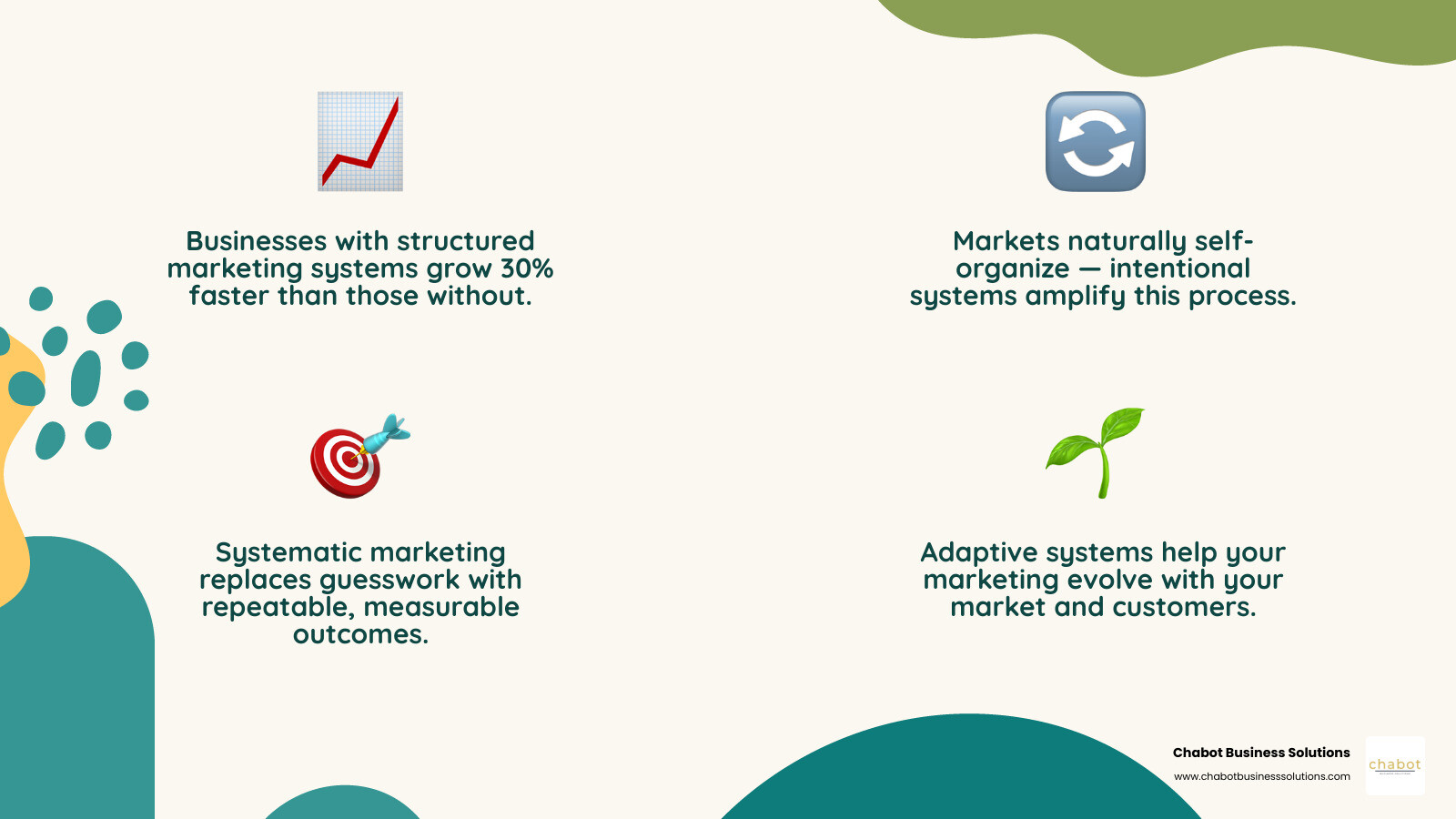
Marketing systems for growth are structured, repeatable frameworks that connect your marketing actions to consistent, measurable business results — instead of relying on one-off campaigns or gut instinct.
Here is what a marketing system does for your business:
- Generates leads consistently — not just when you remember to post or run an ad
- Connects individual actions to bigger outcomes — so every tactic serves a larger strategy
- Adapts over time — responding to shifts in your market, your customers, and your environment
- Replaces guesswork with process — giving your team clear steps to follow, every time
If your marketing feels scattered — some social posts here, an email there, maybe a paid ad when things slow down — you are not alone. Most small business owners spend money and energy on marketing without a system connecting any of it. The result is unpredictable leads, inconsistent revenue, and a lot of frustration.
Research in macromarketing shows that economic exchange in human communities naturally produces structured, collective outcomes over time. In other words, markets organize themselves. But the businesses that grow intentionally are the ones that build systems — rather than waiting for order to emerge on its own.
The difference between businesses that grow steadily and those that stay stuck is rarely effort. It is structure.
I’m Alyx Lofton, founder of Chabot Business Solutions, and over more than 20 years of hands-on work in digital strategy and client growth, I have seen how building real marketing systems for growth transforms a business from reactive to resilient. In the sections ahead, we will break down exactly how these systems work and how to build one that fits your business.
The Science Behind Marketing Systems for Growth
To build a marketing system that consistently brings in revenue, we have to look beyond basic advertising tactics. We need to understand the underlying science of how markets behave.
In academic research—specifically within macromarketing and analytical sociology—scholars like Roger Layton have spent decades studying how economic exchanges in human communities evolve into complex, adaptive systems. Layton’s research highlights that marketing systems are not static; they are dynamic, living networks that grow and adapt through continuous causal processes.
When you run a business in the East Bay CA, you aren’t operating in a vacuum. You are part of a local economic ecosystem. Every transaction, customer review, and competitor ad is part of a broader causal chain.
If you want to scale, you cannot view your marketing as a series of isolated events. Instead, you must design a structured environment where individual customer choices predictably lead to business-wide scaling. For a deeper look at how to structure these campaigns for maximum efficiency, check out our guide on Maximizing Roi With A Professional Digital Marketing Strategy.
Applying the MAS Framework to Marketing Systems for Growth
So, how do we make sense of this complexity? Macromarketing scholars use the Mechanism, Action, Structure (MAS) framework to explain how marketing systems form, grow, and adapt.
The MAS framework breaks down system growth into three interconnected layers:
- Mechanism: The underlying social and psychological drivers (e.g., trust, convenience, value perception) that influence customer behavior.
- Action: The micro-level choices made by individual actors—such as a customer deciding to click your link, or your team sending an email newsletter.
- Structure: The macro-level patterns, channels, and operational frameworks that emerge when those micro-level actions are repeated consistently.
In a healthy system, there is a continuous co-evolution between behaviors (actions) and beliefs (mechanisms), which ultimately solidifies into your business’s growth structure. When you align these three layers, your marketing stops being a series of chores and starts operating as a self-reinforcing engine. This structured philosophy is at the core of Our Approach, where we prioritize strategy and clarity over random execution.
The Core Causal Processes of System Formation
Marketing systems are not artificial inventions; they are natural extensions of economic exchange in human communities. Throughout history, whenever people have gathered, they have formed trade networks to solve problems and exchange value.
At first, these exchanges are informal and chaotic. Over time, however, organic scaling takes place. Patterns emerge, paths are cleared, and rules are established. This is how primitive trade networks transform into highly structured, adaptive systems.
For your business, the goal is to mirror this natural evolution. By systematizing your processes, you transition from manual, erratic exchanges to an organized, adaptive system that can withstand economic shifts and competitive pressures.
How Social Mechanisms and Strategic Action Fields Drive Change
Systems do not change simply because we want them to; they change because of social mechanisms that link individual choices to collective market shifts. In any market, three primary social mechanisms dictate how participants behave:
- Cooperation: Partnering with complementary businesses, platforms, or customers to expand reach.
- Competition: Striving to offer better value, faster delivery, or superior positioning than rivals.
- Imitation: Observing what works for industry leaders and adapting those practices to your own business.
These mechanisms operate within what sociologists call strategic action fields—the competitive arenas where businesses vie for material rewards (like revenue and market share) and status rewards (like brand authority and industry recognition).
To navigate these fields, modern brands use advanced platforms like GrowthLoop | Agentic composable CDP to orchestrate data, understand competitive dynamics, and respond to market shifts in real time.
Linking Individual Actions to Collective Outcomes
The magic of a true growth system lies in its ability to translate micro-level choices into predictable macro-level structures.
Consider this: a single consumer behavior—like a customer reading a blog post or clicking a local search result—seems small. But when your system is designed correctly, thousands of these micro-actions aggregate into predictable outcomes, such as a steady 15% month-over-month increase in inbound leads.
By understanding the social mechanisms of your target audience, you can construct a system that guides individual prospects through a predictable path, transforming chaotic consumer behavior into stable market dynamics.
The Co-Evolution of Tangible and Intangible System Elements
A successful marketing system requires a balance of both tangible and intangible elements. These elements must co-evolve; otherwise, the system breaks down.
- Tangible Structures: These are your physical and digital tools—your CRM, your website, your email marketing software, and your documented workflows.
- Intangible Beliefs and Social Practices: This is your brand DNA, customer trust, team culture, and the shared understanding of your value proposition.
If you purchase the most expensive marketing software (tangible) but lack a clear brand message or a deep understanding of your customer’s pain points (intangible), your system will fail. Conversely, having a great reputation but no operational structure to capture leads will keep your business small.
System innovation occurs when these two sides grow together. As your tools improve, your understanding of your customers deepens, allowing you to refine our services to match their evolving needs.
How Systems Respond to Broader Environmental Contexts
No marketing system exists in isolation. Your business system constantly responds to, and is influenced by, its broader environmental contexts:
- Social Contexts: Shifting cultural values, such as a growing demand for ethical sourcing or local community support in the East Bay.
- Economic Shifts: Inflation, interest rate changes, or local employment trends that affect purchasing power.
- Environmental Constraints & Sustainability Barriers: Regulatory changes, resource limitations, or eco-conscious consumer preferences.
An adaptive marketing system is designed with feedback loops that sense these external changes early, allowing you to pivot your messaging and operations before your competitors do.
Building an Intelligent Marketing Operating System (I-MOS)
In 2026, the frontier of marketing is no longer about running isolated, manual campaigns. It is about building an Intelligent Marketing Operating System (I-MOS).
An I-MOS is a connected, AI-assisted architecture where sensing, deciding, and acting operate in a continuous loop. Instead of manually launching campaigns and guessing what works, an intelligent system uses data signals to automatically adjust your marketing workflows.
| Feature | Traditional Marketing Campaigns | Intelligent Marketing Operating System (I-MOS) |
|---|---|---|
| Execution | Manual, fragmented, and project-based | Automated, continuous, and integrated |
| Data Usage | Periodic reviews of historical dashboards | Real-time signal triangulation and sensing |
| Targeting | Static demographic segmentation | Dynamic, behavior- and intent-based targeting |
| Content | Static, one-size-fits-all assets | Modular content assembled in real time |
| Optimization | Periodic manual adjustments | Continuous machine learning & experimentation |
By transitioning to an intelligent system, you can leverage signal triangulation—combining behavioral, intent, qualitative, and environmental signals—to build deep customer intelligence. To understand how AI is reshaping this landscape, explore our insights on Embracing Ai In Your Marketing Strategy For 2025 A Game Changer For Businesses and learn how to Work Smarter Not Harder Embracing Ai For Business Success.
Designing Modern Marketing Systems for Growth
Designing an I-MOS requires a shift from linear marketing funnels to state-based journeys. Instead of forcing every prospect through the exact same sequence, your system adapts to the prospect’s current state.
To do this effectively, we start by defining your Ideal Customer Profile (ICP) using a simple, powerful formula:
$$\text{ICP} = \text{Fit} \times \text{Readiness} – \text{Friction}$$
- Fit: How well does the prospect match your business’s core offerings?
- Readiness: Are they actively looking for a solution right now?
- Friction: How difficult is it to reach, sell to, or onboard them?
By utilizing signal-based segmentation, your system automatically identifies where a prospect sits in this equation and triggers the appropriate marketing workflows to move them forward.
Transitioning from Legacy Systems to Intelligent Workflows
Transitioning from legacy systems to automated workflows does not have to happen overnight. It begins by laying a solid foundation with a robust Customer Relationship Management (CRM) platform. If you are still managing leads on spreadsheets, read our guide on Why Every Business Needs A Crm To Go With Your Sales And Marketing Plan.
Once your CRM is in place, you can gradually introduce agentic AI services to handle repetitive tasks. However, when introducing automation, always consider the economics of error.
Define clear boundaries for your automated tools, establish governance zones, and implement kill-switch protocols to ensure your AI agents never misrepresent your brand or breach compliance guidelines.
Overcoming Challenges and Managing Systemic Interventions
Intervening in or upgrading a marketing system can feel like working on an airplane engine mid-flight. If you change too many variables at once, you risk disrupting your current revenue streams.
To manage these changes safely, we focus on identifying and optimizing the core feedback loops in your business. We shift our primary measurement metrics from generic vanity metrics (like clicks or impressions) to incrementality and incremental Return on Ad Spend (iROAS). This allows us to isolate the exact impact of our marketing interventions and ensure they are driving true, sustainable growth.
If you are ready to stop guessing and start building a structured growth engine, explore our Services/Marketing Strategy Planning page or view our comprehensive Growth Packages designed for businesses looking to scale.
Tailoring Systems for Local and Niche Markets
A common mistake is trying to apply enterprise-level, generic marketing templates to local or highly specialized niche markets. A local service business in San Leandro or the East Bay CA does not need the same system architecture as a global SaaS company.
For local businesses, your system must prioritize local SEO, regional reputation building, and community-centric touchpoints. For example, if you run a local service business, your customer journey will heavily rely on trust, Google Business Profile optimization, and local referral loops.
To see how this works in practice for a specific niche, take a look at our step-by-step guide on Creating A Marketing Plan For Your Beauty Salon.
Frequently Asked Questions
What is the MAS framework in marketing?
The Mechanism, Action, Structure (MAS) framework is an analytical sociology model used to explain how marketing systems form and adapt. It links micro-level individual choices (Actions) driven by psychological or social drivers (Mechanisms) to the macro-level patterns and channels (Structures) that emerge over time.
How do social mechanisms drive marketing system growth?
Social mechanisms like cooperation, competition, and imitation shape how businesses and consumers interact. When businesses cooperate, compete for rewards, or imitate successful strategies, they naturally drive system-wide innovation and adaptation, establishing new market standards.
Why should small businesses transition to structured marketing systems?
Transitioning to structured systems eliminates operational chaos and predictable revenue plateaus. It replaces manual, erratic tasks with repeatable, automated workflows, allowing business owners to scale their operations, improve efficiency, and secure sustainable growth.
Conclusion
Building marketing systems for growth is the single most effective way to transition your business from a state of constant, reactive hustle to structured, predictable scaling.
At Chabot Business Solutions, based right here in San Leandro, CA, we believe in a strategy-first, clarity-driven approach. We help local and regional businesses cut through the digital noise, simplify their operations, and build robust marketing systems that deliver sustainable, long-term growth.
Stop winging your marketing. Let us help you build a system that works for you. Explore our Ongoing Marketing Management services today, and let’s start systematizing your path to success.