
Why Google Ads Performance in the East Bay Is Harder Than It Looks
Google Ads performance in the East Bay is one of the fastest ways to grow a local business — or drain your budget without a single new customer to show for it.
Here is a quick answer if you need it now:
To improve Google Ads performance in the East Bay:
- Set tight geo-targeting focused on your specific service area (Oakland, San Leandro, Fremont, etc.)
- Build tightly grouped ad groups around closely related keywords
- Match your landing page to the exact promise in your ad
- Monitor CTR and Quality Score weekly to catch waste early
- Use Google Trends to find when East Bay customers are searching for what you offer
- Set a firm daily budget at the campaign level before you go live
Most small business owners launch Google Ads with good intentions and a modest budget. Then the clicks come in, the leads do not, and the money disappears. It is not a Google problem. It is a setup and strategy problem — and it is extremely common.
The honest truth? Google’s own official documentation is so vast that reading all of it would take more than a month of full-time effort. Nobody has time for that. What East Bay business owners do have is the need for clear, practical guidance they can act on right now.
That is exactly what this guide is built to deliver.
I am Alyx Lofton, founder of Chabot Business Solutions, and I have spent more than 20 years helping business owners navigate digital strategy — including building and optimizing Google Ads campaigns that actually move the needle on Google Ads performance in the East Bay. Everything in this guide comes from real experience working alongside local founders, not theory.
The Local Landscape of Google Ads Performance East Bay
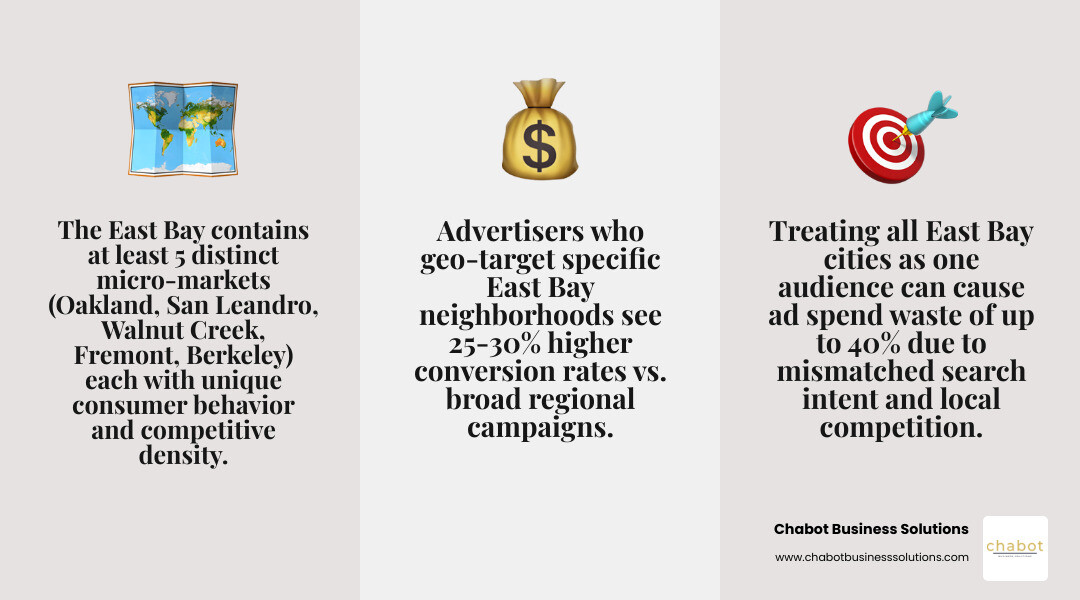
The East Bay is not a single, uniform market. It is a diverse collection of micro-markets, each with its own demographic profile, consumer behaviors, and competitive density. If you treat Oakland, San Leandro, Walnut Creek, and Fremont as if they are the exact same audience, your ad budget will disappear faster than a warm afternoon breeze off the San Francisco Bay.
When we talk about Google Ads performance in the East Bay, we have to look at how local geography and regional competition shape your cost-per-click (CPC). In highly populated hubs like Oakland, you are competing against both massive national brands and aggressive local service providers. However, if your business is based in San Leandro, trying to capture leads in Oakland might cost you three times as much as securing high-intent searchers right in your backyard.
Consumer behavior also shifts across these micro-markets. For example:
- A homeowner in San Leandro searching for “plumbing repair” is often looking for a fast, reliable local specialist who can arrive today.
- A business in Oakland searching for “commercial IT services” might have a much longer decision-making cycle, requiring a search campaign that nurtures them over several weeks.
If you fail to adjust your geographic targeting, ad copy, and bidding strategies to match these micro-regional nuances, you will end up paying for clicks from searchers who have no intention of traveling to your business or hiring someone outside their immediate neighborhood. This is why local context is everything. To dive deeper into why localized targeting makes or breaks your marketing, check out our guide on Why A Local Seo Agency Understands Your Market Best.
Key Metrics to Measure Local PPC Success
To stop wasting money, you have to know which numbers actually matter. Many business owners get distracted by “vanity metrics” like total impressions. While it feels great to know your ad was displayed 10,000 times, impressions do not pay the bills.
To truly measure your Google Ads performance in the East Bay, you must focus on the core metrics that dictate your return on investment (ROI):
- Clickthrough Rate (CTR): This is the percentage of people who see your ad and actually click on it. A low CTR means your ad copy is not resonating with what the user searched for, or you are targeting the wrong keywords entirely.
- Cost-Per-Click (CPC): The actual price you pay each time a user clicks your ad. This is heavily influenced by regional competition and your Quality Score.
- Quality Score: Google’s rating (on a scale of 1 to 10) of the relevance and quality of both your keywords and your PPC ads.
- Ad Rank: This determines where your ad appears on the search results page (or if it appears at all).
Your Ad Rank is not just about who has the deepest pockets. It is a dynamic calculation determined by a combination of your maximum CPC bid and your keyword’s Quality Score. This means a smart local business with a high Quality Score can outrank a competitor with a much larger budget.
| Quality Score Factor | What It Measures | Impact on Ad Rank & CPC |
|---|---|---|
| Expected Clickthrough Rate | How likely Google thinks your ad is to be clicked when shown. | High expected CTR lowers your CPC and boosts Ad Rank. |
| Ad Relevance | How closely your ad text matches the searcher’s intent. | Highly relevant ads ensure you do not pay for useless clicks. |
| Landing Page Experience | How helpful, fast, and easy to navigate your website is. | Great landing pages increase conversions and Quality Score. |
By mastering these metrics, you can systematically lower your advertising costs while driving higher-quality leads. For a complete breakdown of the key performance indicators you should be watching, read our detailed article on Seo Ppc Success Kpis Local Businesses Should Track.
Maximizing Quality Score for Google Ads Performance East Bay
To get the most out of your budget, you must optimize your Quality Score. Google wants to show searchers the most relevant results possible. If your ads provide a seamless, highly relevant journey from the initial search query to the final click, Google rewards you with lower costs and better ad placements.
This journey relies on three key elements:
- Ad Relevance: Ensure your ad copy directly addresses the search query. If someone searches for “commercial electrical repair San Leandro,” your ad headline should say exactly that—not a generic “Bay Area Electrician” headline.
- Landing Page Experience: Your landing page must load quickly, be easy to navigate on mobile devices, and deliver exactly what the ad promised.
- Display URL vs. Destination URL:
- The Display URL is the address searchers see on your ad (e.g.,
www.yourbusiness.com/San-Leandro-Repair). It should be clean, easy to read, and indicate relevance. - The Destination URL (or final URL) is the actual, specific page on your website where the user lands after clicking (e.g.,
www.yourbusiness.com/services/commercial-electrical).
- The Display URL is the address searchers see on your ad (e.g.,
Never send all your paid traffic to your homepage. If a user clicks an ad for a specific service, they should land on a page dedicated exclusively to that service. If you need official troubleshooting or advanced technical guidelines on structuring these elements, you can always consult Google Ads Help.
Strategic Tools and Best Practices for East Bay Campaigns
Building a high-performing campaign requires the right tools and a structured approach. You do not need to guess what your customers are searching for; Google provides the data if you know where to look.
To build a solid foundation for your Google Ads performance in the East Bay, start with these three pillars of campaign setup:
- Keyword Planner: Use this tool to discover local search volumes, estimate historical CPCs, and build a list of high-intent keywords. Focus on terms that show buying intent (e.g., “hire concrete contractor Oakland”) rather than purely informational terms (e.g., “how to pour concrete”).
- Tightly Themed Ad Groups: Avoid the temptation to dump fifty keywords into a single ad group. Instead, group related keywords into highly focused clusters of 5 to 10 terms. Create custom ad copy for each group.
- Negative Keywords: This is your strongest shield against wasted ad spend. By adding negative keywords (such as “free,” “jobs,” “definition,” or “DIY”), you prevent your ads from showing up when people are not looking to buy.
Additionally, always define a strict daily budget at the campaign level. This ensures you control your spend and do not wake up to an unexpected bill.
If you are wondering if pay-per-click is the right move for your current business stage, our guide on When And Why A Business Should Utilize Ppc Advertising offers excellent strategic clarity.
Leveraging Google Trends to Boost Google Ads Performance East Bay
Another incredibly powerful tool is Google Trends. It allows you to analyze and compare search volume patterns across specific geographic regions, categories, and timeframes.
For East Bay businesses, Google Trends helps you identify seasonal spikes in local demand. For instance, if you run a landscaping or HVAC business, you can look at historical data to see exactly when search queries for “AC repair” or “yard cleanup” start to climb in the East Bay.
By identifying these regional search patterns, you can plan your budget allocation strategically. Instead of spending the same amount of money every month, you can pull back your budget during slow seasons and aggressively increase your daily spend right before peak demand hits.
For local business owners looking to learn more about digital marketing and networking in our community, the East Bay SBDC is a fantastic local resource that provides curated educational opportunities and support.
Frequently Asked Questions About East Bay PPC
What is a good CTR for East Bay local service ads?
While industry averages hover around 3% to 5% for search ads, local service providers in the East Bay should aim for a clickthrough rate of 6% or higher. Because local service searches are highly transactional (e.g., “tow truck near me”), a tightly targeted ad with local copy will naturally earn a much higher CTR.
How does regional competition affect my CPC in the East Bay?
The East Bay is a competitive hotspot. Because we are situated next to major tech and business hubs, the cost-per-click for highly competitive industries (like legal, real estate, and home services) can be driven up by larger regional players. To keep your CPC manageable, focus on long-tail local keywords (e.g., “residential roofing contractor San Leandro”) rather than broad terms (e.g., “roofing”).
Should I use SEO or PPC for my East Bay business?
The short answer: both are valuable, but they serve different purposes. PPC is like a faucet—you turn it on, and you get immediate traffic and leads, but you pay for every drop. SEO is like planting an orchard—it takes time to grow, but once it matures, it provides a steady stream of traffic for years to come.
If you need leads today, start with PPC. If you want to build long-term, sustainable authority, invest in SEO. To see how these two strategies compare and how to balance your budget between them, read our breakdown on Seo Vs Ppc Choosing The Right Strategy For Your Business Growth.
Conclusion
Improving your Google Ads performance in the East Bay is not about outspending the competition; it is about outsmarting them. By focusing on tight local targeting, optimizing your Quality Score, structuring your ad groups properly, and keeping a close eye on your metrics, you can stop wasting your ad spend and start driving real, measurable growth.
At Chabot Business Solutions, we take a strategy-first, clarity-driven approach to digital marketing. Based right here in San Leandro, we design focused marketing systems that cut through the noise, simplify your advertising, and support sustainable business growth.
Ready to stop guessing and start scaling your local leads? Let’s build a campaign that works for you. Explore our Services/Paid Advertising Ppc/ to see how we can transform your Google Ads performance today.