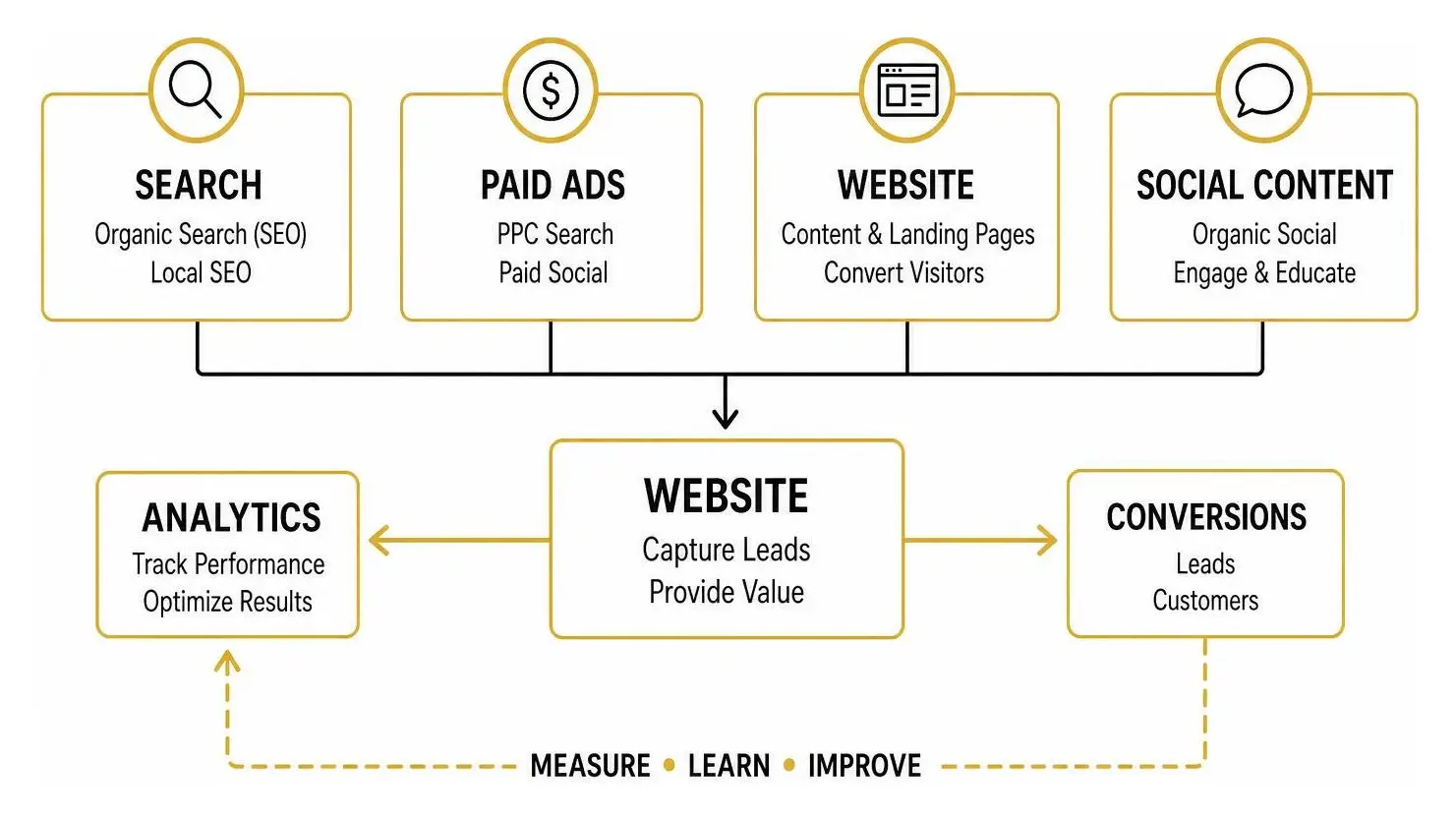
Essential Components of Marketing Management for Small Business
Effective marketing management for small business relies on three primary elements: clear strategy, deep market research, and actionable goal setting. Without a solid plan, you end up throwing money at disconnected tactics that fail to deliver a consistent return.
A structured strategy ensures that every dollar and hour you invest serves a distinct purpose. By establishing SMART objectives (goals that are specific, measurable, achievable, relevant, and time bound), you create direct accountability across your entire sales and marketing pipeline. Setting real targets helps you track month over month growth and identify bottlenecks before they hurt your bottom line.
Target Audience and Brand Strategy in Marketing Management for Small Business
Understanding who you serve is the single most effective way to eliminate wasted effort. When you try to appeal to everyone, your messaging becomes diluted and fails to connect with anyone. Deep market research allows you to speak directly to the exact challenges your prospective customers face every day.
Start by creating detailed buyer personas that outline customer demographics, common objections, buying triggers, and core pain points. Research shows that 66 percent of customers expect companies to understand their unique needs and expectations. Defining these traits allows you to craft a unique value proposition that sets your brand apart from local competition.
Clear brand positioning clarifies your promise to the marketplace and builds long term trust. For deeper insights on building a complete brand framework, review The Ultimate Guide to Small Business Marketing in 2026 – Forbes Advisor.
Key Channels for Digital Growth
Navigating modern digital marketing channels can feel overwhelming for a busy owner. To maximize impact without overextending your resources, focus on a core set of digital channels that drive predictable results:
- Pay Per Click Advertising: Paid search and paid social ads place your brand directly in front of ready to buy customers when intent is highest. This delivers fast visibility and immediate lead flow.
- Local SEO: Optimizing your Google Business Profile and local directory listings helps nearby prospective buyers find your services easily in East Bay CA and surrounding areas.
- On Page and Off Page SEO: Strong on page structure and high quality backlinks build long term domain authority. The top search result on Google earns roughly 29 percent of user clicks, making search ranking critical.
- Web Design and Web Dev: Over 99 percent of marketers plan to use their website as a central marketing hub. A fast, modern website turns interested visitors into qualified inquiries.
- AI Driven Social Media Content Creation: Leveraging modern software lets you create consistent, on brand social messaging without sacrificing hours of manual work.
Selecting the proper mix depends on your budget, business model, and timeline. For ongoing support in managing these initiatives seamlessly, explore our Services/Ongoing Marketing Management/ programs.
Tools and Technology for Marketing Management for Small Business
Modern tools make executing your plan manageable, even for small teams. The goal is not to buy every piece of software available, but to build an integrated technology stack that saves time and automates repetitive tasks.

A central Customer Relationship Management (CRM) platform is essential for tracking leads, logging interaction history, and segmenting your contact list. Pairing your CRM with Google Analytics and a centralized content calendar ensures that your campaigns run on schedule and remain measurable.
When your technology stack works together, your team spends less time copying data between tools and more time serving clients. To learn more about how client databases streamline growth, check out our guide on Why Every Business Needs A CRM To Go With Your Sales And Marketing Plan/.
Measuring ROI and Integrating Sales with Marketing Operations
To protect your bottom line, marketing cannot run in isolation. Managing marketing effectively requires evaluating financial metrics and aligning campaigns with daily business operations.
Tracking Performance Metrics and ROI
Measuring marketing ROI prevents budget waste and highlights which channels generate real profits. Instead of tracking vanity metrics like simple impressions or likes, direct your attention toward numbers that drive actual revenue into your bank account.
Key performance metrics every business owner should monitor include:
- Customer Acquisition Cost (CAC): The total spend required to acquire a single paying customer across marketing and ad spend.
- Conversion Rates: The percentage of website traffic or lead inquiries that convert into paying clients or revenue.
- Customer Lifetime Value (LTV): The total revenue a customer generates throughout their entire relationship with your brand.
Comparing customer acquisition costs against lifetime value provides clear proof of campaign health. When your LTV is significantly higher than your CAC, scaling up ad spend becomes a predictable investment rather than a gamble. For federal guidelines on structuring promotional activities, read the Marketing and sales | U.S. Small Business Administration guide.

Unifying Sales, Marketing, and Operations
Marketing strategies fail when internal departments work in silos. If your marketing campaign generates fifty new inquiries but your sales process lacks follow up bandwidth or standard procedures, potential revenue vanishes immediately.
Aligning sales, marketing, and customer fulfillment creates a smooth experience for every customer. Operational factors like staff response times, service quality, and consistency directly shape your brand reputation and repeat business. Regular operational check ins help teams address sales pipeline gaps before they cause customer churn.
At Chabot Business Solutions, located in San Leandro CA, we take a strategy first approach to help local business owners simplify complex systems and maintain clarity across all client touchpoints. We help you connect your messaging with effective operational workflows so every lead is handled with care.
Disclaimer: Marketing results vary from business to business. The strategies described here are based on our experience and industry best practices, and they are shared for informational purposes only. Chabot Business Solutions does not guarantee any specific outcome, ranking, lead volume, or revenue figure. Results depend on many factors, including your market, competition, budget, and timing, and past performance does not guarantee future results. Any timelines mentioned are estimates, not promises.
Ready to turn this into real results for your business? Let’s talk. Discover how our Ongoing Marketing Management Services can help you map out a custom growth strategy. Book a free strategy call with Chabot Business Solutions today.