
Why Your Digital Channel Strategy Determines Whether Marketing Works
A solid digital channel strategy is the difference between marketing that compounds over time and marketing that just burns budget.
Here’s a quick answer if you need it fast:
What is a digital channel strategy? A documented plan that defines which online channels your business will use, how those channels work together across the buyer journey, and how each one is measured against real business outcomes like leads and revenue.
The core channels most businesses should consider:
- Search (SEO and paid search) — captures people actively looking for what you offer
- Paid advertising (PPC, display, social ads) — accelerates reach when organic isn’t fast enough
- Content marketing — fuels search visibility and nurtures buyers over time
- Social media — builds relationships, trust, and brand awareness
- Email — your most owned, highest-ROI channel ($36 return per $1 spent on average)
- SMS and push notifications — high-urgency, direct-to-device messaging
Every week there’s a new channel someone says you have to be on. SEO. TikTok. Email. LinkedIn. Paid ads. Podcasts. YouTube. The list never shrinks.
And yet nearly half of all companies still don’t have a defined digital marketing strategy guiding any of it.
That’s not a channel problem. That’s a focus problem.
Without a clear strategy, you end up with what one marketing framework calls content chaos — activity everywhere, traction nowhere. You’re posting, emailing, and advertising, but nothing connects, nothing compounds, and you have no idea what’s actually driving growth.
The businesses that win aren’t doing more. They’re doing fewer things better — and they’ve built a deliberate system around how their channels work together.
I’m Alyx Lofton, founder of Chabot Business Solutions, and after more than 20 years helping business owners build and refine their digital channel strategy, I’ve seen how clarity around channel selection transforms scattered marketing efforts into a sustainable growth engine. Let’s walk through exactly how to build that clarity for your business.
What is a Digital Channel Strategy and Why It Matters

A winning digital channel strategy is not a list of social media platforms or a collection of ad campaigns. It is a structured methodology for prioritizing customer-facing touchpoints. It ensures that every marketing dollar you spend is channeled into the touchpoints where it creates the highest mutual value for both your customer and your business.
Why is this so critical in July 2026? Because rapid advancements in digital technology have raised customer expectations to what can only be described as prohibitive levels. Buyers no longer compare your digital experience only to your direct competitors; they compare you to the best digital experiences they have ever had.
If your channels operate in silos—where your social media messaging feels disconnected from your email newsletter, or your online pricing clashes with your physical sales approach—you create friction. Friction kills conversions.
To drive sustainable business growth, you must design a framework that coordinates your channels. When you align your channels, you move from disjointed tactics to a structured, high-performing marketing ecosystem. This strategic alignment is the key to Maximizing ROI with a Professional Digital Marketing Strategy.
However, you cannot apply a single, blanket strategy across your entire organization if you sell to different customer segments. As detailed in the Harvard Business Review guide on how to Tailor Your Digital Strategy to Reach Every Customer, companies rarely sell in just one way. If you manage a direct-to-consumer model alongside a business-to-business enterprise model, they require entirely different digital tools and channel combinations. The secret is tailoring your digital strategy to support each individual go-to-market model rather than forcing a one-size-fits-all solution.
Aligning Your Digital Channel Strategy with Customer Buying Behavior
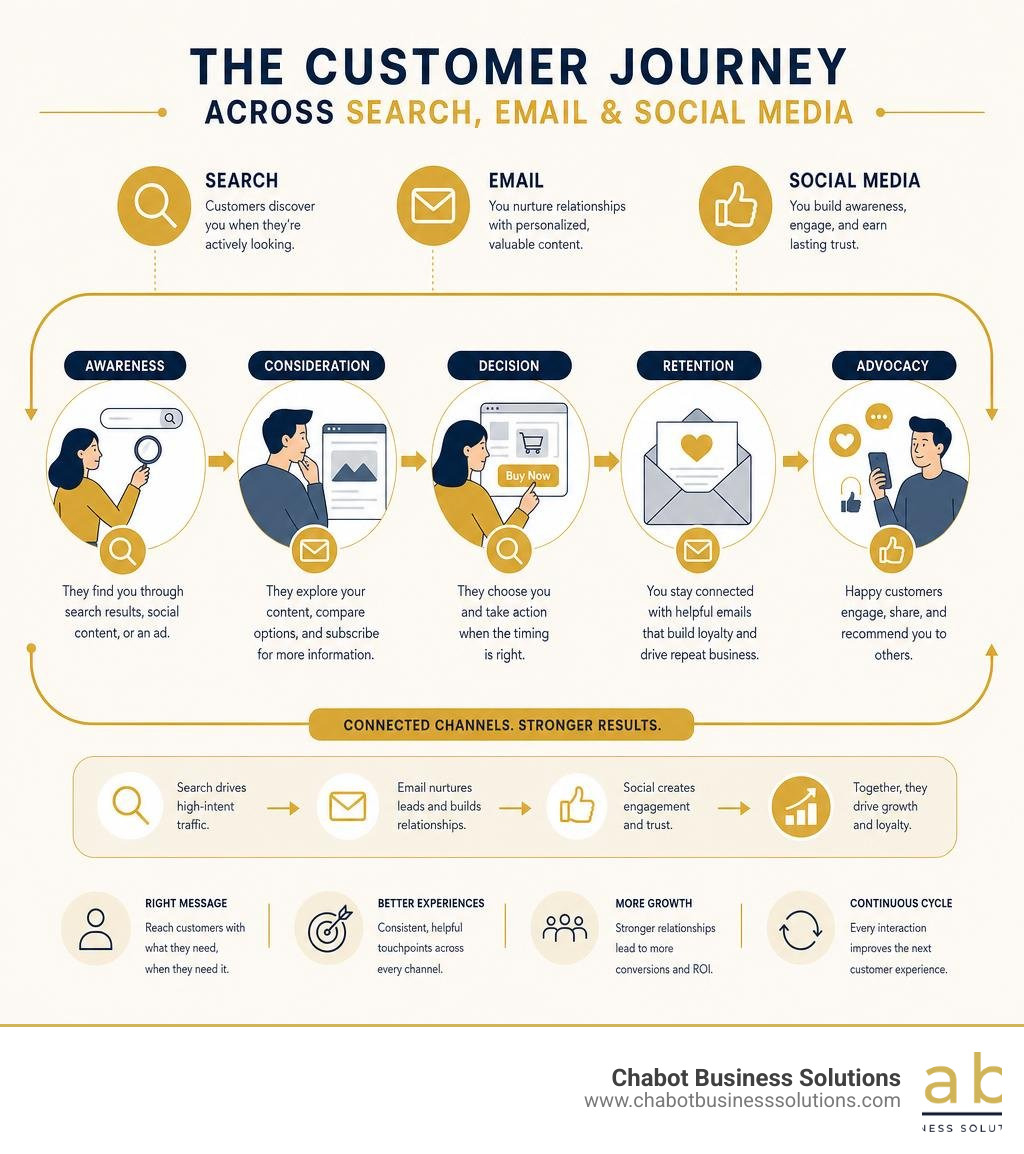
Before choosing your channels, you must understand your audience architecture. Static, demographic-based buyer personas are no longer enough in 2026. Instead, we must map dynamic, behavioral customer journeys based on real-time search intent and decision-making processes.
Every buyer moves through distinct phases:
- Discovery (Top of Funnel): The buyer realizes they have a problem and begins looking for solutions.
- Consideration (Middle of Funnel): The buyer compares different approaches, evaluates brands, and reads resources.
- Conversion (Bottom of Funnel): The buyer is ready to make a purchase decision based on trust and convenience.
- Advocacy (Post-Purchase): The customer becomes a loyal brand promoter.
Your digital channels must be mapped directly to these stages. For instance, search engines are highly effective at capturing high-intent buyers who are actively looking for solutions right now. On the flip side, social media is excellent for building relationships and initial discovery when active search intent is low. By structuring your channels to meet customers exactly where they are in their journey, you are successfully Adapting Digital Marketing for the Next Consumer Generation.
The Role of Owned, Earned, and Paid Media
To build a balanced digital ecosystem, we must look at how we categorize our channels. A healthy digital channel strategy balances three core media types:
- Owned Media: This includes your website, email lists, and mobile apps. You have total brand control over these channels. They are your most valuable long-term assets because you do not have to pay a third-party platform to reach your audience.
- Paid Media: This includes pay-per-click ads, social media advertising, and sponsored content. Paid media acts as an accelerator, helping you acquire new customers and scale your reach quickly while you build up your organic channels.
- Earned Media: This includes organic social shares, public relations, reviews, and word-of-mouth. Earned media is the ultimate builder of trust and credibility, though you have the least direct control over it.
A common mistake is over-investing in paid channels at the expense of owned assets. If a sudden algorithm change or ad platform policy shift occurs, your customer acquisition cost (CAC) can skyrocket overnight. By utilizing resources like the Bay Area Digital Marketing Solutions – Media landscape, we can blend local owned-and-operated media opportunities with paid amplification to build a resilient, highly visible brand presence.
The SES Framework: Selecting the Right Mix of Digital Channels
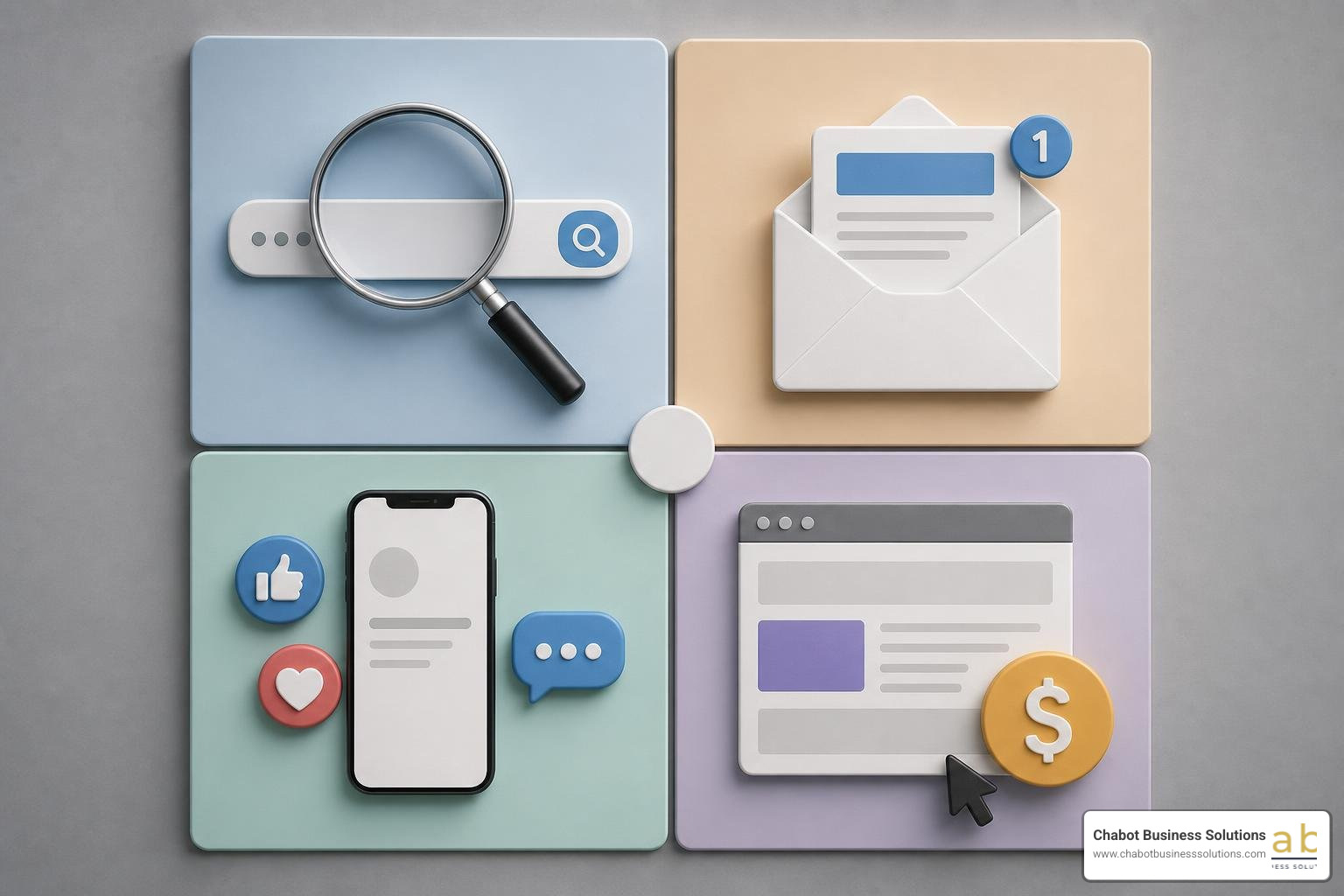
When business owners look at the sheer number of digital channels available, it is easy to feel overwhelmed. To prevent channel overload, we advocate for a simplified, highly effective approach called the SES Framework: Search, Email, and Social.
By focusing on these three core pillars, even small businesses can cut through the noise and build a highly competitive marketing engine. This framework is a primary way How Small Businesses Can Compete with Big Brands Using Digital Marketing without needing a massive enterprise budget.
Search: Capturing High-Intent Demand
Organic search remains the undisputed giant of digital discovery, driving 53% of all trackable website traffic. If people are actively looking for what you sell, search marketing must be a priority in your strategy.
However, the search landscape has shifted dramatically. About 18% of Google searches now trigger an AI summary, and when an AI summary is shown, user clicks to traditional organic search results fall from 15% to just 8% (nearly half). To survive in this “zero-click” search environment, your content must be deeply authoritative, structured to answer direct user questions, and focused on building direct-to-consumer relationships.
Furthermore, local search has become incredibly powerful. “Near me” mobile searches that include transactional terms like “can I buy” or “to buy” have grown by more than 500% over a two-year period. For businesses operating in California, capturing this local intent is vital.
Whether you are optimizing your Google Business Profile to rank in the local map pack or working with local regional directories, local visibility is a must. If you are looking for local marketing support or analyzing the competitive landscape in the East Bay, you can review resources like THE BEST 10 MARKETING IN SAN LEANDRO, CA to ensure your local search presence is fully optimized.
Email, SMS, and Push: Nurturing Owned Audiences
Once a visitor finds you through search, you must convert that anonymous traffic into an owned audience. This is where direct-to-device channels shine.
| Channel | Key Strength | Primary Weakness | Best Use Case | Typical Frequency |
|---|---|---|---|---|
| Highest ROI ($36 for every $1 spent); total control over content and formatting. | Deliverability challenges; crowded inboxes. | Newsletters, educational content, detailed promotions. | 1-3 times per week | |
| SMS | Extremely high open rates (98%); immediate visibility and action. | Strict regulations; risk of annoying users if overused. | Urgent alerts, flash sales, shipping updates. | 2-4 times per month |
| Mobile Push | 100% deliverability; bypasses carrier regulations; high urgency. | Disappears once tapped; requires an app. | Real-time updates, app-exclusive discounts. | 1-2 times per day (highly targeted) |
Building these audiences is incredibly valuable because customers who opt into multiple marketing channels are significantly more engaged and loyal. However, we must navigate recent privacy changes carefully.
Apple’s Mail Privacy Protection (MPP) and Link Tracking Protection (LTP) have reduced traditional visibility into email open rates and conversion tracking. To combat this, we must double down on first-party data collection through consent-based touchpoints, ensuring that the value proposition to sign up for our channels is clear, compelling, and simple.
Social: Building Relationships and Advocacy
With more than 5.7 billion people using social media worldwide (nearly seven in ten people on Earth), social platforms are where relationships and brand advocacy happen.
Rather than trying to post on every platform, choose one or two where your ideal customer profile (ICP) actively spends their time. For B2B businesses in California, LinkedIn is often the primary driver of professional relationships. For consumer brands, platforms like Instagram, YouTube, or TikTok are ideal for visual storytelling and influencer marketing.
Commit to relationships and genuine community building over pure posting volume. Treat social media as a conversational channel to guide prospects toward your owned assets (like your website and email list) rather than keeping them on rented land forever.
Step-by-Step Guide to Executing Your Channel Strategy
To turn these concepts into a functional system, you need a clear execution roadmap. If you want to Build a Digital Marketing Strategy That Delivers Results, you must follow a structured, step-by-step methodology:
- Commercial Grounding: Define the exact business problem you are trying to solve. Are you trying to acquire new customers, increase customer lifetime value (CLV), or improve retention?
- Audience Architecture: Research where your target customers spend their time online and what information they need at each stage of their buying journey.
- Capability Assessment: Honestly assess your team’s skills, content production capacity, and budget. It is far better to execute two channels exceptionally well than to run five channels poorly.
- Channel Selection & Integration: Select your core channels (using the SES framework as your starting point) and map out how they will interact. Ensure there is a single execution lead who owns the channel experience.
- Creative & Message Matching: Ensure your messaging is consistent across all touchpoints. For example, your paid social ad headline must match the copy above the fold on your landing page.
If you are looking to develop these skills locally, organizations like the East Bay Small Business Development Center offer highly practical training, such as the 2025 Digital Marketing Workshops, which are perfect for local business owners looking to sharpen their execution.
Measuring the Success of Your Digital Channel Strategy
You cannot manage what you do not measure, but you also do not need fifty different metrics cluttering your dashboards. To keep your team focused, we recommend dividing your metrics into three distinct tiers:
- L1 Metrics (Business Outcomes): These are your bottom-line commercial results, such as overall revenue, customer acquisition cost (CAC), and customer lifetime value (LTV).
- L2 Metrics (Marketing Performance): These measure how well your marketing is converting attention into business opportunities, including marketing-qualified leads (MQLs), conversion rates, and pipeline value.
- L3 Metrics (Channel Diagnostics): These are platform-specific indicators like email open rates, cost-per-click (CPC), and social media engagement rates. Use these to optimize individual campaigns, but never mistake them for business growth.
To ensure your measurement is accurate, you must ask: Is Your Digital Marketing Agency Truly Data-Driven? A truly data-driven approach looks at holistic, multi-channel attribution rather than analyzing platform metrics in silos.
Leveraging AI and Emerging Technology in 2026
By July 2026, artificial intelligence has completely transitioned from a basic copywriting tool to an essential strategic assistant. High-performing marketing teams are using AI to automate creative testing, analyze predictive customer data, and personalize experiences at scale.
For example, you can use AI-driven workflows to automatically refresh and test ad creatives every 10 to 14 days, lifting campaign performance by 15% to 30% while cutting down on creative fatigue. Embracing these advanced workflows is no longer optional; Embracing AI in Your Marketing Strategy for 2025: A Game-Changer for Businesses is a foundational step to staying competitive in today’s digital landscape.
Frequently Asked Questions about Digital Channel Strategy
What is the difference between multi-channel and omnichannel marketing?
Multi-channel marketing means using several different digital channels in parallel (such as running a Facebook page, an email newsletter, and a website), but managing them separately with individual messages. Omnichannel marketing means those channels share data in real time to present one continuous, seamless customer experience, ensuring that if a customer abandons a cart on your website, they receive a highly personalized email or SMS follow-up based on that exact behavior.
How can small businesses build an effective strategy with limited resources?
The secret for resource-constrained small businesses is radical focus. Do not try to be everywhere. Pick one search play (like local SEO), one email play (like a weekly newsletter), and one social platform where your audience is most active. Master this simple SES loop first, and focus on repurposing your content (for example, turning one high-performing email into three social media posts) to stretch your resources.
How often should a digital channel strategy be reviewed?
We recommend a three-tiered review cadence:
- Weekly: Review L3 channel diagnostics and make tactical optimizations to active campaigns.
- Monthly: Assess L2 marketing performance metrics to ensure your channels are generating qualified leads.
- Quarterly: Conduct a full strategic review of your audience architecture, budget allocation, and channel mix to ensure complete alignment with your broader business goals.
Conclusion
Building a successful digital channel strategy does not require a massive budget or a complex web of dozens of different platforms. It requires clarity, focus, and a structured system where your search, email, and social media channels work together to guide prospects toward a purchase.
At Chabot Business Solutions, based right here in San Leandro, California, we specialize in designing focused marketing systems that remove the complexity from digital marketing. We take a strategy-first, clarity-driven approach to help business owners build sustainable growth engines that compound in value over time.
Whether you are looking to expand your reach across California or dominate the local East Bay market, partnering with a dedicated team can help you avoid costly trial and error. To learn more about how a professional team can elevate your brand, explore The Top Benefits of Partnering with a Digital Marketing Agency.
Ready to tame the content chaos and build a marketing system that actually drives revenue? Schedule a Strategy Planning Session with Chabot Business Solutions today, and let’s build a clear, high-performing digital channel roadmap for your business.