
The Business Owner’s Guide to Customer Segmentation Solutions
Customer segmentation solutions are tools and strategies that divide your customers into distinct groups based on shared traits — so you can market to each group in a way that actually resonates.
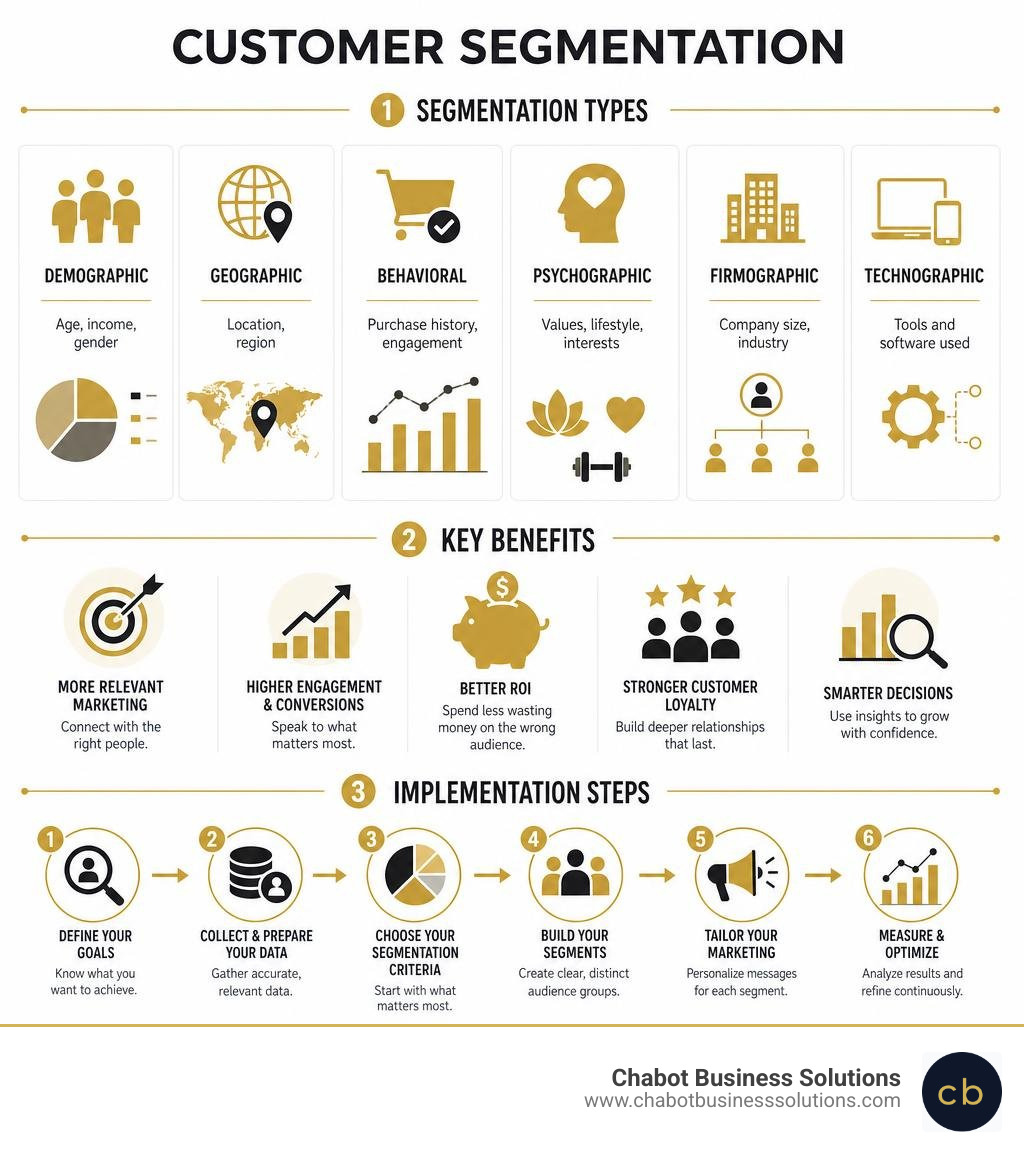
Here is a quick overview of the most common approaches:
| Segmentation Type | What It Groups By | Best For |
|---|---|---|
| Demographic | Age, income, gender | B2C, retail |
| Geographic | Location, region | Local, CPG, SaaS |
| Behavioral | Purchase history, engagement | E-commerce, apps |
| Psychographic | Values, lifestyle, interests | Brand-driven businesses |
| Firmographic | Company size, industry | B2B |
| Technographic | Tools and software used | B2B SaaS |
Most businesses start with one type and expand from there. The goal is simple: stop wasting money on the wrong people, and start connecting with the right ones.
If you have ever felt like your marketing is going out to everyone and landing with no one, you are not alone. Inconsistent results are almost always a sign that your audience is not clearly defined. Segmentation fixes that.
Research backs this up. Segmented email campaigns can drive a 760% increase in revenue compared to one-size-fits-all blasts. Companies using behavioral segmentation have seen conversion rates jump by more than 50% during key sales periods. The data is clear: knowing who you are talking to changes everything about how well your message lands.
I’m Alyx Lofton, founder of Chabot Business Solutions, and over more than 20 years of hands-on digital strategy work I have helped business owners move from scattered, inconsistent marketing to clear systems that drive real growth — and customer segmentation solutions are almost always where that clarity begins. In the guide below, I’ll walk you through everything you need to know to start segmenting smarter.
What is Customer Segmentation and Why Does It Matter?
At its core, customer segmentation is the process of dividing your customer base into distinct groups that share similar characteristics, pain points, or buying habits. Rather than treating your entire audience as a single, uniform entity, segmentation allows you to treat them as the diverse individuals they actually are.
For modern businesses looking to scale sustainably in July 2026, treating all customers the same is a recipe for wasted ad spend and high unsubscribe rates. When you segment your audience, you gain the clarity needed for efficient resource allocation. You stop spending valuable marketing dollars showing enterprise-level software ads to small business owners, or promoting winter coats to customers living in sunny Southern California.
By identifying unmet customer needs within specific groups, you can prioritize product development, design optimal distribution strategies, and establish product pricing that makes sense. Customer segmentation is about aligning your business goals with the real-world behaviors of your audience. This alignment is the secret to Maximizing Roi With A Professional Digital Marketing Strategy, turning broad campaigns into highly focused revenue drivers.

The Core Benefits of Modern Customer Segmentation Solutions
When you transition from manual audience tracking to dedicated customer segmentation solutions, the operational benefits ripple across your entire organization:
- Hyper-Personalization: Today’s buyers do not just appreciate personalized experiences; they expect them. Segmentation allows you to craft tailored messaging that speaks directly to a customer’s current life stage, emotional state, or immediate needs.
- Improved Customer Retention: By identifying at-risk customer groups or subscribers who have not engaged recently, you can trigger automated win-back campaigns before they churn.
- Stronger Brand Loyalty: When customers receive content, offers, and product recommendations that perfectly match their preferences, they feel understood. This builds deep emotional connections that keep them coming back.
- Maximizing Customer Lifetime Value (CLV): Rather than focusing solely on one-off transactions, segmentation helps you nurture long-term relationships. You can identify your highest-value customers (your VIPs) and focus your efforts on keeping them happy, while gently guiding one-time buyers toward their second and third purchases.
For businesses operating in the East Bay CA area, implementing local tools like Email List Segmentation Services in Oakland, CA is an excellent way to bridge the gap between broad digital outreach and highly targeted local engagement.
Key Statistics: The Business Impact of Targeted Marketing
If you are still on the fence about investing time and resources into customer segmentation, the numbers speak for themselves:
- 760% Revenue Lift: According to research from the Direct Marketing Association (DMA), segmented email campaigns can drive up to a 760% increase in revenue.
- 2x Win Rate Increase: B2B organizations that leverage targeted segmentation and lookalike modeling can achieve a 2x lift in sales win rates.
- 51% Conversion Boost: When pet retailer Pets Deli utilized tailored pricing and promotions based on behavioral segments during Black Friday, they saw a massive 51% increase in conversion rates.
- 7x Higher Click-Through Rates: Home decor brand Ruggable achieved a 7x higher click-through rate and a 25% increase in conversions by matching personalized content directly to user segments.
- 23% Lower MQL Costs: Businesses utilizing targeted B2B customer segmentation tools have successfully reduced their average cost per Marketing Qualified Lead (MQL) by 23%.
The Six Primary Types of Audience Division Strategies
To build a strategy that works, you must first understand the primary ways to divide your audience. While you don’t need to use all six types at once, combining a few of them will give you a highly accurate, multi-dimensional view of your customer base. This is precisely How Small Businesses Can Compete With Big Brands Using Digital Marketing — by being more precise, agile, and relevant than the industry giants.

Demographic and Geographic Segmentation
Demographic segmentation is the most traditional form of audience division. It groups customers by identifiable, non-character traits such as age, gender, income, education level, and occupation. While highly useful, relying only on demographics can lead to broad assumptions that miss the mark.
Geographic segmentation groups your audience based on where they live, work, or travel. Interestingly, location-based segmentation is the most popular type of audience division in the industry, utilized by 22.6% of companies across SaaS, e-commerce, and financial services. It allows local businesses in the East Bay to target neighborhoods with specific regional preferences, seasonal promotions, or localized service offerings.
Behavioral and Psychographic Segmentation
Behavioral segmentation groups customers based on what they actually do. This includes their purchase history, website browsing habits, brand loyalty, and product usage. It is the second most popular segmentation type, used by 18.2% of companies. Smaller, more frequent purchases are often highly predictive of long-term brand loyalty compared to occasional large, one-off purchases. Tracking these behavioral touchpoints helps you deliver timely offers, such as cart abandonment reminders or product replenishment alerts.
Psychographic segmentation dives into the why behind customer purchases. It groups people based on their lifestyle, values, social status, interests, and opinions. For example, if you are Creating A Marketing Plan For Your Beauty Salon, you might segment your clients into those who value organic, cruelty-free products versus those looking for high-tech, rapid-results treatments.
To dig deeper into how these psychological profiles translate to actual buying decisions, many businesses partner with professional research agencies like Segmentation – Insights & Consulting Firm | Escalent or utilize a Powerful Segmentation Service for Precise Audience Targeting | Material to uncover deep consumer motivations.
Firmographic and Technographic Segmentation
If you operate in the B2B space, your segmentation needs look slightly different:
- Firmographic Segmentation: This is the B2B equivalent of demographics. It groups organizations based on company size, annual revenue, industry vertical, geographic location, and ownership structure (e.g., public vs. private).
- Technographic Segmentation: This groups companies based on the specific software, hardware, and technology stack they currently use. Knowing whether a prospect uses Salesforce, HubSpot, or custom-built legacy systems allows your sales team to pitch integrations and solutions that fit seamlessly into their existing workflows.
Traditional vs. AI-Powered Customer Segmentation Solutions
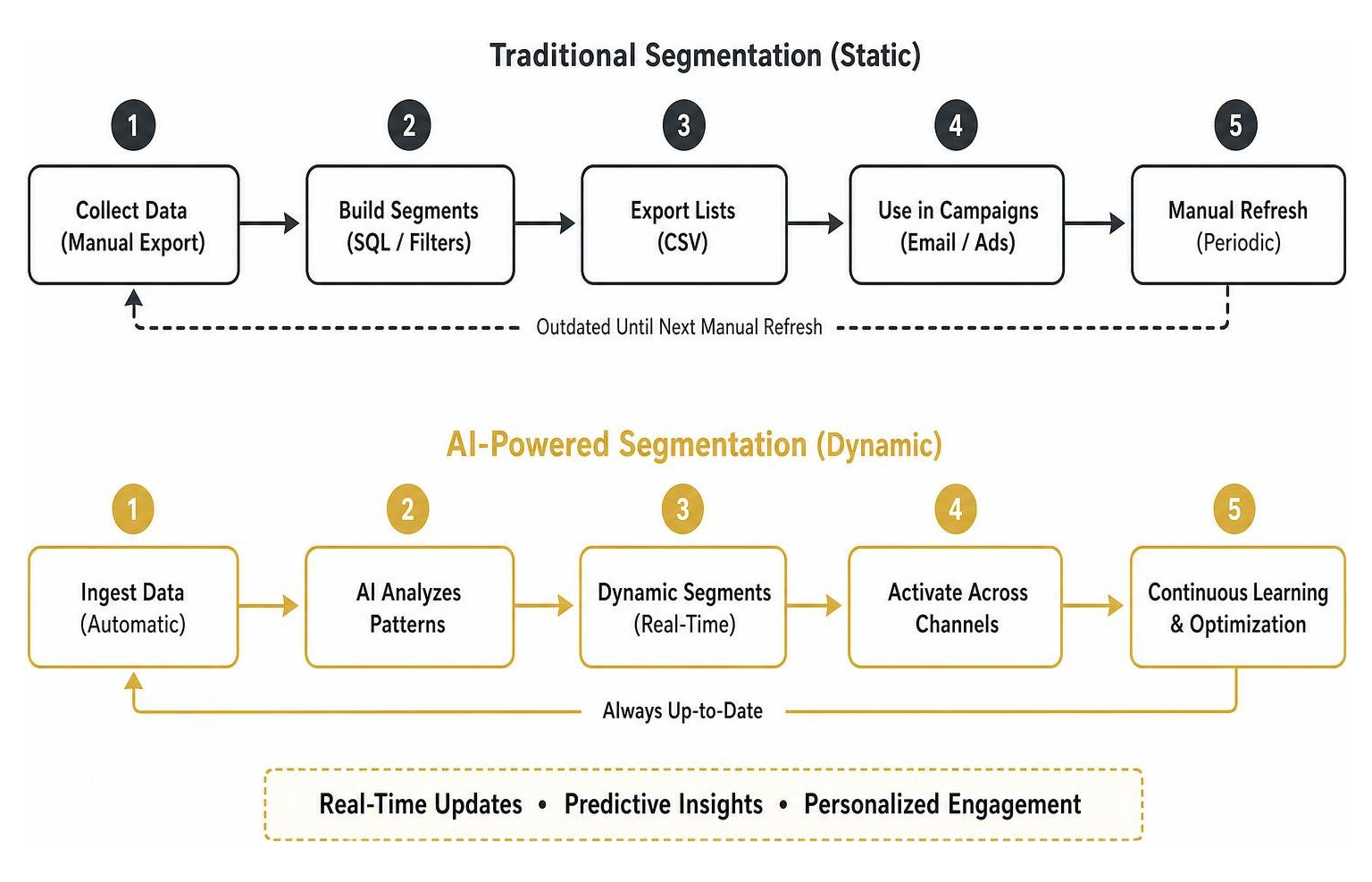
For years, customer segmentation was a static, manual process. Marketers had to pull csv files, run complex SQL queries, and manually build email lists that became outdated the moment they were exported.
Today, AI-powered customer segmentation has completely transformed the landscape. By leveraging machine learning algorithms, modern systems analyze vast amounts of customer data in real time, identifying hidden patterns and automatically adjusting segments as user behavior shifts.
| Feature / Capability | Traditional Segmentation | AI-Powered Segmentation |
|---|---|---|
| Data Processing | Manual, spreadsheet-based, or basic SQL | Automated machine learning algorithms |
| Segment Updates | Static lists that require manual refreshes | Dynamic, real-time recalculations |
| Analysis Depth | Simple demographic and geographic rules | Multi-dimensional behavioral & intent patterns |
| Predictive Power | Looks only at past historical data | Predicts future intent, LTV, and churn risk |
| Creation Method | Complex query building and filter rules | Natural language queries (plain English) |
The Shift to Real-Time Dynamic Updates and Predictive Analytics
Static lists are a thing of the past. If a customer transitions through a major life stage—such as graduating, getting a promotion, buying a home, or starting a family—their purchasing needs change instantly. AI-driven customer segmentation solutions use dynamic rules to recalculate segment membership in real time.
If a user’s behavior suddenly signals a high risk of leaving, the system flags them as an “at-risk subscriber” and triggers an automated retention campaign. This level of responsiveness is why Why Every Business Needs A Crm To Go With Your Sales And Marketing Plan is so critical — it acts as the single source of truth that feeds your real-time segmentation engine.
Natural Language Queries and Agentic AI in Audience Building
One of the most exciting advancements in modern tools is the ability to build complex segments using plain English. Instead of writing database queries, a marketer can simply type: “Show me customers in California who ordered three or more times but skipped last month.”
Platforms like Smart Segmentation – AI-Powered Customer Segments | Finsi use natural language processing to translate these requests into precise database filters instantly. Furthermore, agentic AI systems use specialized digital agents to orchestrate 1:1 interactions, predicting customer intent and delivering personalized ad creatives or email copy completely on autopilot.
How to Choose and Implement the Right Customer Segmentation Solutions
Selecting the right software depends heavily on your business model (B2B vs. B2C), your industry, and your growth goals. A local retail shop in San Leandro has vastly different data needs than a fast-growing B2B software company.
If you are a B2B sales team looking to optimize outbound prospecting and territory planning, a dedicated tool like B2B customer segmentation tool | Ocean.io can help you cluster your current accounts by win-rate and instantly generate lookalike lists of your best customers.
For B2C brands focused on high-volume email and mobile push notifications, exploring a comprehensive guide like the 10 Best Customer Segmentation Tools to Master Audience … | CleverTap will give you a clear comparison of platforms that specialize in mobile engagement and behavioral tracking.
Evaluating Software Integrations with CRM and Email Marketing Platforms
A customer segmentation tool is only as good as the data flowing into it. Before committing to a platform, ensure it integrates seamlessly with your existing CRM, email marketing software, and advertising networks (like Meta Ads or Google Ads).
Your segmentation tool should be able to sync custom audiences bidirectionally. For example, when a user is added to your “VIP Segment” in your CRM, that update should instantly push to Meta Ads to build a high-performing lookalike audience.
To keep this data pipeline running securely and efficiently, many businesses in the East Bay rely on local infrastructure experts like Managed IT Services in Oakland Area | Xobee Networks to set up secure API connections and cloud database integrations. This ensures your platform is ready to scale, which is a key consideration when deciding Which Crm Is Right For You 2024.
Step-by-Step Implementation: From Data Collection to Campaign Personalization
To get your customer segmentation strategy up and running, we recommend following a structured, step-by-step approach:
- Build a Unified Customer View: Consolidate your customer data from all touchpoints—including website visits, in-store purchases, social media interactions, and customer support tickets—into a single database.
- Collect Direct and Indirect Feedback: Use relationship surveys, post-purchase questionnaires, and social media sentiment analysis to enrich your customer profiles with emotional data and explicit preferences.
- Define Your Initial Segments: Start small. We recommend building three to four high-impact segments first (e.g., VIP Repeat Buyers, At-Risk Subscribers, and One-Time Bargain Hunters) rather than trying to build dozens of complex groups overnight.
- Execute Targeted Campaigns: Create tailored marketing campaigns for each segment. Ensure your copy, images, and offers are customized to address the specific pain points of each group.
- Track, Measure, and Refine: Monitor key performance indicators (KPIs) such as Average Order Value (AOV), Lifetime Value (LTV), and churn rates for each segment. Adjust your filtering criteria over time based on what the data tells you.
This structured, data-first methodology is a core part of Our Approach to building marketing systems that deliver consistent, predictable growth.
Common Pitfalls to Avoid When Segmenting Your Audience
While segmenting your audience is highly effective, it is easy to make mistakes if you rely on assumptions rather than clean data. To help you navigate this process, we regularly share deep-dive strategies and tips in our Learning Center.
Relying on Outdated Data and Static Lists
Customer behavior is not static. A customer who was highly price-sensitive last year might have received a promotion and is now looking for premium, high-convenience options. If you rely on old, manual exports to run your campaigns, you will inevitably send irrelevant messages. Always prioritize dynamic, real-time updating segments over static lists to ensure your messaging aligns with your customers’ current needs.
Creating Overly Broad or Unviable Segments
Another common mistake is creating segments that are either too broad to be useful, or so narrow that they are not worth the effort to target. To ensure your segments are viable, validate them against these six core criteria:
- Homogenous: Members within the segment must share clear, common traits.
- Heterogenous: The segment must be distinctly different from your other segments.
- Measurable: You must be able to easily calculate the size and purchasing power of the group.
- Substantial: The segment must be large or profitable enough to justify a dedicated marketing campaign.
- Accessible: You must have a practical way to reach this audience via email, social media, or search ads.
- Responsive: The segment should react differently to tailored marketing messages than the general public.
Frequently Asked Questions about Customer Segmentation
What is the difference between customer segmentation and market segmentation?
Market segmentation looks broadly at the entire marketplace (for example, identifying everyone in the East Bay CA who might buy a car). Customer segmentation focuses specifically on your existing customer base or your target share of that market (for example, grouping your existing car buyers into “families needing SUVs” vs. “commuters wanting hybrids”).
How do B2B and B2C customer segmentation strategies differ?
B2B segmentation focuses heavily on organizational traits (firmographics, industry vertical, buying cycles, and technographics) and involves targeting multiple decision-makers within a single company. B2C segmentation focuses primarily on individual human behavior, personal demographics, lifestyle values, and immediate purchasing emotions.
How often should customer segments be updated?
Ideally, your customer segments should update in real time using dynamic rules powered by your CRM and segmentation software. If you are using traditional methods, you should review and manually refresh your customer profiles at least once a quarter to account for seasonal trends and shifting buying habits.
Conclusion
At Chabot Business Solutions, we believe that successful marketing is never about shouting to the largest possible crowd. It is about speaking clearly and directly to the people who actually want and need what you offer.
As a strategy-first digital marketing agency based in San Leandro, we design focused marketing systems that simplify the complex, eliminate wasted ad spend, and support sustainable business growth. We help business owners in San Leandro, the East Bay, and across California build clear, automated customer segmentation systems that turn cold data into warm, profitable relationships.
If you are ready to stop guessing who your best customers are and start targeting them with precision, we would love to help. Work With Us to find your clarity, or explore our full range of services to see how we can build a focused marketing system tailored to your business goals.