
What Is PPC Competitor Analysis (And Why It Changes Everything)
PPC competitor analysis is the process of studying what your paid search rivals are doing — their keywords, ad copy, budgets, landing pages, and bidding strategies — so you can make smarter decisions with your own ad spend.
Here is a quick snapshot of what it covers:
| What You Analyze | Why It Matters |
|---|---|
| Competitor keywords | Find gaps and high-intent terms you’re missing |
| Ad copy and creatives | Spot messaging angles that convert |
| Estimated ad budgets | Know when and where rivals are spending |
| Landing pages | Identify post-click weaknesses you can beat |
| Impression share | Measure how much auction space you’re losing |
If your ads feel like a guessing game, this is why. Most business owners set budgets, write headlines, and pick keywords without ever looking at what is already working in their market. That is like opening a restaurant without ever eating at the competition.
The good news? Your competitors leave clues everywhere — in the ads they run, the pages they send traffic to, and the keywords they keep bidding on month after month. This guide shows you exactly how to find those clues and use them.
I’m Alyx Lofton, founder of Chabot Business Solutions, and with over 20 years of experience in digital strategy and client growth, PPC competitor analysis has been one of the most reliable tools I’ve used to help business owners stop guessing and start growing. In the sections ahead, I’ll walk you through the full process — step by step.
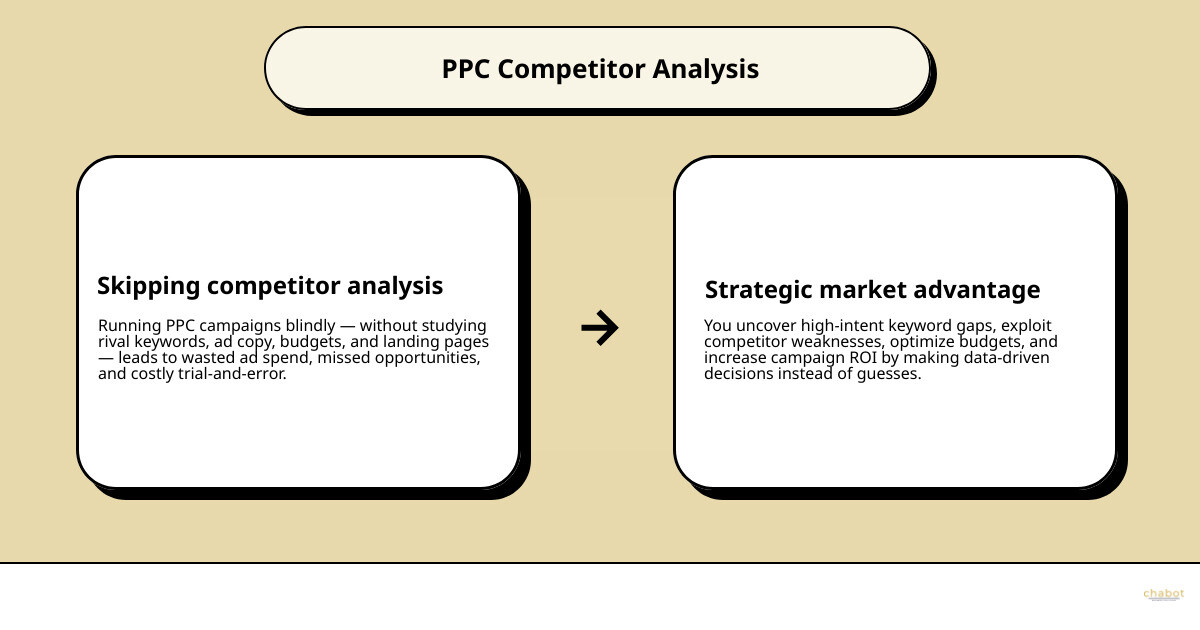
The Strategic Value of PPC Competitor Analysis
Running pay-per-click campaigns in July 2026 without looking at your competitors is an expensive way to learn hard lessons. When we dive into a comprehensive ppc competitor analysis, we are not just looking to copy what others are doing. We are looking for structural mismatches, budget inefficiencies, and market gaps that we can exploit to win more market share.
Analyzing your competitors gives us a clear look at their estimated ad spend and campaign ROI. When you know where a competitor is spending their money—and more importantly, where they are wasting it—you can allocate your budget to the exact search terms that drive high-intent leads. Understanding When And Why A Business Should Utilize Ppc Advertising is only the first step; knowing how to position your campaigns against active market rivals is what guarantees long-term sustainability.
Step-by-Step Workflow for PPC Competitor Analysis
A successful analysis requires a repeatable workflow. Randomly searching for your keywords on Google and looking at who pops up is not a strategy; it is a distraction.
To get actual competitive intelligence that leads to tactical execution, we follow a structured workflow:
- Identify the True Auction Opponents: Use live search results and specialized tools to see who is actually bidding on your core terms.
- Assess Active Channels and Media: Determine whether they are relying solely on Google Search, or if they are scaling across social, display, or YouTube.
- Analyze Keywords and Bidding Posture: Look at their keyword mix, search volume trends, and estimated CPCs.
- Deconstruct Creative Assets: Review their headlines, visual assets, and primary hooks.
- Evaluate the Post-Click Experience: Visit their landing pages to inspect their offer structure, form friction, and trust markers.
- Synthesize and Implement: Build a localized playbook to out-bidding and out-convert them.
Common Mistakes to Avoid in PPC Competitor Analysis
The biggest waste of time in competitive research is cloning your competitor’s ad copy line by line. First of all, your competitor might actually be a mediocre marketer making poor decisions with a bloated budget. If you copy their mistakes, you are simply paying to duplicate their failures.
Second, blind bidding on every single keyword your competitors target will quickly dry up your budget. You must filter their keyword list by intent, difficulty, and relevance to your specific local audience in the East Bay.
Another critical error is relying on outdated data. The PPC landscape changes rapidly. Failing to adjust your campaigns based on real-time market shifts can lead to massive performance drops. Working without an organized system is one of the primary What Mistakes Businesses Make Without A Ppc Agency, as professional agencies have the daily monitoring tools to catch these shifts before they drain your budget.
How to Identify and Segment Your True Paid Search Rivals
Before we pull a single keyword report, we must answer a simple question: Who are you actually competing against?
Many business owners make the mistake of listing their physical, brick-and-mortar neighbors or their organic search rivals as their primary PPC competitors. In the paid search landscape, these are often completely different groups.
To build a strategy that works, we have to separate these rivals into distinct buckets. This ensures we are only spending time and money analyzing companies that actively impact our cost-per-click (CPC) and impression share.
Business Competitors vs. SEO and Auction Rivals
Let’s break down the three types of rivals you will encounter:
- Direct Business Competitors: These are the businesses in the East Bay or San Leandro that offer the exact same services or products as you.
- SEO Rivals: These are websites that dominate the organic search engine results pages (SERPs) for informational keywords. They might be blogs, directories, or national publications. They have massive organic strength but may not spend a dime on paid ads.
- PPC/Auction Competitors: These are the accounts actively bidding on your target keywords. They might not even have a physical presence in California, but they are driving up your CPCs in the local auction.
Interestingly, there is a powerful intersection between organic and paid strategies. Industry data shows that 68% of top SaaS competitors use organic SEO to pre-qualify traffic before adding paid spend, reducing their effective CPC by 25 to 30%. If a competitor has massive organic visibility, they can afford to be highly selective with their paid ads, bidding only on hyper-specific, high-intent keywords. Understanding this dynamic is crucial when balancing Seo Vs Ppc Choosing The Right Strategy For Your Business Growth.
To make sure your marketing dollars are going to the right place, you have to weigh the pros and cons of both channels. For a complete breakdown of how these two forces interact, take a look at our guide on Search Engine Optimization Vs Ppc Which Is Right For Your Business.
Tiering Your Competitor List for Actionable Insights
Once we identify who is in the auction, we segment them into three tiers:
- Tier 1: Core Auction Opponents: These are direct rivals whose ads consistently appear alongside yours on commercial search queries. They directly impact your daily performance.
- Tier 2: Commercial Overlap Players: These are larger, sometimes national brands that bid on your keywords but offer a broader range of services. They have deeper pockets, but their messaging is often generic.
- Tier 3: SERP Occupiers: These are directory sites (like Yelp or Angi) or informational blogs that capture search attention but can be bypassed with highly targeted, localized ad messaging.
Deconstructing the Competitor Strategy: Key Metrics and Tactics
Once you have segmented your rivals, it is time to look under the hood.
We need to extract actionable data that tells us exactly how they run their campaigns and where their vulnerabilities lie. Tracking these metrics is essential for establishing the Seo Ppc Success Kpis Local Businesses Should Track to ensure your budget is actually driving growth.
Essential Tools for Paid Search Intelligence
You do not need an enterprise-level budget to get high-quality competitive intelligence. Excellent free and paid tools can give us an inside look at your competitors’ strategies:
- Google Ads Auction Insights: A free tool built directly into your Google Ads account. It shows you exactly how your impression share, overlap rate, and outranking share compare to other advertisers bidding on the same terms.
- Google Ads Transparency Center & Meta Ad Library: Free, public databases where you can view every active ad a competitor is running. This is perfect for analyzing their visual creatives and promotional offers.
- WASK & Exploding Topics: Great entry-level tools for quick competitive checks. For instance, you can use the Free AdWords Competitor Analysis – See Their PPC Strategy to quickly visualize domain traffic, estimate monthly ad costs, and uncover paid keyword opportunities.
- Semrush & SpyFu: Industry-standard paid platforms that provide deep historical data, keyword gap analyses, and estimated budget allocations over time.
Tracking Key Metrics and Estimating Ad Budgets
When analyzing your rivals, we focus on several key metrics:
- Impression Share (IS): The percentage of times your competitor’s ads showed up out of the total times they were eligible to appear. Impression share overlap among direct competitors is often 30 to 60%.
- Outranking Share: How often a competitor’s ad ranked higher than yours in the search results.
- Estimated Ad Spend: While third-party tools provide spend proxies rather than exact bank statements, they are incredibly useful for tracking trends. For example, we look for seasonal spikes. Failing to increase your bidding frequency or budget during peak periods can cause a 15 to 20% drop in impression share as competitors scale their spend.
To show you how much device targeting impacts these costs, consider this comparison of desktop versus mobile performance metrics:
| Metric Type | Desktop Search | Mobile Search | Strategic Play |
|---|---|---|---|
| Average CPC | Baseline ($5.00) | Reduced ($3.00) | CPC differences can exceed 40% for intent-rich terms between mobile and desktop. |
| User Intent | Research & Comparison | Immediate Action / Local | Use mobile ads for “click-to-call” and desktop for deep comparison. |
| Ad Copy Focus | Feature-heavy, detailed | Short, benefit-driven, local | Customize your messaging based on the device. |
Uncovering Paid Keywords and Bidding Postures
To find the most profitable keywords your competitors are already testing, we run a keyword gap analysis. This process highlights keywords where your competitors are winning significant traffic, but your account has zero visibility.
We look at their traffic share on specific terms. If a competitor is dedicating 40% of their estimated budget to a single long-tail keyword (e.g., “emergency commercial plumbing San Leandro”), that is a clear signal that the keyword is converting well for them. We can target that exact term with a more compelling, localized offer.
Analyzing Ad Copy, Creative Assets, and Landing Pages
To stand out in the search results, you must identify your competitors’ creative patterns. Do they always lead with pricing discounts? Do they rely heavily on trust badges and years of experience?
Once you know their primary angles, you can write copy that directly contrasts with theirs. If they are focusing entirely on “cheap rates,” you can win the high-value customers by highlighting “unmatched reliability and certified local experts.”
The analysis shouldn’t stop at the ad copy. Click through to their landing pages (ideally by viewing them in the Google Transparency Center to avoid wasting their ad budget, or using a tool). Evaluate their post-click experience:
- Is their page mobile-friendly?
- Do they have a clear, single call-to-action (CTA)?
- How much friction is in their contact forms?
If their landing page is slow, confusing, or sends users to a generic homepage, you can easily win the conversion by providing a seamless, fast, and highly relevant post-click experience.
Exploiting Device-Specific Weaknesses and Tactical Plays
Many advertisers set up their campaigns and leave device targeting on “automatic,” running the exact same ad copy and landing pages on desktop and mobile. This is a massive blind spot that we can exploit.
Because CPC differences can exceed 40% for intent-rich keywords between mobile and desktop, you can build a distinct edge by separating your campaigns. If your competitor has a clumsy mobile checkout form, you can build a streamlined, one-click mobile landing page. By optimizing the mobile post-click experience, you can capture high-intent mobile searchers at a much lower cost-per-click.
Another tactical play is targeting the “funnel edge.” If your competitors are fighting over incredibly expensive, high-intent bottom-of-funnel keywords, you can target slightly broader, problem-aware search terms at a fraction of the cost, and then use retargeting ads to guide those users down your own funnel.
Establishing a Repeatable Monitoring Cadence
PPC competitor analysis is not a one-time project. It requires a structured monitoring cadence to keep your campaigns optimized:
- Weekly Scans: Check Google Ads Auction Insights for sudden shifts in impression share or new local competitors entering the market.
- Monthly Metric Checks: Review competitor ad copy updates, promotional changes, and estimated budget adjustments.
- Quarterly Deep-Dives: Conduct a full keyword gap analysis and landing page audit to identify new long-term strategic opportunities.
Frequently Asked Questions
Should I bid on a competitor’s brand name?
Bidding on a competitor’s brand name (also known as brand conquesting) can be highly effective, but it must be done carefully. You should only run conquesting campaigns if you have a clear, distinct comparison proposition, a dedicated landing page that highlights your unique value, and enough budget to test without hurting your core search campaigns.
That brand terms often have lower Quality Scores, which can make them more expensive. Never use trademarked brand names in your actual ad copy, as this violates Google’s policies and can lead to legal issues.
How many competitors should I monitor closely?
We recommend keeping a tight focus on 3 to 5 core auction rivals. These are the accounts that consistently overlap with your ads and directly impact your CPCs. Trying to track dozens of adjacent players will only lead to data overload and keep you from taking meaningful action.
What is the biggest waste of time in competitive research?
The biggest waste of time is manually tracking search results every day or obsessively copying your competitor’s ad copy. This approach only creates generic, lookalike campaigns. Instead, focus on identifying structural gaps—like poor mobile landing pages, neglected long-tail keywords, or weak post-click experiences—and build campaigns that exploit those weaknesses.
Conclusion
At Chabot Business Solutions, we believe that digital marketing shouldn’t be a confusing guessing game. True strategic growth comes from clear data, smart positioning, and a strategy-first approach that simplifies your marketing.

If your current ad campaigns are feeling inefficient, or if you suspect you are wasting valuable budget in competitive auctions, it may be time for a professional change. Recognizing the 6 Signs Your Business Needs A Ppc Agency Now is the first step toward reclaiming your market share.
By Maximizing Roi With A Professional Digital Marketing Strategy, you can stop worrying about what your competitors are doing and start out-performing them.
Ready to turn competitive insights into real, sustainable business growth? Partner with Chabot Business Solutions for Expert PPC Management and let us build a focused, high-performing marketing system designed specifically for your business.