
Why Content Strategy Creates More Consistent Growth
Content strategy is a documented plan for creating, publishing, managing, and measuring content that helps a specific audience while supporting clear business goals.
It is more than posting blogs, videos, or social updates whenever inspiration strikes. A strong strategy connects each piece of content to a clear business purpose: answering specific customer questions, building market trust, attracting qualified website visitors, supporting sales conversations, or keeping existing clients informed. Without an overarching structure, marketing teams often default to random execution, which burns internal resources without yielding predictable pipeline results.
In simple terms, content strategy answers four core operational questions:
- Who are we trying to help?
- What information do they need at each buying stage?
- Where and how will we efficiently deliver it?
- How will we measure whether it is working?
For a business owner tired of inconsistent marketing and unpredictable lead flows, this clarity matters. Content gives potential clients a compelling reason to find, trust, and remember your business long before they are ready to make a purchasing decision. Without a plan, content creation becomes a costly collection of disconnected posts that quickly fade from memory. With a strategic framework, content functions as a compounding business asset that grows more valuable over time.
I am Alyx Lofton, founder of Chabot Business Solutions, with more than 20 years of hands-on experience in digital strategy, client growth, and operational execution. In this guide, I will help you see content strategy as a practical system for making clearer decisions, avoiding wasted effort, and building sustainable business momentum.
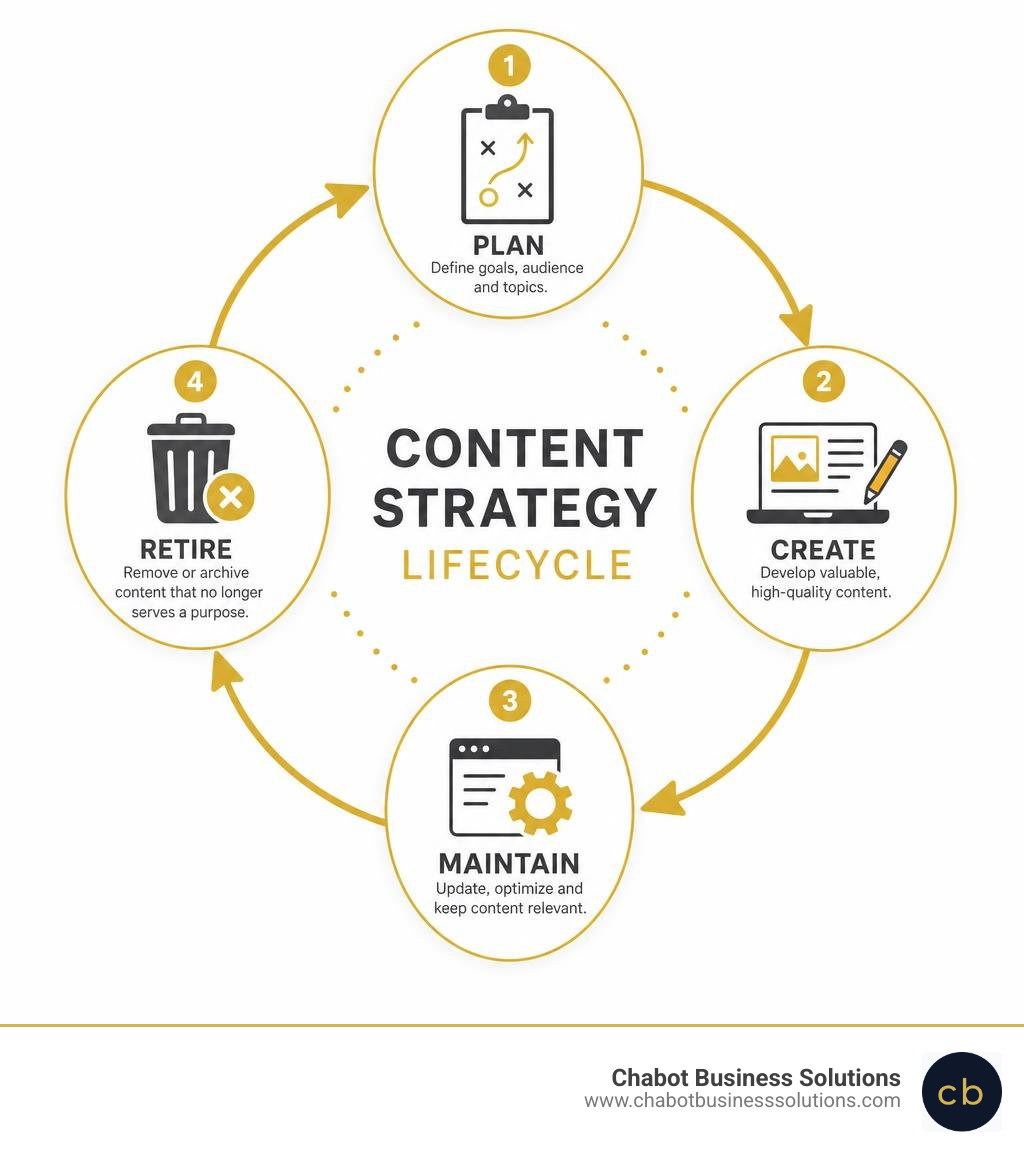
Building a Modern Content Strategy Framework

Developing a successful content strategy requires an organized, repeatable approach. Research shows that 73% of B2B marketers maintain a documented content strategy, and for good reason: documented plans generate roughly three times more qualified leads per dollar spent compared to unstructured marketing efforts. With the average internet user spending six hours and 40 minutes online daily, businesses must publish with clear intent to capture meaningful audience attention.
Defining Content Strategy vs Content Marketing
Industry pioneer Kristina Halvorson defined content strategy as the ongoing practice of planning for the creation, delivery, and governance of useful, usable content. It helps to clarify how overarching strategy differs from tactical execution:
- Content Strategy: The overarching architectural plan. It defines fundamental business objectives, target buyer personas, brand voice parameters, governance frameworks, and core success metrics.
- Content Marketing: The tactical execution layer. This includes drafting individual blog posts, publishing social media updates, distribution workflows, or filming video walkthroughs.
A comprehensive content strategy bridges both front-end user experience (addressing specific customer questions throughout the journey) and back-end content architecture (taxonomies, structured metadata, and CMS management). To align your broader business roadmap and operational goals, review The Complete Guide to Foundational Marketing Strategy in San Leandro.
Audience Research and Goal Setting
Effective strategy starts with deep audience clarity rather than generic demographic buyer personas. Conducting qualitative customer interviews uncovers primary pain points, unspoken sales objections, and actual buying motivations across key buyer touchpoints.
Setting explicit targets ensures every content asset serves a defined strategic function—such as demand creation (building early brand awareness) or demand capture (converting active searchers seeking immediate solutions). For practical framework details, check out How to build a content strategy that protects your focus (+ free template).
Topic Clusters, Pillar Pages, and Audits
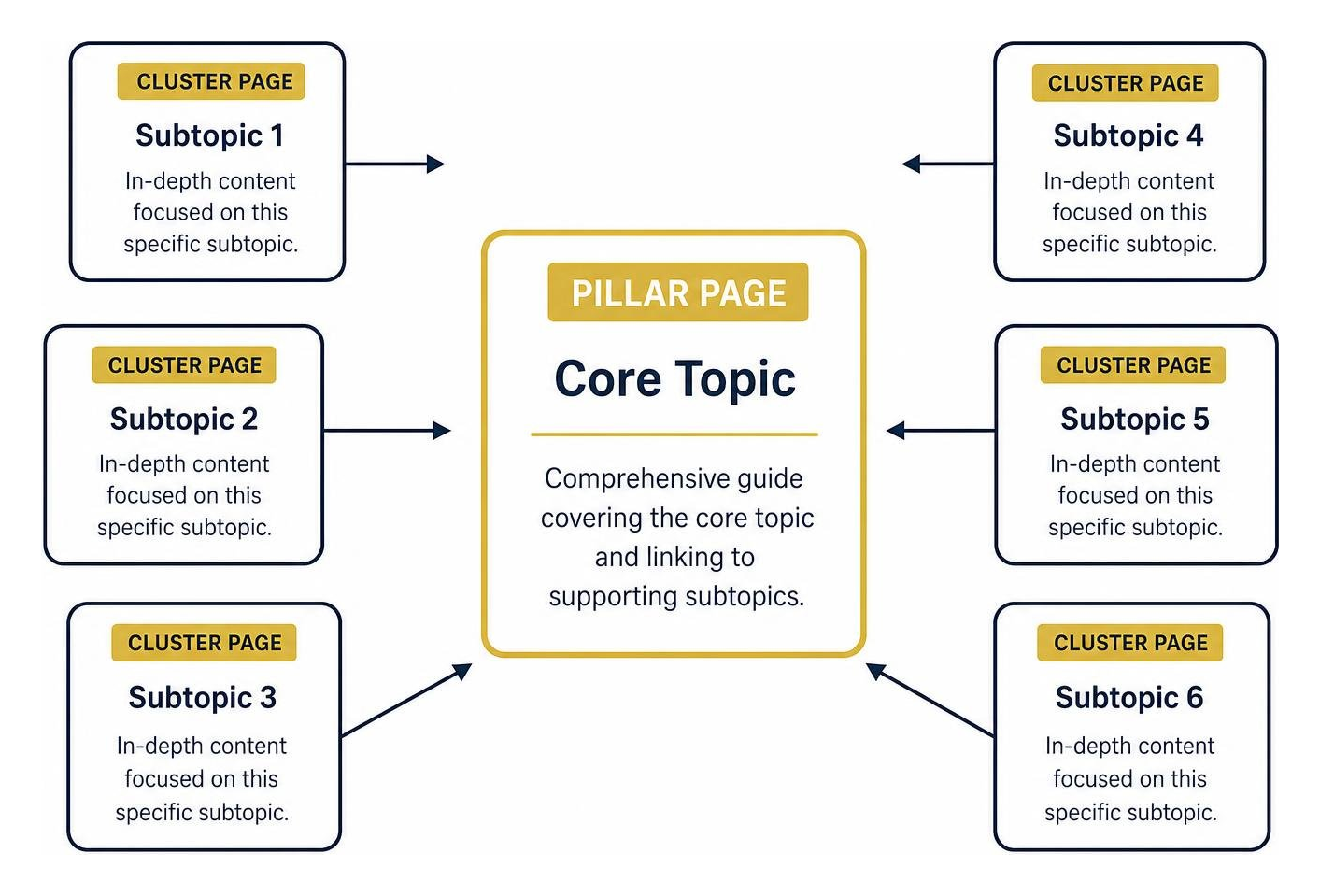
To establish search engine authority without creating confusing site navigation, organize your core topics into comprehensive pillar pages and supporting content clusters. This hub-and-spoke structure signals topical depth to search engines while offering visitors intuitive reading paths.
| Asset Type | Primary Focus | Content Structure | Strategic Goal |
|---|---|---|---|
| Pillar Page | Broad core topic | Comprehensive guide linking out to supporting topics | High-level authority and topic ownership |
| Cluster Articles | Specific subtopics | Detailed answers to specific search questions | Long-tail search capture and internal linking |
Before writing new assets, perform a thorough content audit. Catalog existing URL assets into four distinct action categories: keep, update, consolidate, or retire. Cleaning up outdated or thin content ensures search crawlers prioritize your highest-quality pages. To overcome noisy digital channels and maintain engagement, see our guide on Content Overload How to Cut Through the Noise in a Saturated Market.
Executing, Measuring, and Retiring Content Assets

A functional content strategy requires ongoing governance, structured distribution planning, and rigorous performance analysis to deliver long-term value.
AI Search Integration in Your 2026 Content Strategy
In 2026, search engine optimization requires balancing traditional search rankings with AI search citation share across modern conversational discovery platforms like ChatGPT and Perplexity. Generative AI engines cite brand entities based on clear information structures, authoritative primary research, and off-domain mentions across trusted industry forums, podcasts, and press outlets. Structuring your content with clear entity definitions and logical heading hierarchies significantly boosts inclusion in AI answers. For deeper channel insights and tactical frameworks, explore The Modern Marketers Guide to Digital Channel Strategy.
Multi-Channel Distribution, Governance, and ROI Measurement
Publishing content is only half the battle. A complete promotional model leverages balanced distribution across three distinct content channels:
- Owned Channels: Website, blog, and direct permission-based email newsletters.
- Earned Channels: Organic social shares, media features, podcast appearances, and digital word-of-mouth.
- Paid Channels: Targeted search engine ads, sponsored content placements, and paid social amplification.
To maintain editorial standards, create detailed content briefs, enforce an active editorial calendar, and establish clear content governance roles. Every quarter, evaluate content metrics including organic traffic growth, brand citation share, and conversion attribution. Remove or 301-redirect outdated or underperforming pages to protect overall site usability and search engine rankings.
At Chabot Business Solutions, we help business owners replace random marketing tactics with structured, sustainable growth systems. Learn more about our strategic frameworks by reviewing our Services Marketing Strategy Planning options.
Disclaimer: Results, search rankings, lead volumes, traffic, and revenue growth vary based on market conditions, execution consistency, industry competition, and individual business offerings. Past performance and industry benchmarks do not guarantee specific future outcomes.
Ready to turn your content into a predictable growth system? Book a free strategy call with our team today to get started.